Book Text
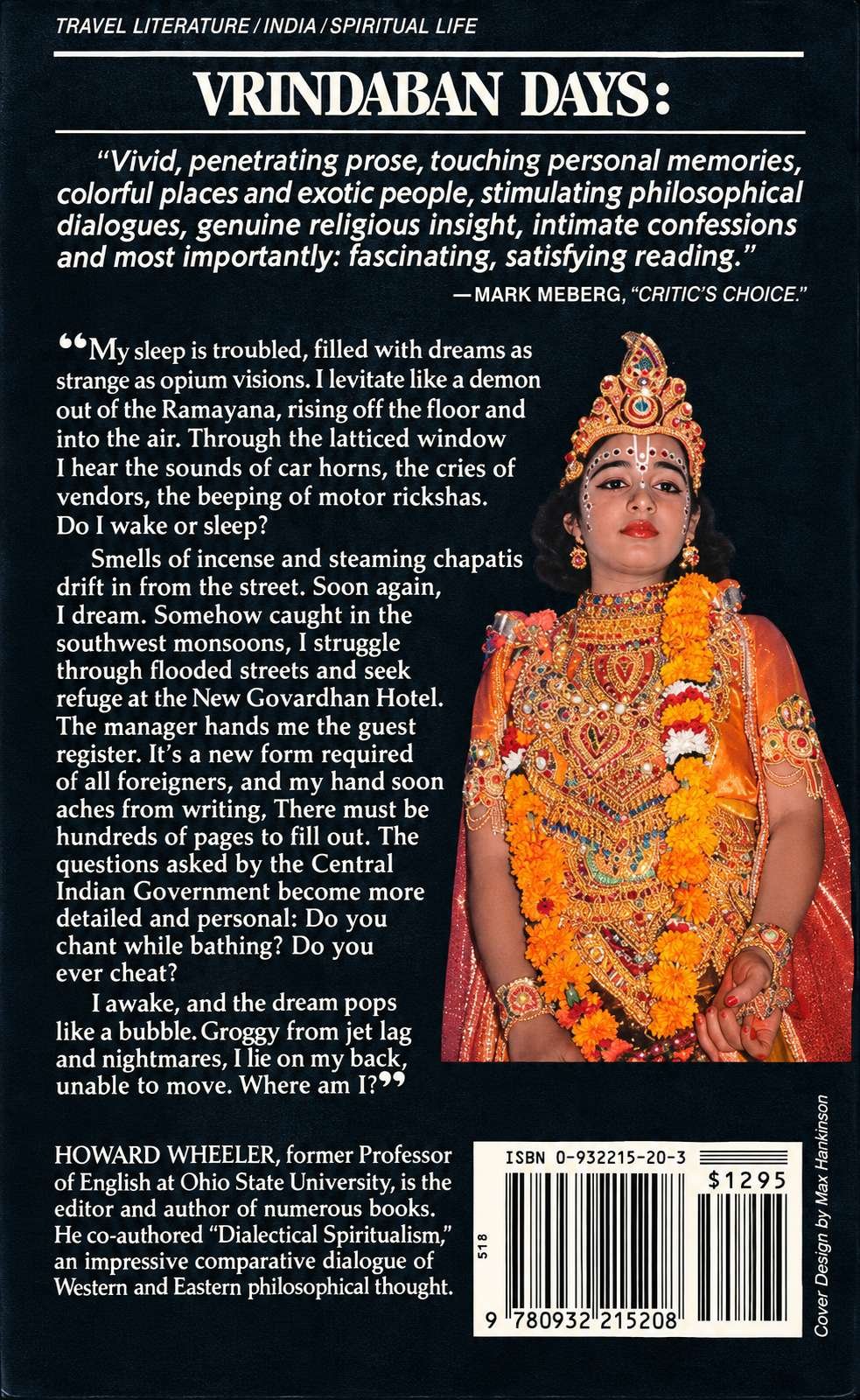
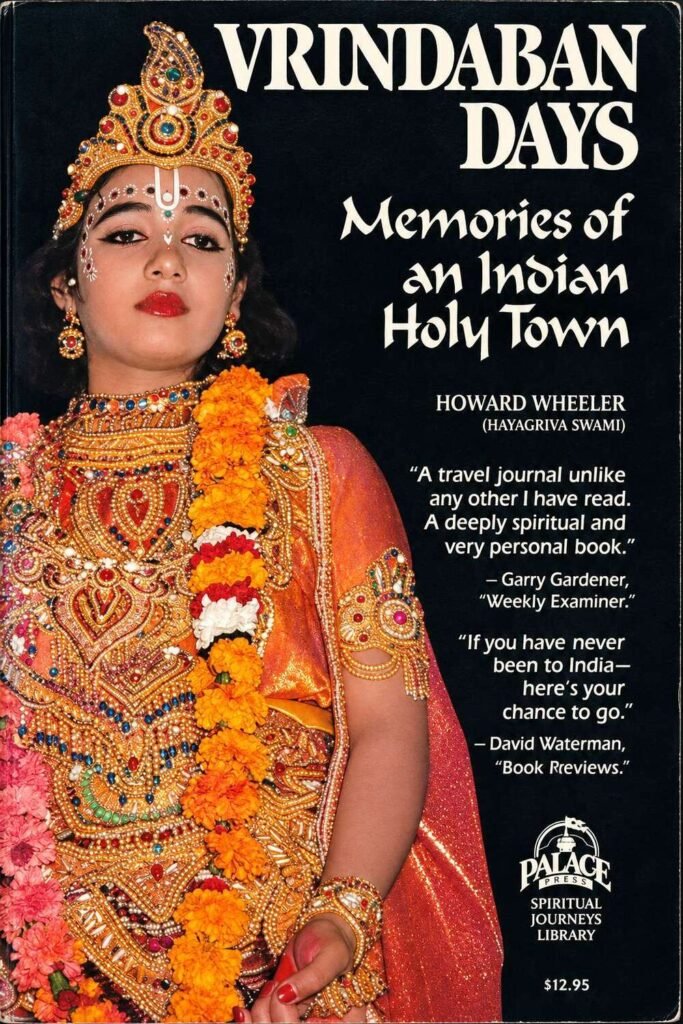
Vrindaban Days

Vrindaban Days
Memories of an
Indian Holy Town
By Hayagrīva Svāmī
This transcendental land of Vrindaban is populated by goddesses of fortune, who manifest as milkmaids and love Kṛṣṇa above everything. The trees here fulfill all desires, and the waters of immortality flow through land made of philosopher’s stone. Here, all speech is song, all walking is dancing and the flute is the Lord’s constant companion. Cows flood the land with abundant milk, and everything is self-luminous, like the sun. Since every moment in Vrindaban is spent in loving service to Kṛṣṇa, there is no past, present, or future.
—Brahma Saṃhitā
Table of Contents:
CHAPTER 4. Road to Vrindaban 22
CHAPTER 5. Śrīla Prabhupāda at Rādhā Dāmodara 27
CHAPTER 9. Madana Mohana and Govindajī 53
CHAPTER 10. Rādhā Dāmodara Pastimes 62
CHAPTER 12. The Keśī Ghāṭa Palace 78
CHAPTER 13. The Rasa–Līlā Grounds 84
CHAPTER 16. Touring Vrindaban’s Temples 102
CHAPTER 17. A Pilgrimage of Vraja Mandala 111
CHAPTER 19. Mathurā Pilgrimage 131
CHAPTER 20. Govardhan Pūjā 140
CHAPTER 21. The Silver Swing 146
CHAPTER 23. Reconciliation 157
Acknowledgements
Thanks go to Dr. P. S. Hari Prasāda (Shyamkunda Dāsa) for taking me to many places in Vraja and patiently explaining much that was incomprehensible. Thanks also go to Yamunā Devī Dāsī and Guru Kṛpā Prabhu for their talks, and to the publication staff. Paramahaṃsa Kṛṣṇa Svāmī, production; Indra Pramada Prabhu, cover and photo layout; Kalki Avatar Prabhu and Gadādhara Prabhu, typesetting, and Rukmiṇī Devī Dāsī, proofreading.
CHAPTER 1. Indraprastha
October 20, 1972
As dawn brightens the horizon, the Boeing 747 circles New Delhi. The Indo-Gangetic plain spreads beneath us, and the misty earth assumes the shapes and colors of a land marked by man’s toil: a vast network of roads and buildings, and, on the city’s outskirts, the green and ocher patches of small farms. With seven thousand people per square mile, this is one of the world’s most densely populated areas. In the capital itself are some four million people, most now joined in the bonds of sleep.
This is a fertile country, though subject to periodic droughts. It’s parched by the sun in May and June and flooded by monsoons in July and August. During monsoons, great river systems carry silt from the Himalayas to fertilize the soil and feed India’s millions. These are the sacred rivers: the Gaṅgā—flowing from the lotus feet of Viṣṇu and down the hair of Śiva—and the Yamunā, flowing past Indraprastha, Mathurā, and Vrindaban, the abode of Kṛṣṇa.
Ancient texts call this land Bhāratavarṣa, kingdom of Emperor Bharata. Empires have flourished here from time immemorial, composed of people as varied as the Pandavas and Kauravas, Dravidians and Aryans, Mauryans and Guptas, Muslims and British. Five thousand years ago, Lord Kṛṣṇa, demigods, demons, and warriors chose it as their stage for both spiritual and military exploits. At that time, Delhi was named Indraprastha and was celebrated as the capital of Yudhiṣṭhira Mahārāja. Lord Kṛṣṇa Himself helped Yudhiṣṭhira regain his kingdom during the Battle of Kurukṣetra, fought on the plains about ninety miles north of here. Lost across centuries now are those battlecries, the rattling of chariots, galloping of horses, and blowing of conchshells. No signs of any cataclysm have ever been unearthed at Kurukṣetra, although tradition says that thirty million soldiers died there in 3138 B.C.
“At that time, Kṛṣṇa, smiling, in the midst of both the armies, consoled the grief-stricken Arjuna.”
I can see Palam Airport’s blue lights, which disappear momentarily as our wings tilt. The plane descends onto the runway, its wheels bouncing lightly. The engines reverse and cabin lights flash on. “Please remain seated until the aircraft has come to a complete halt…”
I gather up my hand luggage—camera, film, shaving kit, notebooks, Bhagavad Gītā, japa-beads—and file out onto the portable staircase leading down to the terminal buses.
A hundred scents assail me, conjuring images of my first trip seven years ago: the smell of cowdung fires, of banyan, of wild date palm, mango, eucalyptus and margosa, of cardamom and turmeric; pungent smoke from fried chili and cumin sauce and bidi cigarets; car and bus fumes, and the peppermint smell of pan-betel nuts that stain the mouth red-whiffs of jasmine and henna incense, and nameless odors that evoke memories.
The bus shuttles us across the tarmac to the main terminal, where passports are stamped and visas checked by drowsy officials. Luggage from previous arrivals is thrown everywhere. Tired and irritable travelers search out their bags, shoving and shouting. The conveyor belt is stuck, and our luggage is thrown about by workers to whom nothing is fragile.
My duffel bag is tossed on one of the heaps, and I start pushing my way forward. I secure my bags, then stand helpless. It’s impossible for me to carry all my luggage.
Before me appears a round, dark face with big eyes outlined with kajal mascara. A piece of burlap is wrapped around the head, coolie-style. He places one small, grimy hand on my duffel bag.
“Porter, sahib? I carry?”
He’s about eighteen, short and wiry, dressed in a dhoti and wearing a T-shirt saying “I can be your super-everything.” With all his strength, he heaves the duffel bag onto his shoulder and then onto the burlap head-pad. There’s a sudden bond between us: out of 600 million Indians, he’s the first to speak to me.
He staggers a bit, then regains his balance. The dark eyes plead: “One dollar, sahib.” His forehead wrinkles under the load. His neck veins bulge.
“Oh no,” I say. “No American money.”
“One dollar, sahib,” the boy repeats, moving as if to set the bag down. But I know he won’t, after the struggle to lift it.
“Two rupees,” I insist. Despite the load, he manages to waggle his head from side to side in that typical Indian gesture of assent. We push our way to the customs counter, where a uniformed official asks what’s in the duffel bag.
“Personal belongings,” I answer, and he motions for the coolie to pass on.
Changing dollars at the Bank of India exchange counter is a slow process, involving quadruplicate forms. I finally get a fistful of rupees, then follow my coolie out of the terminal doors. A ten-foot fence protects me from a mob of shouting cabbies. “Right here, sir. I take you to good hotel close by. Twenty rupees only. Just see. Come. My taxi just here, sahib. Pay whatever you like. Best five-star hotel, sahib, air-condition, close by … I’m too exhausted to haggle, and they know it. For me, instead of six a.m. Thursday, Delhi time, it’s six p.m. Wednesday night. It will take some days to reset my metabolism. The airport has a taxi-booking counter which is supposed to keep foreigners from being cheated and prevent taxi drivers from killing one another to get to them. However, once again I find myself confronted with quadruplicate forms.
“Where do you want to go?” a chubby woman asks.
“I don’t know,” I reply.
“You must have a destination,” she says.
“I don’t know,” I repeat.
“You can’t book a taxi without some destination,” she insists.
“Connaught Place, then,” I say, naming Delhi’s commercial center.
“Best you go to Hotel Moti Mahal,” she says. “That’s near Connaught Circle. Twelve rupees.”
I pay, then hurry across the parking lot, following my coolie. He finds my assigned taxi, number 40002. A turbaned Sikh driver collects my booking receipt and begins to argue in Hindi with the coolie. All I can catch are the words “Moti Mahal.” My duffel bag is finally dumped in the trunk, and I offer the coolie his two rupees. This he declines, holding up five fingers.
“Five rupee,” he says.
I put four rupees into his shirt pocket and get in the cab. The coolie shouts, and the Sikh shouts back, defending me now that I’m his client. We drive away, and I look back to see the coolie counting his rupees and smiling.
Apart from the taxis coming in from the airport, the city’s streets are vacant. A few homeless families sleep on sidewalks, beside fences and gates, in open parks, on grass plots, in doorways, on traffic circles before the massive Parliament Building, at the feet of Victorian monuments, and beneath the sundial and surreal pinkish obelisks of the Jantar Mantar Observatory. Now, a few people begin to stir, their woolen blankets still wrapped around them despite the pleasant October morning. The comer pan, cigaret, and chai stands, always first to open, are still closed. My driver takes advantage of the scant traffic, running red lights joyfully.
“From which country you are coming, sir?” he asks. Our eyes meet in the rearview mirror. Even for a middle-aged Sikh, he’s a fatso. The hairnet covering his beard makes him look like a turbaned panda.
“U.S.A.,” I answer.
“You Essay,” he repeats. “America. Too much rich country, no?”
“India’s also a rich country,” I say.
“Yes,” he agrees, “but too much poor people. It is very, very hard to make the rupees, sir.”
I let the subject drop, and there’s a brief silence before he takes a different approach. “You will be staying long in Delhi, sir?”
“No.”
“There is much sightseeing here, sir. Many tourists are also coming from your country. You have brought camera?” He’s noticed my handluggage. “I can show you places for snapshots—Red Fort, Qutb Minar, Lodi Gardens. If you rent taxi all day, I give you special price. Or two, three, four hours, as you like. Pay by hour whatever you want, sir.”
“I’m not sightseeing,” I say.
“Sir—” He turns around to look at me while dangerously maintaining the same speed. “I give you very, very best price. I can pick you up at nine?”
“No,” I tell him. “I’ve already seen everything.
He returns his attention to the road, reflects a moment, then looks at me again through the rearview mirror.
“Change dollars, sir?” he asks. “I give you eight to the dollar. Bank giving only seven.”
“No, thanks.”
“All right, then. Nine.”
“Not now.”
“Nine point two. That is very best price. Ask anyone. No one else will give you that price.”
“Later,” I say, avoiding his gaze.
“Sell anything, sir? Camera? Watch?”
“No.”
“You like to buy silk Banaras saris? Kashmiri rugs? Stones?”
“No.”
“Then what about good charas, sir?” he asks, needlessly whispering. “The very best hashish. It will send you into another world. Only twenty a tola.”
“I don’t smoke,” I say.
“Girls, then? I know very clean, regularly inspected Indian girls, sir. I will arrange everything.”
“No.”
“White Christian girl?”
“No.”
“Or two girls, sir, Kāma–Sūtra style?”
“I said no!” I shout, startling us both. What a welcome to the land of religion! Still, there’s no point in alienating him. “Sorry,” I say at length. “I’m very tired. Long plane ride. Just take me to the hotel to sleep.”
“Acchā,” he says, giving up and minding his driving.
At Connaught Place, I spot familiar buildings: the Regal Cinema, Khadi Bhavan, American Express, Wenger’s Bakery. The colonnades of the inner circle support an arcade over numerous jewelry, sari, and curio shops, restaurants, airline offices, and banks. In a few hours, the buildings will be crowded, but now they appear desolate with their iron jalousies and gates drawn closed. Throughout the central park, the homeless now stir from beneath ragged blankets, gunnysacks, and even scraps of cardboard. Whole families, awakened by sunlight bursting suddenly over the buildings, wipe away the mucus of sleep. Later, they will petition foreigners for alms—a few paise for tea, rice, chapatis.
We turn left onto Janpath, the principal radial road leading from the Circle down past the
Air India and Government Tourist offices, and stop before the Hotel Moti Mahal. One look at the doorman’s glittering panache tells me that I’ll be staying elsewhere.
“Too expensive,” I tell the cabbie.
“How much do you want to pay?” he asks.
I hesitate. This is a tricky question. If I say one hundred rupees, he’ll take me to a forty-rupee hotel, inform the manager to charge me a hundred, and then pocket thirty for himself. Śrīla Prabhupāda is always reminding us: “This world is simply a place of cheaters and cheated.”
“As little as possible,” I tell him. “How much? Thirty? A hundred?”
“Whatever the hippies pay,” I say. Then, fearing a dormitory ridden with thieves and fleas, add, “But it must be clean and with attached bathroom.”
“Acchā! Attached bathroom. I know good place, sir.”
He swirls the taxi around and heads back to Connaught Place, then cuts down a narrow lane between the Government Tourist and Air India offices. Modest signs announce the Ajanta Guest House and Janpath Guest House, all part of a massive three-story building. We stop opposite the Ajanta Guest House. I pound on the locked front door, and a muscular little Nepali appears.
“Rooms?” I ask.
His smile says yes. He takes my duffel bag out of the trunk, and I give the cabbie a generous five-rupee tip. Still, he stares with disappointment at the money. Before he begins to complain, I turn and follow the Nepali up a dark staircase.
The hotel manager has been sleeping on a bench behind his desk. He passes me the register to fill out: name, passport and visa numbers, date and place of issue, nationality, port of embarcation, address in home country, date of arrival in India, profession, purpose of visit, next destination, etc. I begin to get the strange feeling that the Indian government is attempting to trail me as I wend my way among 600 million people. I’m appalled. If they expected something sinister, why did they ever grant me a visa?
“Thirty rupees,” the manager says, not even glancing at what I’ve written. I inspect the room before paying. It’s as tight as a Manhattan YMCA cubicle, with barely space for me to stretch out, and only one window opening onto the street. At least the sheets are clean, and the bed is firm. There’s no hot-water tap, but the cold water works. The bathroom ceiling is hardly six feet high, spacious enough for the Nepali, but forcing me to bend over to enter. The Nepali points to the toilet and proudly says, “See! Western-style!” This means that the Ajanta Guest House caters to Westerners; otherwise, there would simply be a hole in the floor, where one is supposed to squat, Indian-style.
I hand over the thirty rupees, close and latch the door, take off my shoes and socks, and fall exhausted across the bed. Only eighty-five miles down river is Vrindaban and Śrīla Prabhupāda. Soon I’ll be there, in the abode of Kṛṣṇa.
The last sound I remember is that of a flute and sitar playing morning rāgas on a distant radio.
CHAPTER 2. Road to Mathurā
My sleep is troubled, filled with dreams as strange as opium visions. I levitate like a demon out of the Rāmāyaṇa, rising off the floor and into the air. The coolie with kajal-smeared eyes grabs my duffel bag and dashes through the airport. I lose sight of him and panic. Through the latticed window I hear the sounds of car horns, the cries of vendors, the beeping of motor-rickshas. Do I wake or sleep?
Smells of incense and steaming chapatis drift in from the street. Soon again, I dream. Somehow caught in the southwest monsoons, I struggle through flooded streets and seek refuge at the New Govardhana Hotel. The manager hands me the guest register. It’s a new form required of all foreigners, and my hand soon aches from writing. There must be hundreds of pages to fill out. The questions asked by the Central Indian Government become more detailed and personal: Do you chant while bathing? What do you think of during sex? Do you ever cheat?
I awake, and the dream pops like a bubble. Groggy from jet lag and nightmares, I lie on my back, unable to move. Where am I? Not West Virginia. Hare Kṛṣṇa. Somewhere on the planet. Oh, yesterday, Connaught Place. Now early morning light streams through the lattice. It’s the Ajanta Guest House on Janpath Lane. I’ve slept nearly twenty-four hours. When we come out of sleep, we emerge from the lowest mode, the mode of ignorance.
Antidote: a cold shower and the mahā–mantra. All devotees are required to chant sixteen rounds of Hare Kṛṣṇa every morning—about an hour and a half of chanting.
There’s no chance for a warm shower at the Ajanta. I plunge into the cold drizzle. Half squatting in the tiny cubicle, I lather with neem soap. Cold water is colder when it’s only a drizzle. I try sitting on my haunches, Indian-style, but lose my balance and fall over, banging into the corrugated tin walls. How do the Indians make something so difficult look so simple, and vice versa? When they sit on their haunches, their ninth gate is only a half inch from the ground, and yet they look so natural and comfortable. They squat like this to defecate, bathe, sweep, eat, smoke, chit-chat, and even, according to Kāma Sūtra, procreate. I fall backward every time I try it. No wonder Indians laugh whenever they see our clumsy Western bodies inconvenienced or embarrassed.
I put on a black summer suit and tie, the last remnants of my teaching days at Ohio State.
I was wearing the same suit in my office at Denny Hall when my colleague, Dr. Mohan Lal Sharma, convinced me to go to India. That was in 1965. But during that 1965-66 India trip, I wore only dungarees and plaid shirts. Hippy years. Now it’s back to the black suit. Prabhupāda requested that I come to India wearing a suit. “I will introduce you as Professor Wheeler,” he said.
In the suit, I look like a Bible preacher, especially in India, where only missionaries wear black suits. The surprise comes when I turn around and display my Hindu śikhā, that little telltale tuft of long hair. Hare Kṛṣṇa! Of course, I’m less sensational in the suit than in robes. Now, Prabhupāda’s “dancing white elephants”—the shaved-headed, saffron-clad American and European devotees—are shocking India, just as they shocked the West. It’s crossing cultures that’s taboo, possibly dangerous.
By ten a.m., I catch a motor-ricksha to the Interstate Bus Terminal. A motor-ricksha is a noisy, three-wheeled contraption with a two-stroke motorcycle engine and a rear seat just big enough for two Americans. I’ve seen ten Indian schoolchildren squeeze into one, and the driver was still stopping for more passengers. In Delhi, motor-rickshas are usually driven by Sikhs—our bearded, turbaned friends named Singh (lion). Sikhs claim to be descendants from the old Vedic kṣatriyas who fought at Kurukṣetra. Indeed, I’m reminded of that battlefield as my chauffeur weaves through traffic like an ancient charioteer.
I clutch my duffel bag with one hand and the railing with the other. Affixed over the windshield, where Catholics place Saint Christopher medallions, are colored prints of Guru Nanak and Lord Śiva, who kneels and drinks with cupped hands from an ocean of poison. A Shivaite trident is attached to the front visor of the ricksha like a radio antenna. The trident, sharp and bellicose, indicates that Mr. Singh isn’t to be pushed around.
He sounds his high-pitched horn—Beeeeeep-beeeeeep-beeeeeep—and zips like an angry wasp in and out of a frightening array of traffic: cars, buses, trucks, bullock carts, bicycles, rickshas, pedestrians, goats, burros, and cows. He’s willing to face any danger to get me to the bus terminal. He even plays chicken with a truck barreling down on us. The truck, tottering with cargo, is decorated like a Christmas tree. Zip, zip. It roars by, just inches away.
We pass the Red Fort and Jama Masjid, India’s largest mosque. At the Kashmiri Gate, we scrape the side of an ox cart, then race toward oncoming rickshas. They veer to the left and right as we pass between. Snatched from the jaws of death! My driver looks as if he’d just won a jackpot.
“Never was there a time when I did not exist, nor you, nor all these kings,” Kṛṣṇa tells Arjuna. “Nor in the future shall any of us cease to be.”
At the Interstate Bus Terminal, an old, white-haired coolie sets my duffel bag atop his head and points to his brass armband numbered 346602 IBT. He has the intent eyes of a man frightened by a thunderbolt.
“Bus?”
“Vrindaban-Mathurā.”
“Vrindaban-Mathurā? Acchā!”
I overpay my driver, then follow #346602 into the concrete maze of the terminal. The old man sets such a lively pace that I have to jog to keep up. Dozens of buses come and go, their airhorns shrieking and engines revving. Since nothing is ever replaced until it breaks, none of these buses—with their bald tires, worn brakes, missing mufflers, rattletrap bodies resting on their axles from overweight, and God alone knows what internal defects—would ever be permitted on an American highway.
The coolie sets my bag before a counter where people shove one another to get tickets. I manage to get the ticket-walla’s attention. He’s in no hurry. He calmly ignores the mob’s urgent shouting.
“Vrindaban!” I tell him. “One ticket.”
“Vrindaban?” He notices my kaṇṭha beads and japa–mālā and gives a red, betel-stained smile. “Acchā! Hare Kṛṣṇa!”
I join my hands together. “Namaste.” This unexpected gesture impresses him so much that he abandons the counter and escorts me to the Mathurā bus, one of the worst looking of the lot.
“Hare Kṛṣṇa, Hare Rāma,” he says. I give him four rupees for the ticket, and he makes sure that the coolie puts my luggage beside my seat. “Bus leaving in just twenty minutes. After three hours—Mathurā. Then tonga to Vrindaban. Sevā Kuñja?”
“Yes,” I say. “Rādhā Dāmodara Temple.”
“Bhaktivedānta Svāmī,” he says, approving. “Sādhu. Guru.” He closes his eyes devoutly, letting me know that it’s a privilege to help His Divine Grace in whatever small way.
He leaves me with the warm feeling that I’m being cared for. I’m not just a tourist en route to the Taj Mahal, like most Westerners breezing by Mathurā and Vrindaban on the Taj Express. So intent are they in photographing that monument to a woman that they are unaware of passing India’s spiritual center. My kaṇṭha beads and destination distinguish me as an anomaly, and people stare and wonder.
“India is a land of extremes,” I once read in a travel book. And how true! Mountain and desert, heat and cold, drought and monsoon, rich and poor, beauty and ugliness, love and hate, courtesy and rudeness, disregard and unmotivated helpfulness—all exist side by side, alternating like sun and shadow.
The bus crowds up quickly. All the seats are taken, and then the aisles are filled. The driver garlands a picture of Lord Kṛṣṇa on a little dashboard altar. Incense is fit, and I can smell the fragrant jasmines from the garland. Old women in saris push their way into the aisle, shoving mysterious bundles before them. The driver revs the engine and lays on the airhorn. Vendors of fruits and peanuts fight to get off as last-minute passengers fight to get on.
The shoving becomes more hectic. Someone pounds on the back of the bus to alert the driver that the way’s clear. Airhorns blast a fanfare like doomsday trumpets. Exhaust pours through the windows, and passengers cover their faces with shawls and handkerchiefs. We bumble into the stream of southbound traffic.
We take the Mathurā road south past Hamayun’s Tomb and shady mango trees. Along the roadside, turbaned Sikh schoolboys kick a soccer ball back and forth. Police in brown khaki shorts ride by on bicycles. Rickshas park along the roadside, their seats filled with old tires and sacks stuffed with cotton. From ox-drawn carts, vendors sell bananas and oranges to office workers waiting for buses.
We enter the industrial slum of Faridabad, and traffic becomes even more formidable: bullock wagons, camel carts, mule teams, elephants, and creeping dump trucks with workers standing atop tons of sand, their bandannas flapping, their dark, sinewy skin covered with dust.
I marvel at the chaos along the highway: workers clustered around brick factories and steel mills; men and boys at water pumps, dousing themselves with buckets and lathering up. The factories spawn slums where thousands of families live elbow to elbow in huts built with burlap and cardboard. Teams of water buffalo wallow in greenish ponds beneath date palms stripped of fruit.
Faridabad is a fairly recent nightmare in Indian history, arising where no less than eight distinct cities—from Indraprastha to British New Delhi—have thrived on the fringe of the Great Indian Desert. Here, some Urdu poet even engraved on the walls of the Diwan-I-Khas: “If there is a paradise on earth, this is it, this is it, this is it.”
I remember the time five years ago, sitting on a bench on New York’s Lower East Side, Śrīla Prabhupāda observed: “There’s a small speck covering your pure consciousness, and when it is gone, you will see this as it really is—as Vaikuntha.”
Gradually the traffic thins out. The four-lane highway becomes two-lane, and the air begins to clear. Slums and factories give way to small parcels of land where crops are cultivated by oxen with long sweeping horns. The farms are separated by low stone walls, and peasants live in mud huts shaded by banyans.
I gaze out the window, absorbing all I can of the scenes. Then I suddenly become aware that I’m being observed. I look up to see curious eyes studying me. When I return the stares, a few people look away, but others stare all the harder. Eventually, more eyes turn away, but a few diehards continue to scrutinize me. I look back out the window.
When Lord Caitanya Mahāprabhu first journeyed to Vrindaban, He danced and chanted in ecstasy through the forests. A peacock trumpeting or a cowherd boy playing on a flute would send Him into a trance. As He walked barefoot from holy place to holy place, He would chant the Hare Kṛṣṇa mahā–mantra, and the deer and tigers would chant along with Him. An insignificant stream would remind Him of the holy River Yamunā. In His ecstasy He would ask even the birds and plants, “Have you seen Kṛṣṇa?”
Since then, the iron age of Kali has progressed five hundred years, and I travel like an animal crammed in an iron box. The airhom shrieks to all living entities to get out of the way or perish.
My fellow passengers are not renown philosophers or intellectuals. They all fulfill some simple role in life as farmers, artisans, tailors, vendors of oranges and peanuts, menders of footware, potters, construction workers, ox drivers, masons, and mango peelers. Yet somehow they were born Brijbasis—residents of the land of Kṛṣṇa. From the cradle they were taught to consider Kṛṣṇa as their special Friend. Out of respect, they have given the front seat to a couple of sādhus, who recite japa intently, their eyes half closed, their hands fingering tulasī beads.
We pass from the state of Haryana into Uttar Pradesh, and the road turns from macadam to a poorly maintained tar. The fields of Uttar Pradesh are not as well cultivated, but they are more lush and beautiful. I notice more shrubs, eucalyptus, and neem. Pampas grass, its silver plumes reaching ten feet high, grows wild along the roadside.
A few brick houses, a temple, and a watertower appear on the horizon. We turn off the main highway and enter the town of Kosi, entrance to the Mathurā district. Our arrival sparks a chorus of bus station vendors offering oranges and roasted peanuts. Flies hover around tins of jelebis—sweet, syrupy, pretzel-shaped fritters. From the windows, passengers buy fried nuts mixed with noodles and sprinkled with chili powder.
A group of ragamuffin kids beneath my window demands my attention. They give me their most pathetic looks and beg for rupees. Why so miserable? Just nearby, Lord Balarāma sat and waited for His brother Kṛṣṇa.
Six miles after Kosi, we approach the village of Chatta, once called Chatraban because the gopīs held a parasol (chatra) over Kṛṣṇa’s head there. During the 1857 rebellion against the British, most of the village was burned to the ground. Many stone chatras used to surmount the high-arched gateways of Chatta’s caravanserai and could be seen from afar, but today only two are visible atop the remains of the red sandstone walls.
Vedic kings built chatras not only for their architectural beauty but to attract sages, who would remain under them for weeks, giving spiritual discourses for the benefit of king and kingdom. Now those days are past. On the main highway are seen only a few mud huts and chai stalls advertising Panama cigarets and Limca soda.
Twenty minutes down the road, past cornfields and sugar cane crops, a paved secondary highway branches off to the left. A small sign announces: VRINDABAN 5 KM. It’s the direct route. I strain to see temple spires, but my vision is blocked by shrubbery and pampas grass. There’s no public transport at this junction. It’s necessary to ride on to Mathurā and then backtrack.
Distant banyan and neem. trees spread joyous leaves beneath a clear blue sky. Strange that there’s no sign of the Yamunā here. It must lie just beyond those sugar cane fields.
Jaya Rādhe, jaya Kṛṣṇa, jaya Vṛndāvana Śrī Govinda, Gopīnātha, Madana Mohana. “All glories to Rādhā and Kṛṣṇa and the divine forest of tulasī. All glories to Śrī Govinda, Gopīnātha, and Madana Mohana.”
After five more miles, we arrive at the perimeter of Mathurā. From the main highway we can see the city buildings—two and three stories tall. Aurangzeb’s mosque dominates the skyline. The population grows denser as small farms give way to clusters of mud huts, and side streets empty onto the main highway. Cobblestone lanes teem with children, mangy dogs, cows, goats, and pigs.
Only within the past hundred years has the population—now exceeding 130,000—destroyed Mathurā’s idyllic atmosphere. In the 1880s, deer were so numerous that one could hardly travel a mile without seeing a herd bound across the road. At that time, the cows of Mathurā outnumbered human beings, and over half of the district engaged in agriculture. The very name “math,” meaning “to churn,” connotes a place rich in cows and butter.
Mathurā’s girls and Gokula’s cows Will never move while fate allows. This, then, is Mathurā!
I feel that I’ve arrived home. In the United States, I’m a stranger in a strange land. Now, as I look into the astonishing variety of North Indian faces, I sense having known these people, having lived and died with them aeons before in their ancient villages. At last, I’ve come to rejoin my spiritual family in the land of Kṛṣṇa.
Vendors call out to me, holding up wooden japa beads and bright saffron gamchas imprinted with the holy Sanskrit names of God. Yes! This is today’s Mathurā.
CHAPTER 3. A Brief History
Mathurā! Birthplace of Lord Kṛṣṇa. God’s hometown. “Muttra! Muttra! Muttra!” the drivers helper cries out. The bus halts at one of the station platforms. Mathurā. Muttra. Matura. The British favored the “Muttra” spelling, perhaps because it best approximates the local pronunciation. But this seems as antiquated as “Hindoo.” Today, the “Mathurā” spelling prevails.
The Skanda Purāṇa dates Mathurā’s history back to Satya Yuga, more than two million years ago, when Dhruva Mahārāja performed austerities here. Śrīmad Bhāgavatam relates that over a million years ago, during the Treta Yuga, the Mathurā area was a dense forest inhabited by a giant ogre named Madhu. Being a conceited demon, Madhu named this forest after himself—Madhubana—and bequeathed it to his son, the fierce Lavaṇa. At that time, Lord Rāma was ruling the earth as King of Ayodhyā. The superhuman Lavaṇa challenged Rāma to single combat, but Rāma considered Lavaṇa an unworthy opponent and sent His younger brother Satrughna to battle him. After killing Lavaṇa, Satrughna hewed down the woods at Madhubana and founded on its site the city of Madhu Puri.
More recent were Lord Kṛṣṇa’s times, only five thousand years ago. Then, the throne of Mathurā was occupied by the family of Bhoja, descendants of the great Yadu dynasty.
King Ugrasena was the last emperor in this family, and Kāṃsa was his only son. Although he would have been crowned in due time, Kāṃsa was so demonic that he imprisoned his father and usurped the throne. Kāṃsa was no ordinary mortal, but a reincarnation of the demon Kālanemi, who had been killed ages ago by Lord Viṣṇu Himself.
Kāṃsa learned of his previous life through the sage Nārada. Nārada prophesied that Lord Viṣṇu, as the son of Vasudeva and Kāṃsa’s sister Devakī, would kill Kāṃsa again.
Hoping to thwart destiny, Kāṃsa imprisoned Vasudeva and Devakī and killed their offspring as soon as they were born. When Devakī became pregnant for the seventh time, the Supreme Lord appeared in her womb in the form of Balarāma. By the Lord’s own yoga–māyā potency, Balarāma was transferred from Devakī’s womb to that of Rohiṇī, one of the wives of Vasudeva in Vrindaban, and everyone thought that Devakī had a miscarriage.
Devakī’s eighth child, Kṛṣṇa, was not begotten in the womb like an ordinary child. He manifested Himself before Vasudeva and Devakī in an effulgent form colored like a raincloud. He had four arms, and in His hands He held a conchshell, mace, disc, and lotus flower. His hair was long, as black as a raven, and His beautiful dark eyes were shaped like lotus petals. He was dressed in yellow silks, and He wore necklaces, bracelets, earrings, a crown, and other ornaments, all made with precious metals and dazzling jewels. Indeed, the very brilliance of His body lit up all directions.
Devakī feared that Kṛṣṇa would meet the same fate as her other children. “I understand that this transcendental form is generally seen only by great sages,” she said, “but I’m still afraid. As soon as Kāṃsa realizes that You’re here, he will try to kill You. For now, please, become invisible to our material vision.”
The Lord relieved Devakī’s anxiety by assuming His primal two-armed form as Kṛṣṇa and casting a spell over all the residents of Kāṃsa’s palace. The dungeon guards fell into a deep sleep, and the gates of the dungeon flew open. Vasudeva then picked up Kṛṣṇa, who now appeared as an infant, and carried Him from Mathurā to Gokula on the other side of the River Yamunā. There, while everyone was asleep, he exchanged Kṛṣṇa with a girl who had just been born to a cowherd king, Nanda Mahārāja, and his wife Yaśodā.
Vasudeva then returned to the prison with the girl.
When Kāṃsa was informed of the birth, he hurried to the dungeon and seized the newborn infant to dash her upon the stone floor. Instantly, the infant rose into the air and assumed the eight-armed form of Durgā, goddess of material nature. “Fool!” said Durgā. “You can’t kill me. And the child who will kill you is already born.”
It was then that Kāṃsa began his persecutions, sending forth powerful demons to hunt out and kill Kṛṣṇa, but Kṛṣṇa and His brother Balarāma easily dispatched them all. Living in the beautiful land of Vrindaban and tending cows, Kṛṣṇa manifested His transcendental pastimes with His parents and friends, the gopas (cowherd boys) and gopīs (milkmaids). Through the ages, these pastimes have given joy to sages, who worship them as replicas of the Lord’s eternal activities in the spiritual sky. Dancing with the gopīs, herding cows and playing with the other cowherd boys, killing demons and protecting the inhabitants of Vrindaban, Lord Kṛṣṇa at all times displayed His divine opulences.
When Kṛṣṇa attained His sixteenth year, He left Vrindaban and went to Mathurā. He promptly killed King Kāṃsa and restored Ugrasena to his throne.
Kṛṣṇa defended Mathurā seventeen times against Jarāsandha, the vain king of Maghda (modem Rajgir in Bihar). Finally, Kṛṣṇa chose to retreat to Dvārakā on the coast of modem Gujarat. There He ruled an opulent kingdom. When Mathurā fell into Jarāsandha’s hands, all the palaces and temples of the Yadu dynasty were destroyed and new buildings erected in honor of Jarāsandha’s conquest. During the Battle of Kurukṣetra, Lord Kṛṣṇa, Bhīma, and Arjuna invaded Maghda, killed Jarāsandha, and burned his capital.
Reportedly, at the site of Lord Kṛṣṇa’s birth, a temple was built by Vajranābha, King of Mathurā and son of Lord Kṛṣṇa’s grandson Aniruddha.
Apart from references in the Rāmāyaṇa and Mahābhārata—and the later Puranic accounts, which fix the advent of Kali Yuga and death of Mahārāja Parīkṣit (Arjuna’s grandson) at 3042 B.C.-there’s no specific historical mention of Mathurā until Alexander’s crossing of the Indus in 326 B.C.
Though bhakti cults devoted to Lord Kṛṣṇa are known to have existed in Mathurā centuries before Christ, Mathurā’s Buddhist culture thrived after Emperor Ashoka espoused the faith in the third century B.C. About 175 B.C., Puṣyamitra Śuṅga, a Hindu sun-worshiper whose origin is unknown, repelled a Greek invasion by Demetrios of Bactria and Menander. Puṣyamitra occupied Mathurā and inaugurated brāhmaṇical resistance against Buddhism. At this time, Patañjali was compiling his Sanskrit grammar. The Yuga Purāṇa of the Gārgī Saṃhitā refers to a Greek conquest in 144 B.C.
Then those hateful conquerors, the Greeks, after reducing Saketa [Ayodhyā or Oudh], the country of Panchala [the area north and west of Delhi, from the Himalayas to the River Chambal], and Mathurā, will take Kusuma-Dhvaja [Pāṭaliputra, modern Patna], and every province will assuredly become disordered.
Beginning in the first or second centuries B.C., the Sakas migrated from the northern passes and established their kingdoms in the Punjab and Mathurā. “Saka” was a term given loosely by the Indians to the Afghans and other tribes dwelling in the northwest frontier.
Geographically, north India is most vulnerable to attack. Century after century, soldiers would sweep through the northwest mountain passes and cross the Indus River: Persians, Greeks, and Afghans, the armies of Alexander the Great, Mahmud of Ghazni, Timur, and Babur. Nothing could discourage the hordes from Central Asia. They crossed the Indus and took the route of least resistance, avoiding the scorching desert of Rajputana and entering the fertile Gaṅgā and Yamunā plains, rich alluvial land capable of sustaining great armies. The Gaṅgā and Yamunā flowed through India’s spiritual and artistic center, its heart’s core, a valuable place for a conqueror to obtain and hold. Here indeed was the seat of empires.
The Buddhist sculptures of Sarnath and Mathurā date from the reign of Kanishka in the second century A.D. They include gracious lifesize carvings of standing Buddhas and bodhisattvas whose faces and delicate flowing robes combine the best of the Greek influences with Indian art. Like Ashoka before him, Kanishka dedicated himself to the spread of Buddhism, though his ancestors were Zoroastrians. Architecture also flourished under his reign and that of his successors, and many fine buildings lined Mathurā’s streets. Indeed, Mathurā attracted Buddhist pilgrims from as far away as China. In 400 A.D., Fa Hian journeyed to India in search of ancient Buddhist texts. He noted that most citizens of Mathurā were staunch Buddhists. There were no less than twenty Buddhist monasteries, some stupas, and three thousand Buddhist monks.
Chandragupta founded the great Gupta dynasty in 320 A.D. He ruled from Pāṭaliputra, and his son Samudra added Mathurā to the Gupta empire. His grandson, Chandragupta Vikramaditya, built a great temple at Lord Kṛṣṇa’s birthplace, and this temple stood until the advent of the Muslims in 1018. With the Guptas dawned a Hindu renaissance, a golden age of music, sculpture, painting, and architecture. A partial breakup of the empire in 480 was precipitated by an invasion of nomadic Huns pouring in from central Asia.
With the death of Harsha in 647, the empire disintegrated into small kingdoms whose histories are unknown.
In the seventh century, Hwen Thsang visited Mathurā. He noted that five temples had been erected to Vedic deities and that the number of Buddhist monks had declined to two thousand. “The people [of Mathurā] are soft and easy-natured,” wrote Hwen Thsang, “and take delight in performing meritorious works with a view to a future life.” At that time, the soil was fertile, and grain grew abundantly. Cotton of a fine texture was cultivated, and there were great forests of mango trees. Hwen Thsang even described the two different types of mango: the large, which remains green, and the small, which turns yellow as it ripens.
By the ninth century, all the Buddhist edifices in Mathurā had been destroyed. Once again Mathurans sought shelter in the authority of the Vedas, which had been rejected by Buddha. This change is generally attributed to the influence of Śaṅkarācārya’s teachings. Śaṅkara’s exact dates are unknown, but most scholars place him in the eighth or ninth century. In any case, his Vedantic doctrine succeeded in weakening Buddhism in India by the ninth century. The Muslim invasions of the twelfth century dealt the death blow to Buddhism as an organized religion in India. To escape massacre, Buddhist monks fled to Nepal and Tibet.
In 1018 A.D., Mahmud of Ghazni and his Muslim hordes attacked Mathurā. Mahmud’s secretary, Mir Alutbi, writes:
A Hindu king named Kulchand was overconfident of his strength, for no one had ever defeated him. He ruled vast territories, owned great wealth, and led a numerous and brave army with huge elephants. When Kulchand saw Mahmud of Ghazni advancing against him, he drew up his army and elephants in a great forest [mahā-ban]. Unable to repulse the invaders, the Hindus quitted the fort and tried to cross the broad river [Jamunal. When some 50,000 men had been killed or drowned, Kulchand took a dagger, slew his wife, then killed himself. From this victory, the Sultan Mahmud gained 185 fine elephants, besides other booty. (Tarikh-i-Yamini)
The Muslims quickly proved themselves a destructive force, for their policy was one of systematic plunder and massacre. Mahmud’s attack on Mathurā was devastating.
Vikramaditya’s great temple at Kṛṣṇa’s birthsite was destroyed, although Mahmud himself admitted that it must have taken two hundred years to construct. “In the middle of the city there was a temple larger and finer than the rest, which can neither be described nor painted,” Mahmud noted. The Deities included “five of red gold, each five yards high, with eyes formed of priceless jewels.” After viewing the great temple, Mahmud ordered it and all other Hindu temples in the area “burned with naptha and fire, and leveled to the ground.” Thus he obliterated the grandest monuments of ancient India.
When Mahmud died in 1030, his kingdom stretched from Mesopotamia and the Caspian to the Punjab and the northern Yamunā, almost to Delhi itself. Thus he paved the way for the Delhi Sultanate and the Mughal Empire, which would engulf most of the subcontinent.
Despite torture and oppression, most Mathurans remained Hindu, thanks to the almost exclusively brāhmaṇical population. It was the low śūdra (laborer) caste, as well as the outcastes, that the Muslims managed to convert. Hindu temples were robbed, jewels torn off the Deities, altars desecrated, priests beaten. If temples were left standing, it was because it took too much effort to knock them down.
Mathurā’s history is almost a total blank during the five hundred years from Mahmud’s first attack to the beginning of Akbar’s reign (1018-1556). The Hindus tried to live inconspicuously, afraid of provoking their conquerors. They continued to worship in their impoverished temples and were careful not to display wealth by offering large donations to temples and priests. A jealous Muslim was dangerous indeed. Muslim zealots would sometimes desecrate Hindu holy places by slaughtering cows and defecating in temples. They even made several attempts to change the name of Mathurā to Islamabad (or Islampur) and the name of Vrindaban to Muminabad, but the steel will of the Hindus always won out.
In October, 1512, Lord Caitanya Mahāprabhu arrived at Vrindaban, looking for the site of Kṛṣṇa’s pastimes. Vrindaban was then a thick forest. Only Kṛṣṇa Himself, in the guise of Caitanya Mahāprabhu, could have discerned the exact locations of His līlā.
He ordered His principal disciples, the six Gosvāmīs, to excavate the newly discovered sites and build temples there. That Lord Caitanya did this during the height of the Muslim persecutions testifies to His fearlessness and supernatural abilities. The Gosvāmīs also displayed great bravery by following Lord Caitanya’s orders and going to Vrindaban during the reign of a series of fanatical sultans.
Examples of Muslim cruelty at this time were recorded by Abdullah in Tarikh-i-Daudi: Sultan Sikandar Lodi [1488-1516] was so zealous a Muslim that he utterly destroyed many places of Hindu worship and left not a single vestige remaining. He entirely ruined the shrines of Mathurā and turned their principal temples into serais and colleges. Their stone images were given to the butchers to serve them as meat-weights, and all the Hindus in Mathurā were strictly prohibited from shaving their heads and beards and performing their ablutions. He thus put an end to all Hindu rites there.
In contrast was the enlightened reign of Akbar (1556–1605). Akbar tried to fuse the best of all cultures. Although he was illiterate, he would invite Hindu sages to his court to recite the ślokas of Rāmāyaṇa and Mahābhārata. Akbar’s religious tolerance permitted a flourishing of temples, particularly in Vrindaban. In 1573, Akbar even paid the Gosvāmīs a visit, and they led him blindfolded into the sacred vṛndā groves at Nidhuban, where Lord Kṛṣṇa and Rādhā had rested after the rasa dance. There, surrounded by sacred tulasī trees, the emperor experienced a vision of such intensity that he proclaimed Vrindaban to be holy ground indeed. He therefore supported the Hindu kings, who, at the request of the Gosvāmīs, decided to erect a series of magnificent buildings in homage to Lord Kṛṣṇa.
The varied architectural styles reflecting Akbar’s own eclectic views were successfully combined in the temples of Govindajī, Madana Mohana, and Gopīnātha. The temples of Keśava Dev at Kṛṣṇa’s birthsite, and Rādhā Vallabha and Jugal Kishore in Vrindaban, were built during the reign of Akbar’s son, Jahangir (16051627). Jahangir more or less followed his father’s policy of religious tolerance, but the next emperor, Shah Jahan (1628-1658), reverted to barbaric cruelty, trying to stamp out everything non-Muslim. His son was the cruelest tyrant of all—Aurangzeb.
Aurangzeb (1659-1707) was a compulsive destroyer of Hindu temples. He was so demoniac that Hindus still consider him a reincarnation of Kalayavana, the demon who pursued Kṛṣṇa and was burned to ashes by the glance of the sage Muchukunda. Like Kāṃsa, Aurangzeb was so eager to seize the throne that he imprisoned his own father. Shah Jahan died captive in the fort at Agra, within view of his beloved Taj Mahal.
Whenever Aurangzeb saw a Hindu temple, he quickly thought of reasons to knock it down. He leveled the top stories of Vrindaban’s Govindajī Temple because he wanted nothing higher than his own palace in Mathurā. Deities were stripped of their jewels and taken to Agra, where they were buried under the steps of a mosque “so that Muslims might trample upon them forever.” In 1669, using a Jat peasant rebellion as an excuse, he razed the great 250-foot high Keśava Dev Temple, which had replaced Vikramaditya’s temple, destroyed by Mahmud, and also another Kṛṣṇa temple built in 1150 A.D. and destroyed by Sikandar Lodi. Aurangzeb constructed his own mosque over the ruins of Keśava Dev, and there it still stands.
Rulers following Aurangzeb also dealt cruelly with the Hindus. Mathurā was the scene of dreadful slaughter in 1757, when the army of the Afghan chief Ahmad Shah Durrani passed through. In 1759, the Hindus formed the Maratha Confederacy, a powerful alliance to cast off the yoke of oppression, but they were scattered two years later at the Battle of Panipat.
As the Mughal Empire finally broke into conflicting factions, the British began to consolidate the country. In 1803, Mathurā became a military station on the line of the British frontier, which then extended to the Yamunā. As soon as the British took over, Mathurā was rocked by the most violent earthquake in recorded history (August 31, 1803). Many buildings collapsed, and fissures opened up in fields. The Jama Masjid’s gateway cracked, and one minaret fell over.
The British annexed the adjacent kingdom of Bharatpur in 1826, and in 1832 Mathurā was made the capital of a new district out of the remnants of the old districts of Agra and Saidabad. During the 1857 rebellion, the Mathurā sepoys killed a British lieutenant and seized the treasury, but after seven months the rebellion was quelled, and Pax Britannia restored.
When digging the foundation of a new courthouse in 1860, the British discovered a number of Buddhist statues, pillars, and bas reliefs, all executed in the beautiful red sandstone that is so plentiful around Mathurā. They also found a pedestal, dating from the first century A.D., of a seated figure called Vasudeva, another name for Kṛṣṇa.
Since Independence, Hindus have dreamed of restoring Mathurā to its former Puranic glory, even planning to build a Rādhā-Kṛṣṇa temple adjacent to Aurangzeb’s mosque. This temple will replace the Keśava Dev Temple destroyed by Aurangzeb.
Hindus have suffered through nine centuries of oppression. Now they are looking forward to a reawakening of Vedic culture. By bending like the reeds of the great plains about them, they have prevailed.
CHAPTER 4. Road to Vrindaban
I step off the bus, and legions of ricksha-wallas swarm around me, ringing their bells. “Ricksha, ricksha, sahib? Where going? Vrindaban? Come on.”
These are bicycle rickshas, pedaled by sinewy boys. There are no motor-rickshas in the district. My only option is a tonga—a small, two-wheeled horse-drawn carriage. The horses are hardly bigger than American ponies, and all the poor beasts are quite scrawny. “Ricksha, ricksha?” the chorus continues, louder and more insistent as they see me considering the tonga. “Where going? Where going? Vrindaban? Rādhā Dāmodara? Come on, sahib. Ten rupees only.”
The tonga drivers and ricksha boys understand that most foreigners—uncommon in Mathurā-Vrindaban—are now visiting a famous sādhu at the Rādhā Dāmodara Temple. Of course, ten rupees for the ten-kilometer trip is outrageous. I stall, and like cats before pouncing, the boys watch my every movement. In the bus station hangs a picture of Kṛṣṇa as Govinda, the cowherd boy. He’s sitting on a rock in the Vrindaban forest, and in His hand He holds His flute. A river and waterfall flow in the background, and deer, cows, and peacocks cluster around Him.
“Kṛṣṇa, Govinda,” one of the boys informs me, smiling broadly.
“Hare Kṛṣṇa, Hare Rāma,” another boy says. “Rādhā Dāmodara, Sevā Kuñja. Come on, sahib. Nine rupees only.”
The rickshas are so rickety and my luggage and I so heavy that I choose the tonga.
The driver, an old white-haired man, secures my duffel bag on the footboard. I sit on a narrow bench, and the driver, squatting on a board just below me, cracks the whip. The results are surprising. The skinny little nag snaps to life, jerking forward and breaking into a trot.
The old man starts singing. I try to get comfortable. Where to put my feet? Thanks to the low canvas top, I have to sit with my legs doubled up, my knees almost touching my chin. Gulliver in Lilliput. The horse trots briskly to the Mathurā-Vrindaban road. Clip-clop clip-clop. Iron shoes ringing on cobblestones: sounds from the last century. Only yesterday, powerful jet engines were propelling me at least a hundred times faster. Yet I’m impressed with the horse’s lively trot and the driver’s dexterity, maneuvering through herds of goats and cows.
The crowded, winding lanes, the two- and three-story buildings with their grand central archways, ground-floor rooms rented out as shops, the noisy barter, the wrought-iron balconies overhanging the streets, the reticulated tracery carved in the sandstone facades—all give Mathurā the atmosphere of a thriving town with some of the ambience of its Vedic days. I think of Lord Kṛṣṇa entrance through the gold and marble city gates. When the women of Mathurā heard that Kṛṣṇa was coming, they dropped everything and ran to the balconies and rooftops to glimpse Him. On seeing Him and His brother Balarama walking slowly down the street and smiling, they took Them into their hearts and embraced Them. The women on the balconies threw flowers so that the Lord’s lotus feet would touch the soft petals instead of the hard road. The cowherd boys of Vrindaban followed Kṛṣṇa and Balarāma. To them, Mathurā City was Big Town. In his palace, King Kāṃsa trembled, knowing that Kṛṣṇa had arrived at last to kill him.
Soon the tonga passes out of the crowded streets and heads across flat fields toward Vrindaban. The straight, two-laned road had at one time been a cowpath. Five hundred years ago, when Rūpa and Sanātana Gosvāmīs arrived, Vrindaban was a jungle. Now the road cuts through farmland surrounded by low stone walls. The grass is chomped to the roots by cows and goats, and only the prickly ganger shrubs survive the thorough grazing. Cows seek shelter from the sun under small kadamba (stephanotis) trees.
Although located on the same latitudinal line as central Florida, Vrindaban has no mossy oaks, pecan trees, pines, or palmettos. But there are plenty of bougainvillea and creeper grass, bahera and acacia, banyan and flaming red dhak, tamarind, kadamba, mango, and the medicinal neem.
Three kilometers outside of Mathurā, my driver points to a large new temple built of pink sandstone. “Gītā Mandira,” he says. Then: “Birla Temple,” naming the wealthy industrialists who financed it. On one side of the road is a dharmaśālā, and on the other stands the temple itself, a plethora of spires, lotuses, cakras, and swastikas. Pilgrims check in their footwear at a shoe stall. Sādhus of the Nimbarka sect sit beneath gnarled indrajau trees. They wear red tilaka in the form of a “V” on their foreheads. The scene is timeless, as if captured in a Rajput miniature of holymen listening to the glories of Lord Kṛṣṇa’s pastimes.
Timeless too are the big-hipped, barefoot women walking beside the road, balancing clay pots of water on their heads. They walk with a slow but steady gait. Some are young and beautiful, with golden complexions and doelike eyes; others are old, wrinkled, and brown. They all appear quite happy. Some carry wicker baskets filled with fuel for cooking: bundles of twigs and dried cowdung patties. No feminist movement has ever informed them that they’re being exploited.
“Mandira,” my driver says, pointing to workers carrying bricks up bamboo scaffolds. “New temple. Viṣṇu temple.” Women work alongside the men, placing bare feet slowly and deliberately on each rung of a bamboo ladder. Tiny burros carry sacks of sand to a trough where the bricks are made. Boys put the bricks one by one into baskets on the heads of workers. Some twenty bricks—weighing at least two pounds each—are loaded in the baskets. Remarkably, this work is maintained at the same steady pace from dawn to dusk.
I’ve heard that when Indians perform such arduous tasks, they keep their consciousness focused about six inches above their heads, leaving the body to function by remote control. They’re always carrying, pushing, or pulling loads much heavier than themselves. Perhaps such intense physical hardship helps them attain the brahmā-bhuta platform of self-realization: “Ahaṃ brahmasmi. I am not this body. I am spirit.”
“In India, knowledge that ‘I’m not this body’ belongs to the commonest man in the street,” Śrīla Prabhupāda once said. “It’s no secret. You don’t have to pay some guru to tell you. Everyone knows it.”
The temples grow more numerous as we approach Vrindaban. Most of these temples are quite modest, their spires no taller than ten feet. Their courtyards are surrounded by walls covered with bougainvillea and flaming dhak. In the courtyards stand magnificent banyans, the cutting of which is a crime as serious as the killing of a cow or brāhmaṇa. If no temple stands near a banyan, there’s often a small shrine housing a Hanumān image.
Hanumān, the popular monkey-devotee of Lord Rāma, is the embodiment of spiritual strength. In the service of his Lord, he even carried a mountain from the Himalayas to Śrī Lanka and back Bas-relief sculptures of Hanumān are hardly recognizable, for they are covered with layers of bright orange sindhur, a powder mixed with coconut oil and rubbed on the deity by devotees eager to receive his blessings. The monkeys that scamper about these shrines are always well fed.
Our horse maintains his lively trot all the way. Herds of cows stir up the dust as boys lead them back from the pastures to the goshalas. As we enter Vrindaban township, side streets branch off the main road, leading to temples and āśramas surrounded by walls topped with broken glass to discourage thieves. Monks in bright saffron walk to and fro in the courtyards.
Many pilgrims have come to Vrindaban for the month of Kartik—October-November—some traveling great distances from Calcutta and Bombay. During this time, Lord Kṛṣṇa’s rasa dance with the gopīs is celebrated. Despite inconvenience and expense, the pilgrims come to circumambulate Govardhana Hill, visit Lord Kṛṣṇa’s birthplace in Mathurā, the temples and holy grounds, and walk the parikramā, the dirt path encircling Vrindaban.
There are many elderly purchasers of one-way tickets, widows whose pilgrimage is their final journey. Some hardly seem to have the strength left to walk. Centuries past, such widows did not wander alone through holy towns. They would throw themselves on their husband’s funeral pyre to join him in the next world—the rite of suttee. The British, shocked by this ancient ritual, outlawed suttee in 1829, claiming it barbaric. Indeed, widows were sometimes pushed into the fire by relatives for financial reasons.
In any case, many widows now crowd the streets and temples, chanting in soft monotones: Hare Kṛṣṇa, Hare Kṛṣṇa, Kṛṣṇa Kṛṣṇa, Hare Hare, and Rādhe Śyāma, Rādhe Śyāma, Hare Kṛṣṇa, Hare Rāma. There are also many old men who have renounced their families and other worldly ties to live out their last days with staff and begging bowl.
My driver parks at the tonga stand next to the Vrindaban bus station. Suddenly, a procession turns the comer. Teenage boys beat drums and clash cymbals. Men carry a wooden litter bearing the empty husk of a body wrapped in white linen and garlanded with marigolds. It’s an old man with a waxen death face, sunken cheeks and yellow-grey pallor. On his last journey, his face is expressionless. “There goes another one,” someone comments. The singing is joyous, and the litter bounces along as the bearers jog to the cremation ghāṭa. From the comers of the litter, incense billows into the air, and the boys with firewood laugh merrily and dance. It’s natural, not tragic, for the shell of life to be incinerated and its ashes scattered upon the Yamunā. To die in Vrindaban is to go to Kṛṣṇa. The old man has lived out his years and died successfully in the holy dhāma; therefore his funeral is festive.
From the tonga I transfer to a cycle-ricksha and enter the crowded streets of Loi Bazaar. Here, I get my first view of Main Street Vrindaban, a stretch of small restaurants and shops terminating at Shahji Temple. Under Shahji’s gateway sit lepers with nickel-plated cups into which people throw five- and ten-paise coins. The lepers’ features melt into one another, like candles that have burned too fast in a strong wind. Their limbs appear like stubs gnawed by dogs. One poor fellow’s upper mouth and nose are completely rotted, and his eyes, pleading with passers-by, seem to hang over a ghastly black cavern.
The ricksha boy rings his bell, warning people to make way. Loi Bazaar, the Blanket Bazaar. At one time, blankets were manufactured and sold here. Now Loi Bazaar has become the main commercial area where an amazing variety of religious paraphernalia is sold: japa–mālā beads made from vṛndā, the tulasī plant that grows at the Lord’s lotus feet; beadbags; tilaka, small bars of hardened clay from the river banks, used for decorating the body with symbols and the Lord’s names; colorful pictures of avatars and demigods and Lord Kṛṣṇa in His Vrindaban pastimes; articles for Deity worship: bells, brass ghee lamps, bell-metal cymbals, incense holders, trays engraved with the Lord’s lotus feet; tiny brass spoons for distributing the water that has washed the Deity’s body; incense of sandalwood, jasmine, musk, henna, rose; camphor and dhoop; bell-metal Deities with elaborate jari-work crowns, necklaces, bracelets, silver ankle bells, and beautiful silk clothes; peacock fans and silver-handled chamaras used for fanning Deities; miniature silver flutes for Kṛṣṇa mūrtis, and silver thrones and bracelets with tiny bells; gongs from Bengal; wooden tambourine clappers; fold-out bookstands carved in teakwood, and large tomes of Sanskrit literatures; woolen chadars and traditional khadi clothing made from home-spun cotton: kurtas, dhotis, bright saffron gamchas imprinted with the mahā–mantra; carved conchshells; Gaṅgā and Yamunā water in tiny 30-gram sealed brass pots; marble candleholders; boxes inlaid with mother-of-pearl designs; Śiva liṅgas—phallic stones—black, white, and brown, large and small; ivory carvings of Kṛṣṇa holding a flute to His lips. All these wares and more are sold in little one-room shops open to the street. Clean, white sheets cover the floors. Here, the merchants sit crosslegged and barefoot, sipping tea or tending to customers.
How amazing to find a main street where the Vedas and Purāṇas line the magazine racks!
Here, spiritual life is encouraged and cultivated. Indeed, Loi Bazaar offers all the accoutrements for the making of mahatmas. Its beadbags and tulasī beads dangling across doorways challenge us to leave mundane pursuits and follow the path of pure bhaktas like Śrīla Prabhupāda.
The ricksha boy turns another corner, cycling out of the bazaar onto a side street. Nodding toward one temple entrance, he turns and smiles. “Śyāmasundara,” he says. “Rādhā Shyarnsundar. Sevā Kuñja.”
This is the Sevā Kuñja area, the vicinity of Lord Kṛṣṇa’s rasa dance with the gopīs. Once it was forest. Now it’s crowded with temples and courtyards.
“Rādhā Dāmodara,” I say.
“Acchā!” says the boy, pedaling harder and ringing his bell to clear the way.
CHAPTER 5. Śrīla Prabhupāda at Rādhā Dāmodara
“Rādhā Dāmodara Temple, sahib,” the ricksha boy announces as we stop before the modest archway of one of Vrindaban’s holiest shrines. It was here that Śrīla Prabhupāda resided and wrote his first three volumes of Śrīmad Bhāgavatam from 1962 until his voyage to America in 1965.
It was with full faith and surrender that seventy-year-old Prabhupāda took up the challenge of his guru, Śrīla Bhaktisiddhānta Sarasvatī, to venture forth alone on a freighter to New York. Nearly thirty years after Śrīla Bhaktisiddhānta’s death, Prabhupāda landed in the Brooklyn dockyards with only seven dollars, a pair of cymbals, and a crate of books. The following year, he started preaching Lord Kṛṣṇa’s message—Bhagavad Gītā—in a little storefront on Manhattan’s Lower East Side. For us, that was the apocalyptic year, 1966, the Year of the Guru, the year that changed our lives forever. Now, after six years of nonstop preaching, Prabhupāda is back at Rādhā Dāmodara, where he lived and studied for so long. Now he is working on Vedic homeground, perhaps the most difficult terrain of all. “A prophet is not without honor, save in his own country,” Jesus Christ warned.
Rādhā Dāmodara is a small temple hemmed in by other buildings. Its gateway leads into a courtyard fronting a central altar. Much of the facade of the archway has crumbled, leaving the bare, original bricks exposed. In the interior courtyard are living quarters for the pūjārīs and also Śrīla Prabhupāda’s quarters. The families in charge conduct daily āratis to Jīva Gosvāmī’s Deities.
In the back courtyard rest Lord Caitanya’s principal disciples, interred there since the sixteenth century: the great Rūpa Gosvāmī—founder of Govindajī Temple and author of important treatises on bhakti-yoga—and his nephew Jīva Gosvāmī, founder of Rādhā Dāmodara. Their samādhis, (tombs) give Rādhā Dāmodara its special sanctity.
As I enter, I see wizened old women chanting Hare Kṛṣṇa and prostrating themselves in the dust of the checkered marble floor. Some circumambulate the temple grounds, touching the pillars and walls of the samādhis to absorb spiritual strength. The stones themselves testify to devotion, having been worn smooth by a million touches of fingers seeking salvation. A tulasī tree in the courtyard is also circumambulated, bowed to, and touched lightly and reverently. The bark is as polished as furniture. Beneath this tree’s ancestor, the great Gosvāmīs sat discussing the pastimes of Lord Kṛṣṇa.
The wrought-iron gates before the Deities are now closed, but the forms of the Deities in the shadowy alcove can be seen. I set my duffel bag aside and pay obeisances, stretching out on the ground beside the old women.
“Hayagrīva!”
I look up to see Yamunā standing in the corridor outside of Śrīla Prabhupāda’s rooms. Yamunā, a devotee from Oregon, was a member of the San Francisco temple during the 1967 “good old days,” when our Society was just forming. She married Gurudāsa and helped open the London temple. Three years ago, she sang the lyrics of Brahma Saṃhitā—Govindam-adi-puruṣam-tam-ahaṃ bhajāmi—in a popular recording produced by George Harrison of the Beatles. Prabhupāda liked the song so much that he’s incorporated it into our morning ceremonies, at the greeting of the Deities.
“Haribol! Yamunā!” I say. “All glories to Śrīla Prabhupāda!”
She sets down a broom and bucket and washes her hands, then comes over. She wears a white cotton sari and looks quite at home at the Rādhā Dāmodara.
“Prabhupāda’s inside,” she says. “He’ll be so happy. We’ve been expecting you.”
On the ground outside of Prabhupāda’s door are assorted footwear: American tennis shoes, rubber flipflops, sandals. The screen door is shut, but within I hear Śrīla Prabhupāda’s voice.
“A lot of visitors?” I ask.
“Oh no,” Yamunā says. “Just go on in.”
I bend down to get through the door and enter a small, sparsely furnished room. Suddenly, I’m face to face with Śrīla Prabhupāda. He’s sitting on the floor behind a low desk piled with books and papers.
“Jai!” he says. “Our Hayagrīva has arrived.”
I pay daṇḍavat obeisances by prostrating myself and touching his feet with my right hand. Then I place my hand to my forehead. To remember the spiritual master’s lotus feet is to remember Kṛṣṇa. The effect is as cooling as sandalwood.
“Nāma oṃ viṣṇupādāya kṛṣṇapreṣṭhāya bhūtale śrīmate bhaktivedānta svāmin iti nāmine,” I say, offering respects. Then I sit before him, and he smiles.
Although seventy-six, Prabhupāda seems as ageless as ever. His head is freshly shaved, and the aroma of mustard-seed oil tells me that he has just received a massage. His complexion is radiant, his eyes clear, his face full and healthy. This is the face that attracted me that day when I was walking down New York’s Houston Street and first met him, the face that brought so many young seekers to that little storefront temple on Monday, Wednesday, and Friday nights. For us, his face embodies all the attractive qualities of devotion, for it’s a pure, truthful, and compassionate face. It is both happy and grave. It is magnanimous, gentle, and forgiving. It is also determined and self-controlled, and, above all, most learned and intelligent. It’s a face not afraid to love and give all in love for Kṛṣṇa.
Indeed, Prabhupāda’s face conjures all those virtues that lead to love of Kṛṣṇa. It’s not an ordinary man’s face. It transports an entire spiritual fact, the Vedic culture, an atmosphere of bhakti. I first began realizing his potency just by looking at his face. Whenever I’m Kṛṣṇa conscious, it makes me joyful. Whenever I’m not, I’m afraid to look at it; it accuses me, makes me ashamed without uttering a word. What power there is in the spiritual master’s face! What magnetism! What volumes of wisdom!
“So, when did you come?” he asks, still smiling.
“There were some delays,” I say. “I got into Delhi early yesterday. Thirty hours from New York. Kirtanananda Mahārāja and all the devotees at New Vrindaban send. their obeisances.”
“So, you’ve come as Professor Wheeler,” he laughs, referring to my black suit.
“Only because you requested it, Śrīla Prabhupāda” I say.
“Yes. That’s very nice. You can speak at our functions and convince many gentlemen to help. They may not listen to us, but an American professor … oh!” He smiles broadly and looks at me as if I were a Harvard Professor Emeritus instead of a lowly Ohio State instructor.
“By your mercy, even fools can be useful,” I say.
“So, how are you finding Vrindaban?”
“Uh—” I hesitate, as usual feeling very stupid before His Divine Grace. Sitting crosslegged on the floor in front of Prabhupāda are my godbrothers—Śyāmasundara and Gurudāsa—an elderly Indian gentleman, introduced as Dr. Kapoor, and two Indian boys. As always, others fall into the periphery in Śrīla Prabhupāda’s presence. Customary greetings and chit-chat with others must wait. “Well, I saw the bazaar on the way from the tonga stand,” I say, aware that my opinion of Vrindaban is bound to be mistaken. “I’m afraid I’m going to need a guide to explain everything.”
“Your old friend Acyutānanda is here,” he says. “He can show you around, and you can write up an article for Back To Godhead.”
“I never thought such a place could exist,” I say. “Just passing the bazaar was an experience in Kṛṣṇa consciousness.”
“I told you,” Prabhupāda says. “Remember? On 26 Second Avenue, I was telling you and Kirtanananda and others about this Vrindaban atmosphere, how I was always longing for it there in New York.”
“Even the monkeys here in Vrindaban don’t seem ordinary, Śrīla Prabhupāda,” Śyāmasundara says.
“No one born in Vrindaban is ordinary,” Prabhupāda says. “It may not be very palatable to hear, but those who live in Vrindaban and commit sinful activities take birth as dogs, monkeys, and hogs here. In this way, by eating the dust of Vrindaban, they become purified, liberated.”
“Are these bodies all awarded for the same offenses,” Śyāmasundara asks, “or for different mentalities?”
“Too much sex indulgence means a dog, a monkey, or a pigeon body. Or even the body of a tree. And the hog body is there for one who overeats or eats prohibited food.”
“And what about those men down by the river who smoke ganja all day?” Gurudāsa asks.
“Oh, they get hippy bodies,” Prabhupāda laughs, “with big beards and long hair, and they have to take birth in San Francisco.”
“Well, at least we have a Rādhā Kṛṣṇa temple there,” Gurudāsa says, “so they can take shelter of it.”
“Yes, that is Lord Kṛṣṇa’s mercy,” Prabhupāda says. ‘We may choose to take it or not, but it’s there. Kṛṣṇa never deserts His devotees to the forces of māyā. Na me bhaktah pranasyati. ‘My devotee will never perish.’ For hundreds of years, the Muslims tried to stamp out Kṛṣṇa worship in Vrindaban, Mathurā, Jagannātha Puri—practically all of India—but still it’s going on, and the Muslim and British have come and gone. The potencies of the holy dhāma are greater than any mundane power. Of course, during Muslim times, the Deities had to be hidden, but this does not mean that They need our protection. The Muslims would break the Deities with sticks and then think, ‘Oh, we have killed the Hindu God.’ Of course, this is nonsense. Simply the marble was broken, not the Deity. Foolish men think of the Deity in a limited, mundane way. God manifests Himself in the Deity out of mercy for His devotee, but He is still present in His eternal abode, Vaikuntha, as well as in every atom of the creation. Kṛṣṇa is all-powerful, His Deity form is indestructible, and His dhāma possesses all spiritual potencies. There might have been some damage to the temples, but generally the Muslims did not enter Vrindaban. They were afraid.”
“Even today there are very few Muslims in Vrindaban-Mathurā,” Dr. Kapoor says.
“Yes,” Prabhupāda agrees. “The Brijbasis prefer to die rather than give up their Kṛṣṇa. Throughout India you’ll find that some of the lower castes—the śūdras, or vaishyas, or harijans—will convert to Mohammedanism, but in Vrindaban even the śūdra will not give up Kṛṣṇa, not even for all the gold in the world.”
“Why is that, Śrīla Prabhupāda?” Gurudāsa asks. “Is it from living in Vrindaban and being so close to Kṛṣṇa day by day?”
“Yes, that effect cannot be overestimated,” Prabhupāda says. “At every turn, you are reminded of Kṛṣṇa here, and your spiritual strength increases due to that contact. For instance, from ’62 to ’65, when I lived here, I would sit in these rooms and chant Hare Kṛṣṇa and see the samādhis of Jīva and Rūpa Gosvāmīs. Just by thinking of how they wrote, I got courage to write. I would type and cook a little. I lived very simply, content to be in Rūpa Gosvāmī’s presence. These samādhis are the best in Gauḍīya Vaiṣṇavism. They actually inspired me to go to the West. Now I have hundreds of temples to go to, but I still like it here best of all. What do you think, Hayagrīva?”
“I’m glad you invited me here, Śrīla Prabhupāda,” I say.
“But I think the sanitation facilities are not up to your country’s,” he laughs. Then, seriously: “Since 1965, they have not kept the streets very nicely. The sewage is spoiling it all, even the river. Now there’s no place to go bathing.”
“Most people agree that India’s main problem is overpopulation,” I say.
“Nonsense,” Prabhupāda says. “Does that mean Kṛṣṇa can’t supply His children with sufficient food, clothing, and shelter? No. The creation is perfect because it comes from the Supreme Perfect. Oṃ pūrṇam adah pūrṇam idam. The Supreme Perfect has made perfect arrangements for all living entities. The problem is misuse of Kṛṣṇa’s gifts, misappropriation. Īśāvāsyam idam sarvam. Everything belongs to the Supreme.”
“But why is it, Śrīla Prabhupāda, that here in Vrindaban, Kṛṣṇa’s devotees also seem to suffer so?” Gurudāsa asks.
“Suffer? What is that suffering?” Prabhupāda says. “Many don’t have sufficient food. They sleep on the streets and—Who says there’s not sufficient food? Is anyone starving? Just show me one starving man. In any temple a man can go and take prasādam. And as for sleeping, everyone is sleeping. When you sleep, do you know whether you’re on a king’s couch or a stone road? The Gosvāmīs would sleep under a different tree every night, and then for only two or three hours. There’s no problem eating, sleeping, defending, mating. There’s no lack there, no poverty. The only poverty in India today is lack of Kṛṣṇa consciousness—that’s all.”
“But most tourists are appalled when they come here and see the conditions,” Dr. Kapoor says. He is dressed in a spotless white kurta and pajama pants. “It will take more than your temple at Rāmaṇa Reti to change all that.”
“Therefore I’m recommending a general program of clean-up, preservation, and restoration,” Prabhupāda says. “True, the beautiful temples of the Gosvāmīs—Madana Mohana, Govindajī, especially—are crumbling due to neglect.”
“Sometimes people even use them as stone quarries,” Dr. Kapoor laments.
“So, we must first protect them. Then restore them to first-class condition, install Deities, and conduct daily āratis. Then many people will come and benefit.”
“Why has Kṛṣṇa allowed His dhāma to deteriorate, Śrīla Prabhupāda?” Gurudāsa asks.
“It has not deteriorated,” he replies.
“Well, you just said that the Gosvāmī temples were neglected.”
“That’s a fact. But Vrindaban has not deteriorated.”
“Most Americans would be shocked to see what I saw this morning,” I say.
“How’s that?” Prabhupāda asks.
“Well, for one, they’d consider it unhygienic.”
“Just see. For a materialist, everything is topsy-turvy because his vision is perverted. Beauty and ugliness are in the eye of the seer.”
“But what’s this veneer covering the holy dhāma?”
“The ugliness that you see here is yoga-māyā,” Prabhupāda says. “It’s Kṛṣṇa’s covering. Vrindaban appears this way to drive away the atheists and impersonalists, just as New York attracts them. For a devotee, this Vrindaban is as good as Kṛṣṇa’s transcendental abode in the spiritual sky-Goloka Vrindaban. But you must have the eyes to see.”
“Transcendental vision,” Dr. Kapoor says.
“Yes, Vrindaban hides herself from the materialist,” Prabhupāda says.
“You speak of Vrindaban as a person,” I say.
“In spiritual consciousness, everything is personal,” Prabhupāda says. “Even the city of Rāvaṇa appeared before Hanumān as a gigantic Rakshashi, and Hanumān knocked her down because she challenged him.”
“Well, I’ve certainly noticed a difference between the consciousness of Delhi and here,” I say.
“I couldn’t help but feel it. Still, the poverty—Kṛṣṇa’s mercy keeps His devotees poor,” Prabhupāda says. “Their only wealth is Kṛṣṇa consciousness. Kṛṣṇa doesn’t want them diverted by Māyā Devī.”
“But I still don’t see how this is as good as Goloka Vrindaban,” I say.
“Then you must try to rediscover Vrindaban,” Prabhupāda says. “That you must do. It is a question of consciousness. The real Vrindaban is there in your own heart, hiding herself from you.”
“So how do I go about it?” I ask.
“Just follow the examples of the elevated Brijbasis,” he says, smiling. “For instance, the gopīs, the milkmaids of Vrindaban, simply tried to make Kṛṣṇa happy. That is Kṛṣṇa consciousness: making Kṛṣṇa happy. When you love someone, you want to make him happy, right?”
“Right.
“In Vrindaban, everyone is trying to please Kṛṣṇa: the birds, trees, cows, the river, and all Kṛṣṇa associates. It’s not that Vrindaban is only here. We can have Vrindaban everywhere. Kṛṣṇa is not limited. We should not think that because Kṛṣṇa is far away in Goloka Vrindaban, He cannot accept what we offer Him. If you offer food with love, Kṛṣṇa eats. Kṛṣṇa does not leave Goloka Vrindaban, but His expansion goes and accepts food. This Vrindaban that just happens to appear in India is as worshipable as Kṛṣṇa. So we cannot offend His dhāma, His home. If we live in Vrindaban, we are living with Kṛṣṇa, because Vrindaban is nondifferent from Kṛṣṇa. There’s no difference between the original Vrindaban and this Vrindaban. Vrindaban is so powerful.”
Again, I feel stupid and confused. I look at Gurudāsa and Śyāmasundara, expecting to see my confusion reflected, but they continue staring at Śrīla Prabhupāda. According to scripture, the original Vrindaban, Goloka Vrindaban, is shaped like the whorl of a lotus and is situated in Vaikuntha, the spiritual sky. In Vaikuntha, there’s no anxiety, no birth, old age, disease or death, and everything partakes of the nature of sat-chit-ananda-eternity, knowledge, and bliss.
I wonder: Are the lepers composed of sat-chit-ananda? Are they actually four-armed demigods in disguise? Do they simply assume their ghastly appearances just to frighten the worldly?
“Śrīla Prabhupāda,” I venture, breaking the brief, thoughtful silence. “Yes?”
“Now I’m confused.”
“How’s that? I have not explained clearly?”
“Yes, but I don’t understand how this Vrindaban is nondifferent from Goloka Vrindaban.”
“You do not know what ‘nondifferent’ means?” he asks, looking straight at me, his head held back, his posture very erect, like a hatha-yogī’s.
“It means ‘the same as,’” I answer.
“Yes.”
“So … I can’t quite accept that.”
“Why not?”
“Well, I’m confused because—”
“You must be confused,” he says. “You are not perfect.”
“Well—”
“Are you perfect?” His voice rises, and I sense that I’ve said something offensive.
“No,” I admit.
“Then you must be confused.”
“Well, I’m not the only one,” I say stupidly.
“If you’re not perfect, you must be confused. That’s the only answer.”
“There’s no other?”
“If you are not perfect, how can you get the right conclusion?”
“Most of what you say, I can understand, at least intellectually,” I say. “But this I don’t understand at all.”
“That means you are not completely perfect,” he says. “As far as you are perfect, you understand.”
“I’m afraid I’m far from perfect, Śrīla Prabhupāda.”
“Because your senses are imperfect, you understand in an imperfect way. This means that you must understand from the authorities. Caitanya Mahāprabhu says that Vrindaban is as worshipable as Kṛṣṇa.”
“That I can understand,” I say. “What I don’t understand is how this Vrindaban is nondifferent from Goloka Vrindaban. When coming here in the ricksha, I saw many old people, a dead man, and many diseased people, lepers. So, old age, disease, and death exist here.”
“Of course,” Prabhupāda says. “Just listen. This is not Goloka Vrindaban. This Vrindaban is a replica, and therefore nondifferent, but because it’s manifest in the material universe, the laws of material nature are working here. When we worship Deities in the temple, everyone can see that They are made of stone, metal, or wood, but still the Deities are not different from Kṛṣṇa. They are Kṛṣṇa. We certainly are not worshiping stone and wood, though to the naked eye it may appear so. When Caitanya Mahāprabhu went to Puri and saw Lord Jagannātha, He immediately fell down and said, ‘Here is Kṛṣṇa.’ It’s a matter of vision. Now do you understand?”
“Yes,” I say. “My eyes deceive me.”
“Not just you,” Prabhupāda laughs. “Everyone in a madhouse is more or less a lunatic, and everyone in this material universe is blind to Kṛṣṇa. Otherwise, no one would be here.”
“Another point I don’t understand,” I say, “is Kṛṣṇa’s departure from this earth. You once said that when He leaves, He takes His paraphernalia with Him to the spiritual sky.”
“Yes. When a governor comes and goes from a circuit house, he takes his things with him but leaves the empty house behind. Similarly, when Kṛṣṇa comes to this planet, He comes here. This Vrindaban is Kṛṣṇa’s house. Therefore it’s as good as Goloka Vrindaban.”
“Will He come again in this age?”
“No, not in Kali Yuga. But when He comes, this is the place.”
“But it wasn’t like this when He was here, was it?”
“That may be,” Prabhupāda says patiently, “but that doesn’t mean it’s less important. Rest assured that those who are responsible for the upkeep of Vrindaban will have to suffer by taking birth as dogs and hogs here. Still, they are not the losers. Vrindaban is even more potent because the dogs and hogs here are going to be liberated. Life here is not polluted because even the most polluted are being purified.”
“I still don’t understand why Kṛṣṇa has allowed His own abode to deteriorate,” I say.
“It is not deteriorating,” Prabhupāda says firmly. “If even the dogs are going to be liberated, how has it deteriorated?”
“But it’s not nicely kept up.”
“Not nicely kept up in your eyes, but your vision is imperfect.”
“Not only mine,” I persist.
“No. Everyone’s. But even if everyone says that two plus two equals five, is that a fact?”
“No.”
“Therefore the majority opinion may be mistaken. You must take shelter of a perfect authority like the bona fide guru. Because he never contradicts Śāstra, the guru’s opinion outweighs all others. If guru says that grass is blue and sky is green, his opinion must still be accepted. We must accept the fact that our vision is so imperfect that we are mistaken about the color.”
“People are often mistaken about Vrindaban in the beginning,” Gurudāsa says.
“Yes, because they are trying to find fault with Vrindaban,” Prabhupāda says. “But a devotee knows that Vrindaban is Vrindaban. ‘England, with all your faults, I love you still.’ So, even if the people living in Vrindaban do not appear very pious, they are most fortunate because they live in the land of Kṛṣṇa. Jaya jaya vṛndāvana-vasi yata jana. All glories to all the inhabitants of Vrindaban! It is not said that only the devotees here are glorified. Everyone! Even the hogs. It is more fortunate to be born in Vrindaban than in a rich or aristocratic family, because in the next life, one will go back to Godhead.
Both hogs and devotees here are liberated, indiscriminately. Unless one is a devotee in a previous life, he cannot take birth here. He may take a hog’s or dog’s body for a few years, but that’s no impediment. He is simply getting rid of sinful reactions.”
“Śrīla Prabhupāda, are people here liberated even if they don’t have a bona fide spiritual master?” Gurudāsa asks.
“Yes,” Prabhupāda says, “because Vrindaban is directly under Kṛṣṇa’s supervision. Kṛṣṇa is their spiritual master.”
“I think it’s better to have you as a spiritual master,” Gurudāsa says, “than to be born in Vrindaban.”
“That’s a Vaiṣṇava attitude,” Prabhupāda smiles. “I remember that wherever my Guru Mahārāja went, Vrindaban was there also. Since the bona fide spiritual master carries the Vrindaban atmosphere with him, then it’s better to be with him.”
“We’re in the best situation of all, Prabhupāda,” Śyāmasundara says. “We have both you and Vrindaban.”
“I’m simply Vrindaban’s messenger,” he says humbly, his demeanor suddenly very serious and reflective. “Vrindaban is revealed in the heart of the sincere devotee. In reality, it is not on any map, nor is it part of any country. It was in Vrindaban that I first began writing, not for name and fame, but because my Guru Mahārāja told me, ‘Spread the gospel of Kṛṣṇa in the English language.’ Although he gave that instruction in 1935, I hesitated, not knowing how to go about it or how to write. Then, twenty years later, my Guru Mahārāja began appearing in my dreams, telling me to give up householder life and go to Vrindaban. After several of these dreams, I knew that the time had come. My children were grown, and I could leave my wife in their care. So, I came here, and eventually, by Kṛṣṇa’s arrangement, stayed at this most sanctified place, Rādhā Dāmodara. It was here that I began writing. I thought, ‘It may be published, or it may not be published—that does not matter. I will write for purification, that’s all.’
“Actually, it was my Guru Mahārāja speaking through me. But I was not very expert at writing, as he was. Oh, he was a most erudite man, most refined and expert, a gentleman, a Vaikuntha man. Because I had never written before, there were so many grammatical discrepancies, yet I had to write. The subject matter was so important, so urgent. So I wrote those first three volumes of Śrīmad Bhāgavatam, the First Canto. All of our philosophy, everything you need to know, is in those first three volumes. By Kṛṣṇa’s grace, I managed to collect money to get them printed, and I took them with me on the boat to New York I didn’t go to America empty-handed. I went with the complete philosophy of Caitanya Mahāprabhu, written in these rooms, inspired by the Gosvāmīs. That’s what is pushing this Kṛṣṇa consciousness movement. If I have been successful, it’s because I have delivered my Guru Mahārāja’s message intact, without change or deletion. That is parampara. The bona fide guru is like the postman delivering a message. He doesn’t open the mail and write his own opinion. You may like the message or not, take it up or not—I have done my duty. I have delivered it. And it all began here.
Therefore these Rādhā Dāmodara rooms are the hub of the wheel of the spiritual universe.”
* * *
Bells ringing in the courtyard signal that it’s time for evening ārati, and by his expression, Prabhupāda indicates that our darśana has come to an end. Someone starts beating gongs: boing-boing, boing-boing, boing-boing. A conchshell blows, and I hear a strange, high yodeling sound: oddle-oddle-oddle-oodle-oddle. I look at Gurudāsa and Śyāmasundara, who are laughing at my surprise.
“What’s that?” I ask.
“Ārati,” Prabhupāda says. “You may attend.”
“But that strange noise?”
“The women do it,” Gurudāsa says. “It’s supposed to be an auspicious vibration.”
We pay obeisances to Śrīla Prabhupāda and go out into the courtyard. By dim lights hanging along the wall, I can make out a group of old women dressed in faded saris. They leave their sandals under the archway of the main gate and enter barefoot, ringing a bell at the gateway. Then they prostrate themselves before the altar, sometimes rolling over on the marble floor, and then arise, disheveled and dusty. With hands joined in supplication, they stand before the Deities and chant:
kiba jaya jaya gorachander aratiko sobha
jāhnavī-tata-vane jaga-mana-lobha
“All glories, all glories to the beautiful ārati ceremony of Lord Caitanya. This Gaura ārati is taking place in a grove on the banks of the Jāhnavī [Gaṅgā] and is attracting the minds of all living entities in the universe.”
On the altar, a young pūjārī wearing saffron robes offers the Deities henna incense, a camphor lamp, water, and a handkerchief. The Deities shine golden in the dim light. Their eyes—black dots on white almonds—seem to leap out at us. They are dressed in pink velvet robes and almost smothered in gold and silver jari work, white and green rhinestone crowns, armbands, anklets, and necklaces. They are surrounded by bouquets of marigolds and night jasmine.
The old women watch every movement of the pūjārī, as if waiting for a slip-up, but he conducts the ritual flawlessly. The chanting reaches its climax. A peacock fan and chamara are waved gently before the Deities. Then the pūjārī blows a conchshell, reminding everyone of Lord Kṛṣṇa’s charioteering Arjuna into battle and blowing His transcendental conchshell, Panchajanya, heralding the victory of the godly over the demonic.
The pūjārī kneels and wipes up the floor with a wet cloth. When the gates to the altar swing closed, we again offer obeisances. Then the old women resume their circumambulation, which seems designed to lead them blissfully to the threshold of death, to the moment when the machinery of the body runs completely down. “Hayagrīva!” Yamunā calls from the gateway. “Look who’s here!”
I turn to see Acyutānanda Svāmī enter the courtyard. I last saw him in September, 1967, as he was departing for India. That was just months after Prabhupāda suffered his near-fatal stroke in New York. Prabhupāda returned to India to consult Ayurvedic physicians, and Kirtanananda accompanied him. Then Acyutānanda joined them in Vrindaban. We were all afraid that Prabhupāda had returned to India to die. Prabhupāda gave Kirtanananda the renounced order of sannyāsa that September, and soon afterwards Acyutānanda also took sannyāsa. They were the first sannyāsīs in the movement.
To everyone’s surprise, Acyutānanda remained in India to preach. When I last saw him, he was a slender, curly-haired, seventeen-year-old jazz flutist. Now, his head is shaved, and he must weigh over two hundred pounds. Indians believe that they amass spiritual merit by offering mountains of food to sannyāsīs.
“All Kṛṣṇa prasādam!” he says, slapping his stomach. “Bliss!”
“Jai! You look like Chaucer’s monk,” I say, offering obeisances.
“I can’t help it,” he says. “People keep stuffing me with gulabjamuns and rasmalai.”
One day in 1966, at my Mott Street apartment in New York, Acyutānanda demonstrated a very advanced yogic exercise by expanding and contracting his stomach muscles through breath control. I was impressed to see one half of his stomach pushed out while the other half was drawn in, and then vice versa, back and forth, pectorals rippling. But Prabhupāda discouraged hatha-yoga.
“You’ve seen Prabhupāda?” Acyutānanda asks.
“Yes. He looks wonderful. The Vrindaban climate must be very good for him.”
“Oh, Hayagrīva, you’re going to love Rādhā Dāmodara,” Gurudāsa says, coming over. “Living here is a real Gosvāmī experience. Nothing’s really changed in the last five hundred years.”
“So it seems.”
“Electricity first came in 1963,” he says. “Before that, there were just candles and gaslights. No radios, no fans, no Kali Yuga.”
“Now’s the best time of year,” Acyutānanda says. “Pleasant days and nights, and no mosquitoes. Rādhā Dāmodara starts pulsating with kīrtanas at 2:30 a.m. It really comes alive. The rest of the year, no one comes.”
“Just show me where to put my luggage,” I say.
“You can stay up on the roof with Pradyumna and Śruta Kīrti,” Gurudāsa says. “Come on, I’ll get you a bed and blanket. Charpoys rent for fifty paise a night, and clean blankets for a rupee.”
“Fair enough,” I say.
Gurudāsa slings my duffel bag over his shoulder, and I follow him and Acyutānanda up a narrow brick staircase to the rooftop. Half of the rooftop is taken up by a two-room concrete structure with a stucco roof. The other half is open to the stars. A two-foot high wall keeps the unwary from falling onto the street below.
“Put your luggage in my room for now,” Gurudāsa says, “and I’ll see about getting you a bed set up.”
Gurudāsa goes back downstairs, and Acyutānanda and I sit on the wall and look down at the evening street scene. Beneath a dim street lamp stands an old man chanting, his eyes closed. His voice gets sadder and sadder as he sings. I listen until Śyāmasundara appears at the top of the stairs.
“Hayagrīva, Prabhupāda wants to see you,” he says.
“Coming,” I say, and hurry down to Prabhupāda’s room. Through the screen door I can see Prabhupāda on the floormat behind his desk. He’s chanting on his beads, and his face appears very grave, as if displeased. He’s sitting alone. For the first time in my life, I’m afraid to face him, but I know that now I mustn’t try to hide what he must know. Without looking up or changing his expression, he calls my name. I enter and fall before him. “Oh, Prabhupāda! Māyā is so strong.”
“Yes, my dear boy,” he says gently. “I’m always praying to Kṛṣṇa to protect us.”
CHAPTER 6. Darśana
Above Śrīla Prabhupāda’s head hangs a color print of Lord Kṛṣṇa in a wooden frame. The frame itself is garlanded with red flowers called dhak in Sanskrit, a word meaning “on fire,” and small white flowers called arni, which look and smell like honeysuckle. “I have never felt that my Guru Mahārāja has been absent from me for a moment,” Śrīla Prabhupāda says. “I’m always aware that he’s present in my heart.”
I sit before him on the floor, ashamed—and yet not ashamed enough. I’d broken a couple of the rules and regulations; moreover, knowing my own weaknesses, I’ll break them again. If I were truly ashamed or repentant, I’d be so horrified that I’d rather die first. My bad habit of sinning, repenting, then sinning again is rooted in the bad-Catholic tradition. I remember high school days when I knelt in the confessional before Father O’Farrell. “Bless me, father, for I have sinned. It has been one week since my last confession. I have yielded to impure thoughts and acts. …”
And Father O’Farrell, leaning his big furrowed head on one hand, and fingering his rosary on the other hand, said, “My boy, the monkeys and baboons do that sort of thing, you know.”
Christ said to forgive the sinner “seven times seventy” times, but Śrīla Prabhupāda has said, “Aren’t you ashamed to go back and say, ‘Forgive me,’ over and over? This is simply taking advantage of the Lord’s mercy. It’s showbottle, that’s all. You sin once, I forgive. You sin twice, I forgive. You sin three times, I don’t forgive. Punishment must be there for rectification, otherwise rascals will keep on sinning.”
I look at the color print of Lord Kṛṣṇa. I’m ashamed to look directly at Śrīla Prabhupāda. He sits crosslegged, fingering his beads and chanting. I want him to speak, to tell me where to go from here. I look at Lord Kṛṣṇa and pray for guidance. “What is man, that Thou art mindful of him?” Kṛṣṇa sits on a rock, one lotus foot tucked behind the other ankle, His yellow dhoti drawn up above His knee. One arm is around a calf, one hand holds His flute. A garland hangs around His neck. He looks off into the distance, as if waiting for someone. Perhaps He’s at Rāmaṇa Reti, waiting for Balarāma to come and play. Or maybe He’s waiting for His nightly meeting with Rādhārāṇī.
Śrīla Prabhupāda is also wearing a garland. On his forehead is sandalwood paste. His golden hand suddenly turns upward in the dim light.
“Kṛṣṇa and light,” he says softly. Then, turning his hand downward: “Māyā and shadow.” I close my physical eyes and see in my mind’s eye his image and his flickering golden hand, then open my eyes again. “Light or shadow,” he says. “Kṛṣṇa or māyā. It’s your choice which side is up. It all depends on your desire.”
“I’ve come to Vrindaban because I want Kṛṣṇa,” I say, “but I’m torn. It’s like two people sitting here: Hayagriva das and Howard, Dr. Jekyll and Mr. Hyde.”
“So, let the māyā go. Howard is born with this body and dies with this body. Hayagriva das is the eternal personality of the soul, the real you.”
“I think at death he turns back into Dr. Jekyll,” I say. “That depends on your thoughts at death.”
“Then I have to learn to think of Kṛṣṇa.”
“That’s this bhakti–yoga process,” says Prabhupāda, “the science of the soul, the science of God. Now, in the mornings, I’m lecturing on this Nectar of Devotion. So you must come and listen and write down your realizations.”
“My problem’s that the false ego won’t stay dead,” I say, “even though I want him to. Why?”
“That’s also Arjuna’s question,” Prabhupāda says. “He asks Kṛṣṇa, ‘Why does a man sin, as if forced to?’ And what is Kṛṣṇa’s reply?”
“Kāma,” I say. “Lust.”
“The eternal enemy of the world,” Prabhupāda says, “the enemy within. Conquer him, and you’re in Vaikuntha, you’re in light. Surrender to him, and you’re in hell, in darkness. That means rebirth.”
“It seems that I keep condemning myself to hell.”
“This bhakti–yoga is practical, scientific, proved,” says Prabhupāda. “If it doesn’t work, then you should examine yourself to see that you’re following properly. Do you think that you can try to cheat Kṛṣṇa without His knowledge?”
“No,” I say.
“What do you think omniscience means?”
Again, I look down at the floor. I remember one of my grandmother’s favorite quotes: “There’s always an eye upon you.” It made me feel uneasy. Even as a child, I used to hate the idea.
“It means all-knowing, Śrīla Prabhupāda,” I answer.
“Kṛṣṇa knows your innermost thoughts,” Prabhupāda says. “Nothing is secret to Him. Even if you think you can hide your sins from your guru, how long do you think you can go on committing them? Do you think your guru can’t tell which disciple is cheating and which isn’t?”
“No, Śrīla Prabhupāda.”
I resist the urge to hide. I remember The Picture of Dorian Grey. All of Dorian’s sins were manifest on a canvas portrait, which he kept hidden. Although the aging Dorian’s face remained youthful and unblemished, his hidden portrait was ghastly. And it was Freud who noted that a man’s guilt oozes out from every pore of his body.
“Even an ordinary man can often tell when you’re lying,” Prabhupāda continues. “What to speak of Kṛṣṇa or your guru?”
“I’m sorry, Śrīla Prabhupāda.”
“Within your heart, Kṛṣṇa as Paramātmā is witness. Sarvatah pānī-padam tat sarvato ’ksi-siro-mukham. ‘His hands, legs, eyes, and faces are everywhere, and He is hearing everything. He is the Supersoul.’ Kṛṣṇa within every atom is witness. Kṛṣṇa witnesses in so many ways. How do you think you can avoid Him?”
“I don’t. But I always think that since Kṛṣṇa knows everything, He understands everything.”
“Yes. He knows you better than you know yourself. Kṛṣṇa not only knows everything about this life; He knows all your previous lives as well. ‘Arjuna, I can remember all the births we have passed together, but you cannot.’ That is the difference between God and the conditioned living entity—forgetfulness.”
“Sometimes I get discouraged, Śrīla Prabhupāda,” I say. “I feel like the mouse before the moon.”
“Of course, it’s impossible by your own endeavor. If you want to see the king, there are so many impediments. But if the king wants to see you, there’s no problem. If you take one sincere step toward Kṛṣṇa, He’ll take ten toward you. But to get Him completely, you have to surrender completely. As soon as you’re purified, you see nothing but Kṛṣṇa. Devotional service is the purification process, but you must be patient.”
“I’m afraid I’m very impatient, Śrīla Prabhupāda. It’s a family trait.”
“Oh?” he smiles. “You Americans are spoiled children. Kṛṣṇa consciousness is not an LSD pill you can purchase for five dollars. No. Great sages undergo penances for many lifetimes to attain Kṛṣṇa. But now in Kali Yuga, Lord Caitanya Mahāprabhu has given us the easiest method: chanting. It doesn’t even matter what name of God you chant. This is not a sectarian process. The Lord has millions of names, and His transcendental potencies are in all of them.”
Drifting in from the street are the cries of the old women finishing their evening rounds: “Rādhe Śyāma! Rādhe Śyāma!” I would have been luckier to have been born one of them. Peasants, simple folk, the earth’s meek and humble—they never seem to have difficulty being God conscious. They but see a Deity, sādhu, temple, or picture of Kṛṣṇa, and their eyes brighten in ecstasy.
I look up and see that Prabhupāda is laughing at me. In the picture above him, Kṛṣṇa also seems amused.
“What do you think, Hayagrīva? Is this not an easy process?”
Again, I’m at a loss for words. “You make it sound easy,” I say. “It’s easy when I’m with you.”
“But it’s not so easy?”
“No,” I say. “Actually, it’s very difficult.”
“If a child can do it, what’s the difficulty? Anyone can chant, dance, take prasādam.”
“It’s the rules,” I say.
“If you chant, the rules are easy. They’re only difficult because you stop chanting. Therefore, in the beginning I suggested that you chant sixty-four rounds daily, but you complained that was too much. So, I said, ‘All right, sixteen, then.’ And now you complain that the rules are too difficult.”
“It’s the mind,” I say. “The mind keeps wallowing in stool, even while I’m chanting.”
“The mind must be controlled by the intelligence. If it is controlled, it is your friend; uncontrolled, your enemy. You control the mind by reading Bhagavad Gītā and chanting.”
“The mind still wanders,” I say. “I find myself thinking of things that happened twenty years ago. Or of the future. Or something comes along to distract me.”
“Therefore you have to beat the mind every morning with your shoes,” he laughs. “Let the mind know who’s boss. Mana eva manusyanam karanam bandha-moksayoh. Mind is the cause of bondage, and mind is the cause of liberation. Bandhaya visayasango maktyai nirvisayam manah. Mind absorbed in sense objects is the cause of bondage, and mind attached to Kṛṣṇa is the cause of liberation.”
“My mind’s a wild tiger,” I complain.
“That means if you don’t control him, he’ll kill you. But if you control him—ah! You have a friend. Then success is guaranteed. Māyā will stand before you with folded hands.”
“Jai! When will that day come?”
“When you get serious,” he says. “It all depends on your desire. Kṛṣṇa consciousness cannot be checked by any material impediment.”
“It seems hard.”
“Being in māyā isn’t hard? Rebirth isn’t hard?”
“But it’s a vicious circle,” I say. “How can I get serious and surrender when the mind won’t let me surrender?”
“Well, if it’s not possible for you all at once,” he says patiently, “then just take a step at a time. In the morning, attend maṅgala ārati and chant sixteen rounds. Do this steadily. It may be some austerity, but you will see the tiger mind grow quieter. Just try. When Kṛṣṇa sees you trying, He will say, ‘Oh, My dear boy. Now you are sincerely approaching Me. How can I help you?’
“Kṛṣṇa is unconquerable. No one can defeat Him. But He becomes bound by His devotee’s love. You’re experiencing some difficulties now because of old bad habits, but sooner or later all this will be cleared because you have taken to this process. That’s the beauty of Kṛṣṇa consciousness. Execute fifteen percent in this fife; next life you start at sixteen percent. It’s guaranteed that some day you will become one hundred percent Kṛṣṇa conscious. Just see.”
Śrīla Prabhupāda hands me the copy of Bhagavad Gītā on his desk. “Just read,” he says. “Api cet suduracaro.”
“Api cet?” I look up the words in the index of Sanskrit verses, then read the translation: “Even if one commits the most abominable actions, if he is engaged in devotional service, he is to be considered saintly because he is properly situated. He quickly becomes righteous and attains lasting peace. O son of Kuntī, declare it boldly that My devotee never perishes.”
“You’re so merciful, Śrīla Prabhupāda,” I say, my eyes filling with tears. “And I’m such a rascal.”
“Just don’t forget Kṛṣṇa,” he says. “You have already rendered so much service, and Kṛṣṇa does not forget. Just continue your writing and editing. Even if you have material desires to fulfill, go to Kṛṣṇa. He’ll satisfy your material desires, and at the same time you’ll get shelter at Kṛṣṇa’s lotus feet. I promise you. Don’t be disturbed.”
CHAPTER 7. On the Rooftop
One of the temple boys brings a charpoy to the rooftop and sets it down. I inspect the ropes, strung crisscross along the wooden frame, to see whether they can hold my weight. Another boy appears with a mattress, sheets, and blanket.
“So, now your bed’s all together,” Gurudāsa tells me. “Pick your place.”
I select a spot near the far corner of the roof, overlooking the exterior courtyard and Rūpa Gosvāmī’s samādhi. Already Pradyumna, Acyutānanda, and Śruta Kīrti are in their beds asleep. One of the rooms at the far end of the rooftop is locked up, and Gurudāsa and Yamunā occupy the other.
“We can store your valuables in here,” Gurudāsa informs me. “There’s nothing in this room but some of Prabhupāda’s trunks.” He unlocks the door and turns on the light. “See. You can set your things over there.”
I place my duffel bag and camera case in a comer beside the trunks. “What’s in those?” I ask.
“Books. We’re going to start cleaning up this room for Prabhupāda. It’s too noisy downstairs for him to write.”
Gurudāsa turns off the light, then secures the storeroom again with a padlock the size of a foot. “When Prabhupāda found out that this door was unlocked, he was furious. He asked us, ‘What do you think locks are for? So I got the biggest padlock I could find.”
“I never knew they came that big,” I say.
“Dacoits around here knock out whole walls,” Gurudāsa says. “You can’t be too careful. Well, goodnight. And pleasant Vrindaban dreams.”
“Haribol.”
Gurudāsa leaves, and I arrange the mattress and sheets. The charpoy is quite comfortable, the sheets and pillows are clean, and the blanket is adequate for open-air sleeping. Since the air is dry, there’s no dew to worry about. How lucky I am to be in Vrindaban at last! I should be happy on a bed of nails.
I lie down, look up at the waxing moon, and start chanting japa on my beads. How compassionate Śrīla Prabhupāda is! How patient! Knowing that the rules and regulations are often difficult for us, he guides us like a kindly father. We only have to make a sincere effort, and he’s pleased.
It was so embarrassing to sit before him with my sins oozing out of every pore of my body. From infancy we have been conditioned to gratify our senses. Like a father seeing his child playing with a razor, Śrīla Prabhupāda replaces the razor with something beneficial. Still, some of us are not content until we cut ourselves.
How strong is our early conditioning! Even after being fully instructed in Kṛṣṇa consciousness, I’m still addicted to the world. Now I must chant more. Chanting softens the hardened heart and increases attachment for Kṛṣṇa. In Kṛṣṇa’s presence, undesirable things vaporize. And what better place than Vrindaban to think of Him? All these impurities will gradually fall away, as Śrīla Prabhupāda promised. But it will take a combination of my effort and his grace. If I keep my end of the bargain, Prabhupāda will keep his. The enemy is kāma, lust, but Kṛṣṇa, Madana Mohana, the charmer of Cupid, can defeat that enemy within. “Just think of Kṛṣṇa’s pastimes with the gopīs,” Prabhupāda once told me, “and Mr. Lust will be vanquished.”
In three nights, the moon will be full. Pūrṇimā, it’s called. Rasa–Līlā Pūrṇimā: The full moon night of Kṛṣṇa’s dance with the gopīs. “Among the radiant stars, I am the moon.” Here, just a few blocks away, beside the Yamunā, Lord Kṛṣṇa would join hands with the gopīs and dance all night. Beneath the full moonlight, Kṛṣṇa would multiply Himself 108 times so that each gopī could think that He was hers alone. What mystic nights!
Kṛṣṇa in the moonlight, His bluish skin radiant, His long raven-black hair hanging in tresses down His neck, His ears decorated with crocodile-shaped emerald earrings, His full lips smiling as He places His flute to them. …
The gopīs were jealous of that bamboo flute. “What pious activities and austerities did it perform?” they asked. ‘Whatever did it do to merit being touched by Kṛṣṇa’s lips?” The lakes and ponds from which the flute grew were overjoyed to see their descendant receive from Kṛṣṇa’s lips that intimate touch usually reserved for the gopīs. The sound of the flute causes the four Kumaras to break their meditation. Hearing Kṛṣṇa’s flute, the serpent Ananta Deva, holding all the planets on his thousand hoods, sways back and forth, and Lord Brahmā, sitting on the lotus flower and creating the universe, stops his work and looks about, astonished. When Kṛṣṇa’s flute echoes through the groves of Vrindaban, the peacocks go mad, and even men, cows, deer, and trees are enchanted.
Rādhārāṇī cries out like a kurobi bird, the bodies of the gopīs tremble, calves stop drinking milk, Indra begins weeping, and the puzzled Lord Śiva drops his drum and shouts so loudly into space that he frightens the demons and inspires the devotees to jump for joy.
I wonder what would happen if Lord Kṛṣṇa made an unscheduled appearance, if He just suddenly walked into Rādhā Dāmodara Temple and knocked on Śrīla Prabhupāda’s door.
How would we react? Since we’re advised to first worship the Lord’s lotus feet, it’s to His feet that we should first turn our gaze. Their very sight fills and satisfies the mind. Kṛṣṇa’s lotus feet, like the rest of His body, are a dark blue, described as the color of a raincloud, and their soles and nails are pink like the palms and nails of His hands. Having been held against the breasts of the gopīs, His feet are reddish with kum-kum powder.
And they are sweet. “Mādhava,” one of Kṛṣṇa’s names, means “sweeter than honey.” The greatest yogīs faint, overcome by sweetness, just to touch those feet. When Kṛṣṇa walked the ground of Vrindaban, He left footprints in the dust marked with a flag, thunderbolt, fish, a rod for controlling elephants, and a lotus flower. Kāṃsa’s envoy Akrūra fell to the ground in ecstasy upon seeing Kṛṣṇa’s footprints.
How wonderful to be staying on the Rādhā Dāmodara roof, looking up at the moon and hearing the myriad night sounds of Vrindaban! How pleasant to smell the night-blooming jasmine and rich scents of life scattered by the night breezes! On such a night, Kṛṣṇa seems so near.
Fortunately, thanks to the mercy of Śrīla Prabhupāda, we don’t look on other ordinary beings as Kṛṣṇa, like the sahajiyās. It is most offensive to think that the eternal, transcendental Lord inhabits a material body. The Vaiṣṇava sees Kṛṣṇa within all beings, and all beings as part of Kṛṣṇa, but he doesn’t make the mistake of thinking that an ordinary living entity can be Kṛṣṇa.
Śyāmasundara told me of one foreigner who went around Vrindaban inspecting cowherd boys’ feet for the signs of a flag, thunderbolt, etc. His madness was inspired by reading the life of Jayadeva, who was once saved from dying of thirst by a cowherd boy, whom he considered to be Kṛṣṇa. Stories abound of sahajiyās who think themselves to be Kṛṣṇa and go to Vrindaban to carry on “rasa līlā” with a harem of young girls. And there are also women who “worship” some obliging cowherd boy as part of their “sādhana.”
“If you go to the rasa-līlā grounds at night, you’ll never return, because you’ll see Kṛṣṇa dancing there with the gopīs.” To this local rumor, Śrīla Prabhupāda once replied, “Do you think that Kṛṣṇa is so easily seen?”
Worship in separation: that’s Lord Caitanya’s teaching. I look up at the autumnal moon-now at its zenith-and finger the 108 large, red japa-mālā beads. “Hare Kṛṣṇa, Hare Kṛṣṇa, Kṛṣṇa Kṛṣṇa, Hare Hare, Hare Rāma, Hare Rāma, Rāma Rāma, Hare Hare.” The names of God are nondifferent from God. In one sense, there is never separation.
Still, Lord Caitanya says that in relation to Kṛṣṇa, separation is more ecstatic than meeting. Only in separation can one realize the bleakness of existence without Kṛṣṇa and thus become aware that Kṛṣṇa is all-in-all. Caitanya Mahāprabhu prays in His Śikṣāṣṭakam: “O my Lord, when will my eyes be decorated with tears of love flowing constantly when I chant Your holy name? When will my voice choke up, and when will the hairs of my body stand on end? O Govinda! Feeling Your separation, I am considering a moment to be like twelve years or more. Tears are flowing from my eyes in torrents, and I am feeling all vacant in this world.”
The scrawny weasel-like dogs of Vrindaban howl and yelp, their snouts pointed up at the moon, their brains maddened by its radiance. “Uuuuuuuuuuuuuuh!” they yowl eerily, wailing through the empty streets of Sevā Kuñja. The white-domed samādhi of Rūpa Gosvāmī glistens in the moonlight like bleached sands. The aroma of eucalyptus fills the air. “Uuuuh uuuuh uuuuuuuuh!” The howling continues as I fall off to sleep. Why should they complain? They’ll get to Vaikuntha before me.
I pass in and out of consciousness. I dream of American devotees languishing in jail for proselytizing in parking lots. In Moscow, devotees are arrested at night, then disappear into Siberian mental hospitals, never to be seen again. In Honolulu, a saṅkīrtana party is knifed by a gang of Hawaiians. In Jagannātha Puri, devotees are tossed out of the temple of the Lord of the Universe by lathi-wielding guards shouting, “Janma! Janma! Next birth! Next birth!”
“Mlecchas!” priests yell from the temple parapets.
I awake. The pariah dogs are still howling, and the moon is now twenty degrees past zenith. My watch indicates midnight. What does eternity indicate? Such vivid dreams for early night! Such awful Kali-Yuga nightmares!
In the Mahābhārata, the sage Mārkaṇḍeya prophesies the symptoms of this dark age of Kali: devotees are persecuted; charity and sacrifices are performed just for show; brāhmaṇas work like śūdras while śūdras prosper; kings and presidents cannot set a good example for the people because they themselves are sinners; meat-eating becomes common; animals and even humans are raised for slaughter; people are short-lived, and their stature is diminished; the senses of taste and smell vanish; women become prostitutes; cows give no milk; violent, bestial men run rampant, and murder and robbery are commonplace; no one knows the meaning of God or truth; people become mad for intoxication and sex; flowers and fruits decrease and crows increase; people think that they become beautiful just by growing long hair; no one observes religious principles; the seasons become mixed; rainfall diminishes; trees and plants refuse to grow; young girls become pregnant, and boys turn gray-headed; old men refuse to abandon the follies of youth; large-scale famine and violent earthquakes kill millions of people.
Instead of helping mankind, science simply accelerates the death process. “The demoniac—unintelligent and lost to themselves—engage in horrible works meant to destroy the world.” Biological warfare. Genetic warfare. Poison gas, defoliants, synthetic plagues, nuclear warfare. Kalki! Doomsday, at last!
Arjuna said: “O Kṛṣṇa! I see all people rushing with full speed into Your mouths as moths dash into a blazing fire.”
The Blessed Lord said: “Time I am, destroyer of worlds.”
“Kṛṣṇa takes away everything,” Prabhupāda warned us during a 1966 lecture. “So give everything to Him out of love and get the credit. Don’t, and you won’t. In any case, you’ll lose it.”
“Everything?”
“Everything.”
Sans teeth, sans, eyes, sans taste, sans everything. Śāntiḥ śāntiḥ śāntiḥ.
“Do you think you’ll have peace just because there’s no war?” Prabhupāda asked at one lecture. “How can you ever have peace as long as there’s birth, old age, disease, and death?”
War or no war, death moves inexorably forward as Time, the serpent. “For the born, death is certain; and for the unborn, birth is certain.” Mahārāja Yudhiṣṭhira said that the greatest wonder of all is that each man thinks he’ll keep on living, although everyone else is dying.
Again I dream. This time, I’m in lower Manhattan, standing in front of Prabhupāda’s little storefront temple and looking downtown toward the Brooklyn Bridge. I chant my rounds and watch the traffic hurry down Second Avenue past the Red Star Bar, Wetzner’s Funeral Home, and Cosmos Parcels Express Corporation.
The storefront door opens, and Śrīla Prabhupāda appears. He stands under the “Matchless Gifts” sign left by the storefront’s previous owner. Prabhupāda’s saffron robes shine brightly, and around him rainbows glow. “It’s time for ārati,” he says, smiling, and I awake.
CHAPTER 8. Vrindaban Morn
Boing-boing boing-boing, be-dooo, be-dooo. The gongs and conchshells reverberate, announcing maṅgala ārati at Rādhā Dāmodara.
The moon is still high in the sky. No hint of dawn. It’s 2:30 a.m. I sit up, wide awake. The dogs have stopped howling. I can clearly see Rūpa Gosvāmī’s samādhi in the courtyard below, luminous in the moonlight. Overhead rustle the dark leaves of mango trees. The ferny branches of the flaming dhak wave in the breeze like beckoning hands. I smell the heavy, feminine scent of henna incense—Rādhārāṇī’s favorite—rising from the altar.
What an inspiration, Rūpa Gosvāmī! Absorbed in the ecstasy of Kṛṣṇa consciousness, he’d sleep only two or three hours a night, and each night bed on the ground beneath a different tree.
Now I hear someone bathing at the corner pump. An old man’s trembling voice chants, “Rādhe Śyāma, Rādhe Śyāma.” He pours a bucket of cold water over his head. “Kṛṣṇa hey! Keśava hey! Rādhā Rāmaṇa hey! Rādhā Dāmodara hey!” the old man cries out, then empties another bucket. I sense the chill of the night air outside my blanket. The old man has probably been enduring this ritual all his life. Whether in the staggering heat of May and June or in the coldest pre-dawn hours of winter, the devout Hindu won’t neglect his bath, though he may overlook a dozen rules governing it.
Śrīla Prabhupāda must be awake by now. Pradyumna, Acyutānanda Svāmī, and Śruta Kīrti—outside with me on the rooftop—are still hidden under their blankets. On the street below, someone else moves into the old man’s place at the water pump. “Rādhe Śyāma, Hare Kṛṣṇa, Hare Rāma,” he chants to a side chorus of nose-blowing, coughing, and spitting. There’s no 2:30 a.m. chit-chat. I go downstairs to the bathroom and pour two buckets of water over my head. The cold shock takes my breath away. In contrast, the air suddenly feels warm. Refreshed, I dry off and return to the rooftop.
What to do? My only dhoti is locked up in the storage room, and Gurudāsa, who has the key, is still sleeping. I can’t attend ārati without a dhoti. Fortunately, my bedsheet is clean and white. I try it on, and it serves adequately. After putting on tilaka, I go downstairs.
The courtyard is crowded with old women. They look rather small and insignificant in their faded saris, but they are there nonetheless, all spirit soul, and all staring at me. I stretch face down on the ground, offering daṇḍavats to Their Lordships Rādhā Dāmodara. Two old men stooped with age play the gongs, and one Indian brahmacārī pounds a mṛdaṅga. I stand up and start clapping in rhythm to the mantras.
After ārati, I offer obeisances before the closed door of Śrīla Prabhupāda’s rooms. He’s awake; there’s a sliver of light under the door. He must be translating Śrīmad Bhāgavatam. No point in disturbing him. I return to the rooftop and start chanting my sixteen rounds.
Now that ārati is over, a peaceful hush prevails. How soothing, chanting japa in the early morning beneath the near-full moon! The old women circumambulate the back courtyard, offering obeisances to the samādhis, muttering, “Rādhe Śyāma, Rādhe Śyāma.” Again, I hear buckets being filled at the corner pump, the sound of water rising to a sharp pitch as it nears the rim, the sound of grunting, then water splashing on the head. “Kṛṣṇa hey! Keśava hey!”
I chant an hour and a half before Śyāmasundara and Mālatī arrive to awaken Gurudāsa and Yamunā. Then Acyutānanda Svāmī, Pradyumna, and Śruta Kīrti also awake. It’s five a.m., and still no hint of dawn.
We gather in Śrīla Prabhupāda’s room for an ārati to his Deities. Prabhupāda sits behind his desk, his dictaphone before him. Open books—a Sanskrit-English dictionary and a large tome of Śrīmad Bhāgavatam—testify to the night’s work. Now he sits erect, his eyes closed, expression meditative.
Offerings are made to the Deities, and we chant the maṅgala ārati mantra. Prabhupāda doesn’t open his eyes until the conch signals the end of the ritual. Then he takes up his beads and begins chanting japa. “Chant your rounds,” he tells us, and we all sit on the floor and chant Hare Kṛṣṇa until the dawn begins to light up the sky.
“Now let’s take our walk,” Prabhupāda says. “Śruta Kīrti, get my chadar.”
We follow Prabhupāda out of the temple gateway and into the near-deserted streets. The smoke of cowdung fires hangs in the air. An occasional pilgrim passes by on his way to or from his eye-opening bath in the Yamunā. Ārati bells ring from the rose-tinged spires of temples. A boy cycles past, empty milkpails, jangling from his handlebars. Old women sweep the street with long straw brooms. A milk-walla stokes coals beneath an enormous wok of steaming buffalo milk.
Walking down the streets of Loi Bazaar, Śrīla Prabhupāda fingers tulasī beads in a cloth beadbag and chants softly, “Hare Kṛṣṇa, Hare Kṛṣṇa, Kṛṣṇa Kṛṣṇa, Hare Hare, Hare Rāma, Hare Rāma, Rāma Rāma, Hare Hare.” About fourteen of us-all American and European disciples follow him, our woolen chadars draped over our heads.
We pass Shahji Temple and hear the transcendental staccato rhythms of mantras pulsate through the air, broadcast from Shahji’s loudspeakers. Such ethereal language! Its very accents and rhythms are worthy only of lofty subject matter.
“What are those mantras?” I ask Prabhupāda.
“Viṣṇu Sahasranam,” he says. “Viṣṇu’s thousand names.”
Prabhupāda does not stop to rest but heads straight for the river. A light haze, shrouding the chatras and ghāṭas, slowly lifts as the sun rises above mango, neem, and banyan trees. Then the sacred cadences of the mantras fade as we walk down the parikramā toward the temples of Imlitala and Madana Mohana. Rowboats are already transporting pilgrims back and forth, although the river is now so low that most of its bed is a dry winding ribbon of gray-white sand. At some places, it’s barely twelve feet wide. Scattered hundreds of feet from the banks stand ancient ghāṭas and chatras, left high and dry over the years by the river’s ever-changing course. The Yamunā is a mere rivulet for eight months of the year, meandering through wide stretches of sand across the North Indian plain. In the monsoons, it swells into a mighty torrent, a mile or more broad, and the ponds and lakes of the region overflow.
The weeks immediately following monsoons are a good time for bathing. The waters are clear then. Now, looking at the brown, sluggish stream, I can make out bits of raw sewage from the open gutters of Vrindaban.
In Lord Kṛṣṇa’s day, before human industry could pollute the earth, Kaliya, a gigantic black serpent, emitted a vapor that poisoned the Yamunā’s pure waters. Birds passing over would drop dead on the spot. Trees and grass near the Yamunā’s banks wilted and died.
Thanks to Kaliya, the entire river turned into a stream of venom.
Kṛṣṇa decided to confront the demon. He jumped into the Yamunā, making a great splash, and began swimming about like an elephant. Kaliya then appeared and beheld Lord Kṛṣṇa smiling and exhibiting great strength in the water. Kṛṣṇa’s body resembled a dark cloud, and His yellow garments flashed like lightning. His lithesome beauty belied His incalculable strength. Indeed, His arms and legs seemed as lustrous as lotus flowers. Kaliya grew angry watching the Lord’s radiant form. He quickly grabbed Kṛṣṇa with his mighty coils. When the inhabitants of Vrindaban saw this, they collapsed out of fear. The earth trembled, meteors fell, and all men shivered with anxiety. Only Kṛṣṇa’s elder brother Balarāma was unperturbed, for he knew that Kṛṣṇa was invincible.
For two hours, Kṛṣṇa remained in Kaliya’s grip like an ordinary child. Then He saw His father, mother, gopīs, cowherd boys and cows nearly dead from fright. For their sake, He began to expand Himself, forcing Kaliya to slacken his coils and free Him.
Infuriated, Kahya expanded his hundred hoods, exhaled deadly fumes and flames, and flicked his tongues, but Kṛṣṇa pounced on his hoods and began to dance. Leaping from hood to hood, the Lord danced vigorously, the rays from Kaliya’s jewels tinging His feet red. Kṛṣṇa then pounded His feet and kicked, and Kaliya vomited refuse and fire in a desperate struggle for life. His hoods crushed, Kaliya spewed blood. Understanding Kṛṣṇa to be master of everything, Kaliya surrendered unto Him, falling unconscious.
Demigods in the sky showered Kṛṣṇa with flowers, sang hymns of praise, and beat kettledrums.
The Nāga-patnīs, wives of Kaliya, prayed to Kṛṣṇa: “O dear Lord, how is it that Kaliya is so fortunate? He has received the dust from Your lotus feet. Even the goddess of fortune underwent severe austerities to get that dust. Your dancing on Kaliya’s hoods has released him from all sins.”
Kṛṣṇa listened to the prayers offered by the Nāga-patnīs. He then restored Kaliya to life and mitigated his punishment by banishing him to the ocean. Thus the Yamunā was freed from poison.
Until recently. Looking down at the flotsam and jetsam, I resist the urge to criticize. Śrīla Prabhupāda has made himself divinely clear: the holy dhāma does not deteriorate. The pollution must be a by-product of my polluted consciousness, of repentant rascals like me washing away their sins in the holy river. A devotee should never consider the Yamunā, which is identical with Śrī Kṛṣṇa, as anything but crystal pure. Now, Prabhupāda has decided that it’s time to return to Rādhā Dāmodara.
The red sandstone towers of Madana Mohana loom above us in the haze. Of all landmarks in Vrindaban, Madana Mohana is the most prominent. It stands on the highest hill around. Acyutānanda Svāmī agrees to take me there after breakfast prasādam.
On the way back, Prabhupāda sets an even more lively pace, not stopping to talk. Already people are waiting at Rādhā Dāmodara for his 7:30 lecture. They sit in the back courtyard beneath a spreading mango, next to the samādhis of Rūpa and Jīva Gosvāmīs.
Prabhupāda enters the courtyard, followed by Śyāmasundara with a tape recorder and Śruta Kīrti with a rug and cushion. Pilgrims stop their circumambulations to watch him receive obeisances from his foreign disciples. He then sits on the cushion, picks up a pair of cymbals, and leads the chanting of a song by Bhaktivinoda Ṭhākura. This song gives a complete picture of Vrindaban. “Everything’s there,” Prabhupāda once said. “Kṛṣṇa, Rādhārāṇī, Vrindaban, Govardhana, the Yamunā, and the gopīs.”
Now he sings in a voice trembling with devotion. His eyes are closed, and in his hands the cymbals flash in the morning light. His singing is so intense that each word seems like a condensed Veda, replete with transcendental significance.
Jaya Rādhā-Mādhava Kunja-Bihari
Gopījana-vallabha Giri-vara-dhari
Yaśodā-nandana, vraja-jana-ranjana
Yamunā-tira-vana-cari.
“Kṛṣṇa, the lover of Rādhā, displays many amorous pastimes in the groves of Vrindaban. He is the lover of the milkmaids of Vraja. He lifted Govardhana Hill to protect His devotees. He is the beloved son of mother Yaśodā. Delighting all those who live in Vraja, He wanders in the forest along the banks of the River Yamunā.”
After chanting this verse, Śrīla Prabhupāda begins his series of lectures on his recently published Nectar of Devotion: The Complete Science of Bhakti Yoga, a summary study of Rūpa Gosvāmī’s Bhakti Rasamrita Sindhu.
“Everyone has a unique relationship with Kṛṣṇa,” Prabhupāda says. “That will be revealed gradually as you advance in devotional service by following Śāstra and the spiritual master. We must associate with devotees to understand the writings of Rūpa Gosvāmī. We should not try to understand the Rādhā-Kṛṣṇa loving affairs immediately. First we must learn to become pure devotees by rendering service to the Gosvāmīs. As we advance, our relationship with Kṛṣṇa is revealed or manifest. For instance, the sex urge is automatically manifest in a young boy when he reaches a certain age. It doesn’t have to be taught or learned. It appears, like the sun rising. You cannot force the sun to rise in the dead of night. Just wait. When the time is right, it will rise.
“Devotional service must be executed with patience and enthusiasm. Enthusiasm is the first qualification. Dullness will not help you. You must become enthusiastic. My Guru Mahārāja used to say, ‘A person can become a preacher if he has life. A dead man cannot.’ So we should be enthusiastic to preach the Lord’s glories to our best capacity. We don’t have to be a very learned scholar. ‘My Lord is so great, so kind, so beautiful, so wonderful—I must speak something about my Lord.’ This is the qualification of enthusiasm. You may not know Kṛṣṇa very perfectly. He is unlimited. It’s not possible to know Him cent per cent. But we can understand as far as Kṛṣṇa reveals. If we are sincere and serve faithfully, then Kṛṣṇa reveals. Not that immediately you will become fully Kṛṣṇa conscious and perfect. No. We are in an imperfect atmosphere. Still, if we execute our duty, success is guaranteed.
“We have to chant sixteen rounds minimum. Sixteen rounds is nothing. Here in Vrindaban there are many devotees who chant a hundred and twenty rounds. In Western countries it’s difficult to finish sixty-four rounds; therefore the minimum is sixteen rounds. That must be finished. That is a regulative principle.
“If you engage in Kṛṣṇa consciousness, you’ll get at least a human body next birth. Say that you do not mature, that for some reason you fall down. There’s nothing inauspicious because whatever you have done sincerely is recorded in Kṛṣṇa’s book. Kṛṣṇa is an accountant.” Prabhupāda suddenly laughs. “Yes, He keeps nice accounts of the activities of His devotees. That’s a fact. The activities of nondevotees are kept by Yamarāja, god of death, for punishment. Similarly, devotees’ accounts are kept by Kṛṣṇa personally. “Our real business is to surrender to Kṛṣṇa. If we surrender cent per cent, we get cent per cent results. Sarva-dharman parityajya mam ekam saranam vraja. If Kṛṣṇa relieves me from the result of all sinful activity, then where is my misery? Because a devotee does everything for Kṛṣṇa, a devotee neither enjoys nor suffers. For his personal self, there’s no question of karma. If you act for Kṛṣṇa, you’re free; but if you act otherwise, that is karma-bhanda. Activities of karmis, jñānīs, and yogīs are all karma-bhanda, bound up.
Jñānīs and yogīs merge into the Brahman existence without distinction, but this is not a devotee’s liberation. For a devotee, liberation means going to Vaikuntha, Goloka Vrindaban, and serving Kṛṣṇa eternally.”
“To better serve Kṛṣṇa, the great Gosvāmīs abandoned their administrative posts and became mendicants. They became poor voluntarily. If one changes his dress artificially by imitating, he will eventually fall down by taking some intoxication or sex. But the Gosvāmīs did not fall down because they were merged in the feelings of the gopīs with Kṛṣṇa.
“There’s a flow of waves in the ocean of loving affairs between Kṛṣṇa and the gopīs. Because the Gosvāmīs were merged in it, material enjoyment did not attract them. If you take shelter at Kṛṣṇa’s lotus feet, you will never lack pleasure. That is a fact. And if you want to stay attached to His lotus feet, you must keep yourself busy in His transcendental loving service. Thank you very much.”
Śrīla Prabhupāda waits for questions. Now the people’s eyes are riveted on him. Pilgrims interrupt their parikramā and cluster around the edges of the audience, straining for a better view. Monkeys swing on the mango branches and chatter, as if trying to ask Prabhupāda for solutions to their problems, too. Śruta Kīrti hands Prabhupāda a newspaper clipping, and he reads it over.
“So, we have just received one news article from Durban, South Africa,” he says, holding up the clipping between his thumb and index finger. “Two of our young Gosvāmīs—Rishi Kumar and Girirāja Brahmacārī—their age is only twenty years, yet they have gone to spread Kṛṣṇa’s message in South Africa. This is very encouraging. By the grace of Lord Caitanya, the message of His Lordship is going all over the world nicely. You are also members of the Society. Just try to preach this message: Chant Hare Kṛṣṇa. The more you preach, the more strength you get. Śrīla Rūpa Gosvāmī says, ‘Somehow or other, induce people to become Kṛṣṇa conscious.’ just like our little girl, Sarasvatī.” Prabhupāda gestures to Sarasvatī, the five-year-old daughter of Śyāmasundara and Mālatī. Sarasvatī offers namaste.
“Sarasvatī’s also preaching. She goes to some friend and says, ‘Do you know what is Kṛṣṇa?’ And her friend says, ‘No.’ Then she says, ‘The Supreme Personality of Godhead.’” Again, Prabhupāda laughs. “That is preaching. It’s not difficult. Just like this child, you go everywhere and inform everyone, ‘Kṛṣṇa is the Supreme Personality of Godhead.’ Anyone can do it. Just believe it, be convinced of the statement: Īśvara parama kṛṣṇa. Everyone has a controller over him except Kṛṣṇa.
“People generally think that liberation is the ultimate goal, but it is very insignificant in the presence of devotional service. Dharma, artha, kāma, moksha. Usually, people labor hard for artha, money, thinking that the highest goal is to get money somehow to satisfy the senses—kāma, sex life. But sex life is so strong that you can never be satisfied, not as long as you remain in material existence. Your sex life is satisfied only when you come to Kṛṣṇa consciousness. Kṛṣṇa is Madana Mohana, the charmer of Kamadev, or Kandarpa, the god of sex. In the West, Kamadev is known as Cupid. If we’re attached to the beauty of Kṛṣṇa, we’ll never be enamored by the arrows of Cupid. And if we’re not attracted to Kṛṣṇa’s beauty, we’ll surely be attracted to the beauty of this material world. That beauty is but a perverted reflection of Kṛṣṇa’s infinite beauty. So, are there any questions?”
“Yes,” a middle-aged Indian gentleman says. “I have.”
“Just ask.”
“You said that Kṛṣṇa is Cupid?”
“Yes,” Prabhupāda says. “Prajanas casmi kandarpah. ‘I am Kandarpa,’ Kṛṣṇa says in Bhagavad Gītā. Kṛṣṇa is everything, but this does not mean that we worship everything as Kṛṣṇa. Distinctions are there. So, Sanātana Gosvāmī constructed this Madana Mohana Temple here. Mohana is also another name for Cupid, and Madana. Mohana means one who has conquered Cupid. Another name for Kṛṣṇa is Madana Mohana because His beauty defeats the beauty of thousands of Cupids. And Rādhārāṇī is called Madana-Mohana-Mohinī, which means one who attracts the attractor of Cupid. No one is more attractive than Kṛṣṇa, but Rādhārāṇī attracts Kṛṣṇa. So, we cannot imagine Her potencies. She is the expansion of Kṛṣṇa’s very own pleasure potency. Is that clear?”
“Yes, thank you,” the man says.
“Any other questions?” Prabhupāda looks around, then indicates that Śyāmasundara is to
turn off the tape recorder. “So, let us have kīrtana.”
* * *
After kīrtana, Śrīla Prabhupāda returns to his room to take a light breakfast and then rest. I go upstairs to the roof and ask Gurudāsa to open the storage room so I can get my luggage.
“Hayagrīva Prabhu!” Yamunā calls, then starts laughing. “Oh, Gurudāsa, just look! I was searching all over for that sheet.”
I was locked out this morning,” I explain.
“Really, Prabhu,” Gurudāsa laughs. “Dhotis are only ten rupees in the bazaar. Yamunā got those sheets for the beds.”
I open my luggage and get out my own dhoti.
“Acyutānanda promised to take me around to the temples,” I say. “Where is he?”
“He’s coming up,” Gurudāsa says. “Are you going out to Rāmaṇa Reti?”
“Later,” I say. “Right now I want to see Madana. Mohana.” Pradyumna sits reading on the edge of the roof. He beckons me over.
“The Mahārāja awaits,” he says and points to the street below. Acyutānanda Svāmī is waiting in a cycle-ricksha.
“Come on, Haya,” Acyutānanda shouts. “The meter’s running.”
“Be right down,” I shout back.
I load my Pentax with film and change from the bedsheet into a dhoti. Then we set out on pilgrimage to the temple of Madana Mohana, the Enchanter of Cupid.
CHAPTER 9. Madana Mohana and Govindajī
“The two of us will never fit,” I say. It’s obvious to me.
“Come on, Haya. You can squeeze in,” Acyutānanda insists, but his girth speaks louder than words. Only four inches are left on the ricksha seat. Even the ricksha boy looks skeptical.
“Let’s get another,” I suggest, and summon another boy. “My treat.”
Thus in the bright October morning, we take two rickshas down to the holy river. The ricksha boys, joking and giggling, race through the narrow, cobblestone streets. We bumble past the house of Mīrābāī and down past Shahji Temple to Keśī Ghāṭa. I pay the boys, and we start out on foot along the parikramā.
There’s considerable activity on the river banks. Pilgrims walk swiftly down the old cowherd path, trying to circumambulate the town before noon. All along the banks, people wash clothes, pounding them on rocks. A colorful array of saris is spread out on the sands to dry. Down where the river is shallow, cowherd boys lead hundreds of white high-humped cows across to the northern shore. Near-naked bābājīs, their bodies smeared with ashes, squat under the chatras at the top of the ghāṭa steps. Shivaites smoke ganja in clay chillums and swallow bhang patties, washing them down with holy Yamunā water.
Rowboats take passengers from Keśī Ghāṭa to the opposite bank, where there’s more room for spreading out laundry. And, of course, men, women, and children bathe leisurely, reveling in that most thorough of ablutions—the Hindu bath. Huge snapping turtles swim back and forth alarmingly close to the bathers, but no one pays them any mind.
“Their teeth are like razors,” Acyutānanda tells me, “but they never attack a living body.”
“So, what do they eat?”
“Children,” he says. “What?!”
“Kids under ten don’t rate a cremation. They’re just thrown in the river. The turtles strip them clean within minutes.”
“Jai!”
Suddenly we encounter Mālatī leading Sarasvatī by the hand. They’re both coming from Chir Ghāṭa, and are brimming with wide-eyed bliss.
“We just saw Kṛṣṇa,” little Sarasvatī says. “He was stealing the clothes from the gopīs.”
“Did you really?” I ask, patting her head.
“Yes, really,” Mālatī says seriously. “Just around that corner, Kṛṣṇa’s stealing clothes. You can’t miss Him.”
“Yeah, come on, Haya,” Acyutānanda says, and we leave Mālatī and Sarasvatī still talking about Kṛṣṇa swiping clothes.
We turn the comer and enter the shade of an immense banyan. There, sitting in the tree, is Lord Kṛṣṇa. He holds the milkmaids’ saris in His hands. His eyes are big and dark, and His expression is one of lively amusement.
“This is Chir Ghāṭa,” Acyutānanda says. “Women come here to hang their saris on the branches of this tree and pray for a good husband.”
“Who tends the Deity?”
“The Deity’s put outside in the morning and taken in before sunset,” he says. “He’s kept in the temple over there. According to Jīva Gosvāmī, this pastime took place ten kilometers upriver. Anyway, this is a popular place.”
“He’s beautiful,” I say. “Look at those eyes.”
I leave a two-rupee donation in the hundi at the base of the banyan, pay obeisances, and take photos.
It was in October that the gopīs worshiped goddess Katyāyanī (Durgā) to acquire Kṛṣṇa as their husband. The gopīs used to come here in the early mornings to bathe. As was customary, they left their clothes on the banks and bathed naked in the river. Kṛṣṇa knew of their desire to have Him as their husband. He suddenly appeared one morning, collected all their clothes lying on the banks, and climbed up into an ancestor of this banyan tree.
“Come for your clothes one at a time,” He called down to the gopīs. “You all have slender waists, and I want to see them.”
The gopīs were overjoyed, but they pretended to be annoyed. Although they loved Kṛṣṇa more than life itself, they were too shy to come out of the water naked. After a while, they began to shiver with cold.
“Dear Kṛṣṇa,” they said, “we’re all Your eternal servants, but if You don’t give us back our clothes, we’re going to tell Your father, Nanda Mahārāja. And if he doesn’t do anything, we’ll go to King Kāṃsa.”
“Go tell My father, if you want,” Kṛṣṇa said. “He’s too old to do anything. But if you’re My servants, then come here one by one for your garments.”
The gopīs complied, seeing that Kṛṣṇa was determined. As they came out of the water, they held their hands over their pubic area. In Vedic culture, a woman cannot go naked before any man except her husband. The gopīs wanted Kṛṣṇa as their husband, and to fulfill their desire, Kṛṣṇa said, “You’ve offended the river deity, Varuṇa, by going naked in the water. You’d better offer him namaste to be excused.”
The simple girls immediately offered namaste by joining their hands together over their heads. Thus they stood naked before Kṛṣṇa, and their dreams of becoming His wives were realized.
Five thousand years later, beautiful dark girls with doelike eyes come to Chir Ghāṭa, tie a sari to the banyan, bow to the ground, and pray, “Dear Kṛṣṇa, please give me a young, handsome, strong, rich husband.”
Acyutānanda and I follow the parikramā upstream. The path winds in and out of temple courtyards, passes by ghāṭas and chatras left high and dry by the everchanging Yamunā, and then merges with a dirt road lined by retaining walls made of mud. The road is even ditched for drainage. On the left side stand the crumbling facades of houses and old palaces; on the river side are fields divided into small farmlands.
“That’s Imlitala there,” Acyutānanda says, pointing to a small temple beneath a spreading tamarind tree. “We’ll stop by later for prasādam.”
Soon, the towers of Madana Mohana loom above us. Stone steps lead up the side of a hill to the temple. Though less than a hundred feet high, it’s the highest hill around.
“This is Dwadashadipya Hill,” Acyutānanda tells me, “the hill of twelve suns. This whole area’s known as Kaliya Ghāṭa because here Kṛṣṇa defeated Kaliya. After dancing on Kaliya’s hoods, Kṛṣṇa felt a little chilly and came here. When Rādhārāṇī prayed for Him to get warm, twelve suns arose at once in the sky to warm Him.”
We walk over mud puddles to the base of the hill. A stone staircase leads up to the temple. At the top of the steps we get a good view of both sides of the Yamunā. Fields extend some two hundred yards from the hill to the river, and farmers have planted them with vegetables and built small huts of mud and straw. The fields flood during monsoon, but now they’re very dusty. Across the river stands Nandagrāma forest.
“Madana Mohana was the first temple constructed in Vrindaban,” Acyutānanda says. “It was completed in the 1580s. Let’s walk around.”
The red sandstone complex consists of a gateway, a nave, and two cylindrical towers-four distinct edifices in all. The towers are no higher than fifty feet, but they dominate the Vrindaban skyline from Dwadashadipya Hill.
What makes Madana Mohana so successful? The glory is not in height, nor ornamentation. The smaller tower has no carvings at all, and only two basic patterns—a lotus and a diamond—adorn the other. The taller tower is divided into four sections, each higher section smaller than the one below. The lotus carving on the top is a masterful crown, even though five of the eight horse gargoyles surrounding it are missing.
“There used to be a golden spire on top,” Acyutānanda tells me, “but the Muslims stole it.”
Standing beside the towers is a square gateway with a pyramidal top and a nave nearly sixty feet long. The vaulted roof of this nave has entirely disappeared, and the upper part of a choir loft within has also been destroyed. The exterior surface is covered with sculptured panels, and over the eastern door a Sanskrit inscription proclaims the temple dedicated to Nandakishore, Kṛṣṇa. Within the past hundred and fifty years, someone tried to restore the nave with brick instead of red sandstone. Fortunately, this attempt was abandoned. The square gateway, executed in the same warm red sandstone as the towers, now serves as home for countless bats. They flap their wings as we enter the portico.
Lotus and diamond patterns are abundant, and two carved elephants fight above the exterior archway.
In the small alcove of the main tower, Rādhā Kṛṣṇa and Gour Nitai Deities are worshiped, as well as Deities of Gopal Kṛṣṇa, the butter thief, and Govardhana sila, stones from Govardhana Hill.
After walking around the temple, we sit down and rest beside the samādhi of Sanātana Gosvāmī. An old sādhu draws water from a well and hands it to us in clay cups. The water is pure, cool, and sweet.
“Drink deep,” Acyutānanda says. “Kṛṣṇa also drank from this well.” While we sit and drink, Acyutānanda relates the temple’s history.
When the Gosvāmīs arrived here in the sixteenth century, Vrindaban was a jungle, a forest of tulasī and neem. Still, the Gosvāmīs were instructed by Caitanya Mahāprabhu. to establish temples.
Of all the Gosvāmīs, Sanātana underwent the most severe austerities. Once, a very naughty boy named Madana Mohan was entrusted to him for rectification. It was hoped that the great sage’s influence would be beneficial. Sanātana used to get the boy to fetch water from this very well, but one day the boy disappeared, and in his place appeared the Deity of Madana Mohana. Of course, there was no temple here then. Sanātana kept the Deity in a tree, wrapped in a cloth.
Sanātana made offerings to the Deity every day. He would take some flour, mix it with Yamunā water, roll it into a ball, and throw it onto a cowdung fire. Then, after the ball baked very hard, he would offer it to Madana Mohana. This somewhat unpalatable food was offered day after day. Finally, the Deity spoke: “You are offering Me only these bread lumps? Not even a little salt?”
“Today You want some salt,” Sanātana replied, transcendentally angry, “and tomorrow You’ll want some sugar. Then some ghee. So, You’re supplying the universe with everything. I can offer only what You give me.
At that moment, a rich merchant named Rāmadāsa was passing down the Yamunā in his boat loaded with salt. Suddenly, he ran aground just opposite Dwadashadipya Hill. The boat couldn’t be budged. Some local boys suggested that the merchant consult Sanātana Gosvāmī for help. Out of frustration, Rāmadāsa went to Sanātana, who said, “I can’t do anything, but you can pray to Madana Mohana, who’s in that tree over there.”
As soon as Rāmadāsa began to pray, the boat slid off the sand. “How can I repay you?” he asked.
“I don’t want anything,” Sanātana said, “but you may build a temple for my Madana Mohana.”
Thus, the Madana Mohana Temple was built from the profits of that cargo of salt. During the Muslim persecution of 1780, the Mahārāja of Jaipur ordered all the valuable Deities of Vrindaban moved to Jaipur for safety, but a princess of Karauli, Rajasthan, prayed for Madana Mohana to come to her. Madana Mohana did so, and to this day, the original Deity is worshiped very opulently in Karauli.
We pay obeisances before the samādhi of Sanātana Gosvāmī. In front of the samādhi, a Sanskrit verse is inscribed on a marble plaque: Param vijayate śrī-kṛṣṇa-saṅkīrtanam. Words from Lord Caitanya’s Śikṣāṣṭakam: “All glories to Śrī Kṛṣṇa saṅkīrtana. Hare Kṛṣṇa, Hare Kṛṣṇa, Kṛṣṇa Kṛṣṇa, Hare Hare, Hare Rāma, Hare Rāma, Rāma Rāma, Hare Hare.” Then the last phrase of the first verse of Śrīmad Bhāgavatam: Satyam param dhimahi. “I meditate on the Absolute Truth.”
After taking photos, we descend the staircase and return to the parikramā.
“On festival days, so many sādhus go up and down here,” Acyutānanda says, “that it looks like one of those Byzantine stairways to heaven.”
We retrace our steps down the parikramā and arrive at Imlitala Temple in time for the noon ārati. The knarled, ancient imli (tamarind) in the courtyard has reportedly survived five thousand years. Kṛṣṇa waited beneath this tree for Rādhā after disappearing from the rasa dance. And when Kṛṣṇa returned to Vrindaban as Lord Caitanya Mahāprabhu on October 25, 1512, He sat here again and became absorbed in Rādhā’s ecstasy of separation.
“Lord Kṛṣṇa’s blackish body would turn golden from thinking of Rādhārāṇī,” Acyutānanda tells me. “And Caitanya Mahāprabhu’s golden body would turn blackish from thinking of Kṛṣṇa.”
The pūjārī blows a conch, announcing ārati, and the doors of the Deity room swing open. The altar has three alcoves: in the center are Deities of Rādhā and Kṛṣṇa. Kṛṣṇa is carved in black marble, and Rādhā in white marble. In the alcove to the right are Deities of Gour Nitai—Lord Caitanya Mahāprabhu and Nityananda—and in the alcove to the left is a mūrti of Śrīla Bhaktisiddhānta Sarasvatī sitting very straight and wearing glasses. Imlitala is run by his Society, the Gauḍīya Math.
At the ārati’s conclusion, the pūjārīs close the doors. Prasādam is then distributed in the courtyard on banana leaves: rice, dahl, chapatis, sabji, and clay cups filled with cold watermelon juice. Acyutānanda takes second and third helpings. The brahmacārīs are delighted to see him eat and hear him speak in Hindi and Bengali. Many of the monks come from Bengal.
Afterward, I’m introduced to the āśrama leader, Nityananda Svāmī, a peaceful, intellectual man with short-cropped white hair and beard. He looks about sixty. He knows little English, but Acyutānanda talks to him for some time in Hindi. Like most of the Gauḍīya Math leaders, Nityananda is Śrīla Prabhupāda’s godbrother.
“He’s quite sympathetic to Śrīla Prabhupāda,” Acyutānanda tells me, “unlike most of Prabhupāda’s godbrothers, who criticize him for preaching in the West. Some are so envious that they claim that Prabhupāda lost his brāhmaṇical status simply by crossing ‘the black waters.’”
After Imlitala, we return to the streets of Vrindaban and take rickshas to Rūpa Gosvāmī’s Govindajī Temple. Govindajī has been praised as “the most impressive religious edifice that Hindu art has ever produced, at least in Upper India.”*
My first reaction is: “It’s too squat.” But then I remember that only the first three stories are here; Aurangzeb knocked down the top four. So I’m looking at less than one half of the original.
The red sandstone was reportedly donated by Akbar the Great, and the construction financed by Rāja Man Singh, a disciple of Raghunātha Bhatta Gosvāmī. The magnificent seven-story temple was built in the 37th year of Akbar’s reign (1590) under the direction of Rūpa and Sanātana Gosvāmīs. The story goes that Rūpa Gosvāmī was led here by a beautiful cowherd boy and advised to dig nearby. He thus unearthed the self-manifesting Deity of Govinda Dev: Kṛṣṇa the cowherd boy.
Accounts of the Deity’s appearance differ. Most Brijbasis believe that Rūpa Gosvāmī dug up the Deity here, but some claim that the Deity appeared to Rūpa and Sanātana Gosvāmīs in a cowshed at Nandagrāma, a few miles away. Another has it that the Deity came from a pond near Govardhana. In any case, the Deity was taken to Jaipur for safety during the reign of Aurangzeb.
Aurangzeb was infuriated when he looked out of his palace window and saw an enormous ghee lamp burning at the top of Govindajī Temple. He promptly announced that no light could be higher than that of his own palace and ordered the top four stories removed, block by block. Originally, Govindajī was pyramidal and crowned by five towers.
“It’s magnificent,” I tell Acyutānanda. “Let’s take a closer look.”
We walk up the incline of the exterior courtyard, paved with flat, square stones a shade darker than the temple. Seven steps lead up to the main entrance, now doorless. The ten-foot-thick walls give the structure solidity. Its warmth—like that of Madana Mohana’s—comes from the natural glow of the red sandstone, suggestive of dark redwood. Yes, Govindajī has the warmth of wood, yet the carvings have the precision and solidity of stone. A rich panoply of sculpture—horizontal layer upon layer—gives the whole building a generously stratified effect. Everywhere are carvings of octagons, leaves, diamonds, spades, fleurs-de-lis, hearts, bells, lotuses, concentric circles. At the epicenter, one’s vision is drawn to the vaulted ceiling and its magnificent carving of a lotus.
Originally, the dome had been studded with jewels; now we see only the vicious lacerations left by the Muslims when they hacked them out.
The overall design of the building is that of a Greek cross, in which both the nave and its intersect extend a hundred feet in length. The unique combination of dome and spire reminds me of Western cathedrals. The altar is flanked on both sides by lateral chapels, each with separate entrances. Even within the cross shape, one gets the feeling of space. Light enters abundantly from three directions. No less than a hundred small, arched windows create a honeycomb effect.
Govindajī’s original central altar was razed to the ground, but in 1854 it was roughly rebuilt in brick, and new Deities were installed. From Aurangzeb’s day to the present, nothing has been done to preserve Govindajī from decay. Indeed, a hundred years ago, Brijbasis looked on it as a convenient quarry for house-building materials. Most tourists pass it by because of its stunted appearance, resulting from the demolition of the top stories and lofty arcaded parapet.
“There’s a subterranean vault under one of the chapels,” Acyutānanda informs me. “It’s rumored to be the shrine of vṛndā, the tulasī plant worshiped by the Gosvāmīs when they first arrived.”
“It makes me sad to look at all this,” I say. “It’s the devas and asuras all over again, the creators and destroyers.”
I look down the hill at the popular Rangajī Temple, a tasteless imitation of the famous Srirangam Temple of South India. In contrast, the magnificent ruins of Govindajī speak eloquently of a great saint’s work of love. “My kingdom’s not of this world,” the stones of Govindajī announce. Rūpa Gosvāmī must have known that some day a Mogul heir would rule who would not be as magnanimous and sympathetic as Akbar. Yet Rūpa worked as the great always work, for the sake of devotion only, leaving the results to God.
We hail two rickshas from the street below, and as we coast down the hill toward Rangajī, I curse Aurangzeb again and again.
From Rangajī’s loudspeakers come the shrill, ethereal sounds of shenai horns, arabesque melodies evoking images of swaying cobras and harem dancers. Through the opening in the outer wall, I can see pilgrims taking off their shoes to enter. Foreigners are not allowed. Rangajī was completed in 1851 at the cost of six years’ work and four and a half million rupees. There are no less than eight South Indian gopurams overpopulated with avatars and demigods. These are carved no better than most lawn sculpture. The largest gopuram is almost 150 feet tall. In front stands a 93-foot-high brown sandstone gateway pavilion executed with tasteful tracery in the Mathuran style. Architecturally, this gateway has no connection whatsoever with the gopurams behind it. I can’t help but think that all that money and energy could have been better spent on reconstructing Govindajī’s missing stories.
But preservation is a Western tradition. The Indian tries to improve upon the work of his predecessors by building something bigger. Consequently, there are very few structures of any great antiquity remaining.
Acyutānanda and I take the rickshas to Loi Bazaar. We buy clay cups of delicious rubbri, a kind of sweet condensed milk skimmed from a bubbling wok. Then we start walking back to Rādhā Dāmodara.
When we turn the comer, we encounter street children playing. As soon as they see us, they shout, “Hare Kṛṣṇa, Hare Rāma,” and jump up and down from the excitement of speaking to foreigners.
“Hare Kṛṣṇa,” I call back, and pass on. The children continue to frolic. “Hare Kṛṣṇa, Hare Rāma,” they yell. “Dum-maro-dum.”
“Oh ho!” Acyutānanda says.
We stop and turn back to look. The children keep their distance. “Did you hear that?” Acyutānanda asks me.
“Yeah,” I say, turning back. “Dum-maro-dum.”
“Do you know what it means?”
“Yeah, I’ve heard. ‘Smoke pot.’”
Suddenly I hear a splat and look down to see a big blotch of mud on my dhoti. One of the kids threw it. I shake my fist at them, and they scatter. “Rakshashas!” I shout. “Take birth as lizards!”
“Patience,” Acyutānanda says. “Remember, we should not insult the Brijbasis.”
“To Patalaloka with ’em,” I curse. My dhoti is ruined for the day.
“It’s all the fault of that stupid ‘Hare Kṛṣṇa, Hare Rāma’ movie,” Acyutānanda says. “Hare Kṛṣṇa, Hare Rāma” is a poorly made, low-budget movie that opens with a film clip of one of our public kīrtanas. There’s also footage of the San Francisco Jagannātha festival, 1969 or 1970. The story that follows shows how Mohinī, daughter of a respectable Delhi businessman, is lured away to Nepal by drug-crazed American hippies. Mohinī joins in hippy orgies and sings the song destined to become a national hit: “Dum-Maro-Dum.”
Dum-maro-dum Niti-jai-dam Bolo suba śyāma Hare Kṛṣṇa, Hare Rāma. Smoke dum (marijuana), Forget your troubles, and chant morning and evening, Hare Kṛṣṇa, Hare Rāma.
Mohinī succumbs to a drug overdose, and her body is returned to her grief-stricken family. The movie closes with footage of more Hare Kṛṣṇa chanting in Golden Gate Park.
The moral is clear: C.I.A. agents, disguised as hippies and Hare Kṛṣṇa monks, are out to destroy Indian youth with drugs and sex.
“But there’s no cinema house here,” I tell Acyutānanda.
“They went to Mathurā to see it,” he says. “Everybody. Some even went as far as Agra. They loved it. Whatever they see in newspapers and movies is taken as Vedic truth. Once TV arrives, the government can mold them like putty.”
“The movie was government backed?”
“I doubt it. Probably just some crackpot out to make money and take a shot at America and ISKCON. Anyway, we’ll be hearing ‘Dum-maro-dum’ some more. It’s everywhere-Delhi, Calcutta, Bombay. More people know it than the national anthem.”
“But they’re insulting Śrīla Prabhupāda,” I protest, “and the mahā–mantra, equating it with some hippy dope chant.”
“Some people are very jealous of Śrīla Prabhupāda,” Acyutānanda says. “They know that he’s building a big international temple at Rāmaṇa Reti, and they want to stop him. There’s no telling what little tricks they’ll be pulling. They’re very envious.”
Just before we enter Rādhā Dāmodara, we hear sudden screams. We turn to see children stampede down the street. Then we see the creature who sent them running. It’s a young man dressed like the ghastly goddess Kali. His body is painted black, his teeth are filed to points, and a long plastic tongue hangs from his mouth. Around his head is a garland of tiny wooden skulls.
Somehow, he has cleverly attached an extra set of papier-mache arms, which he moves along with his real arms, so that he resembles the four-armed goddess. In one of his real hands he flails a machete, and in the other he holds a copper pot for donations. A black gown extends down to ankles decorated with jangling bells. Suddenly, he breaks into a vigorous dance. There is much violent stamping and gesturing. After all, Kali, material nature, is out to wreck us, to delude and finally kill us, to somehow get us to surrender to Kṛṣṇa’s lotus feet. Kali is a ghastly mistress. The impersonator has even absorbed some of her qualities in minute portions, thankfully. I perceive a ghostly aura hovering above him, shimmering with the jangle of ankle bells.
When I throw a rupee into his copper pot, Acyutānanda disapproves. “You shouldn’t give him anything,” he says.
“You’ve been in India too long,” I say. “He’s making some interesting points.”
“Like what?”
“Like, ‘All men must die.’”
“You didn’t know that?”
“I keep forgetting it,” I say.
Acyutānanda turns away and walks toward the Rādhā Dāmodara gates. “Come on,” he says. “I’ll help you clean your dhoti.”
CHAPTER 10. Rādhā Dāmodara Pastimes
I go downstairs to Śrīla Prabhupāda’s rooms, where Yamunā is cooking his n-ddday prasādam. In the cooking alcove, separated from the rest of the room by a low brick wall, a fat, gray-haired Indian woman squats beside a wok of sabji. Prabhupāda sits outside on the patio. Through the verandah, I can see Śruta Kīrti massaging his head with mustard-seed oil.
The elderly woman says something in Hindi and removes the wok from the fire. Her face, though round and chubby, is Prabhupāda’s feminine counterpart.
“You’ve met Pishimā?” Yamunā asks me. “She’s Śrīla Prabhupāda’s younger sister.” Of course! Pishimā looks at me through hornrim glasses, smiles, and shakes her head back and forth. I offer obeisances, and she returns them with a namaskāra, then resumes cooking.
I already feel that I know her. She’s the favorite grandmother type, the kind who pampers grandchildren with affection and candy. Her name is Bhavatarinī, but all the devotees call her Pishimā, “auntie.” Like Prabhupāda, she looks as if she’s never had an unkind thought in her life. Her brown eyes are expressive and loving.
Prabhupāda returns inside from his massage. Pishimā begins talking to him in Bengali, and for a moment it seems they are arguing. Then Pishimā shakes her head and breaks into a laugh. She obviously adores Śrīla Prabhupāda, and though seeming to scold him like a mother, still pays him the respect due a sannyāsī.
“Pishimā’s a wonderful cook,” Yamunā tells me. “She’s been teaching me Prabhupāda’s favorite recipes.”
“Yes, she’s very expert,” Śrīla Prabhupāda says. “Especially with kachoris.”
“Prabhupāda liked kachoris so much that his parents nicknamed him Kachoridas,” Yamunā says.
“That’s a fact,” Prabhupāda laughs. “And now my fat sister is spoiling me with her kachoris day and night, so that I’ll become as fat as she is.”
Pishimā is the only family member Prabhupāda has maintained relations with after accepting sannyāsa in 1959. I’m surprised by her resemblance to him. I had always thought that his face defied duplication.
Prabhupāda is served prasādam, and Yamunā and Pishimā start cleaning up the cooking area.
“Pishimā is teaching Yamunā to cook,” Prabhupāda says. “She knows many first-class preparations. When Yamunā learns the art, she can compile one cookbook of pure Vaiṣṇava recipes. It should sell many copies in America, no? Some people were requesting such a cookbook when I was in Hamburg. Once they try these Vaiṣṇava recipes, they will give up cooking all those nasty things. What do you think, Hayagrīva?”
“Vegetarianism is becoming a fad,” I say, “but I doubt that most Americans or Europeans will give up meat-eating.”
“Ritu prapta kosati na kansiti,” Prabhupāda says, quoting Bhagavad Gītā. ‘When one is shown something superior, he will give up his nonsense.”
“Some people in America are getting interested,” I say.
“And in India also,” Prabhupāda says. “Because of centuries of Muslim and British influence, many Indians forgot their heritage. Now they are free to take up Vedic culture again. And they’ll do it. We just have to ren-dnd them by setting an example. They’re imitating Americans now because America is the number one country. Once they see you Americans seriously taking up Kṛṣṇa consciousness, they’ll follow.”
“The government’s afraid that young Indians will imitate American hippies,” Shyarnsundar says.
“Yes, that’s a danger,” Prabhupāda says. “What the great do, others follow. For that reason I went first to America to start this movement. Now I’m trying to interest the Indian government to help us push it here. ‘What do you want?’ I ask them. ‘Devotees or hippies? Kṛṣṇa bhaktas or drug users?’ Unfortunately, they can’t agree on anything. So now you young American devotees must show them.”
“Some Indians are suspicious,” Shyarnsundar says. “They think that we’re either hippies or spies.”
“That’s nonsense. They may say like that, but let them prove it. Let them come to our functions and live with us. Then they will see. Now America has the technology and India the Vedic knowledge. Together, you can make the earth as good as Vaikuntha, the Kingdom of God.”
“Is that what’s called Rāma-raj?” Śruta Kīrti asks.
“Yes, real Rāma-raj,” Prabhupāda says. “Gandhi used to have one popular saying: ‘Swaraj means Rāma-raj.’ They were thinking that Independence would solve everything, that the British were to blame for their problems. They didn’t consider that many countries have been ruling themselves for years, and still the people are dissatisfied. That means no Rāma-raj.”
“Now it’s been twenty-five years since Independence,” I say, “but Rāma-raj looks a long way off.”
They can have Kṛṣṇa-raj immediately,” Prabhupāda says, “if the government just takes up this movement.”
Suddenly, I remember the myriad dark faces of the workers of Faridabad, the phantoms of migrants sitting idly in slums, the men sharing a bidi and worrying how to keep their wives and children from starving, and contemplating countless other problems unknown to Westerners-like gathering sufficient dowry to marry off their daughters. Perhaps in Vedic times, such people would have had their niche in a society centered around Rāma or Kṛṣṇa, and they’d be enjoying Rāma-raj within and without. Now their culture is fractured by centuries of foreign occupation and crippled by mass poverty. They struggle from day to day, looking for work, chasing unattainable rupees, sharing a few puffs of bidi, and wondering if Rāma-raj will ever come again.
After prasādam, Śrīla Prabhupāda announces that he’ll be resting. Śruta Kīrti closes the shutters and turns out the light. Yamunā and Pishimā finish wiping up the floor, then carry out remnants of prasādam to distribute and the dirty dishes to wash.
“Mahā!” Yamunā calls, and we all take some remnants from Śrīla Prabhupāda’s plate. They always prepare huge plates, from which he eats sparingly. Prabhupāda always eats less whenever he thinks he’s gaining weight. Once he told us that his spiritual master, the lean, ascetic Bhaktisiddhānta Sarasvatī, would immediately caution a disciple who was overeating: “You are getting fatty.” And the disciple would fast until Bhaktisiddhānta reminded him to eat again.
It’s the custom in India to rest or nap after the noonday meal. Between two and four in the afternoon, the hottest time of day, shops are often closed, and people need little encouragement to get off the streets.
Acyutānanda and Pradyumna sleep in the shade on the roof. Though I slept little last night, I feel wide awake. I sit with Gurudāsa and Yamunā and ask them about the first time they ever came to Rādhā Dāmodara.
Yamunā laughs. “Oh, Gurudāsa, do you want to remember that? It was so austere.”
“When was that?” Gurudāsa asks. “February or March?”
“February,” she says. “February, 1970. That was when you and I received that bulky manila envelope, registered, from Śrīla Prabhupāda. Remember?”
“I remember the key,” Gurudāsa says. “Prabhupāda sent us this six-inch-long black key in the mail. It was the key to his rooms here. He wanted us to come here, clean up his rooms, and burn all his old business papers.”
“His rooms hadn’t been opened since 1967,” Yamunā says, “the year Kirtanananda took sannyāsa here. So, when Gurudāsa, Girirāja, and I opened the door, there were two inches of dust over everything. As you see, Rādhā Dāmodara doesn’t have any glass windows-just some iron bars and shutters. You can’t imagine how much dust from the streets can accumulate over three years. The dust made the room look like another world with strange forms like sculpture. We wrapped our heads with cloth and made little holes for breathing. It took us hours to carry out buckets of soot and dust. “
“What about his old papers?” I ask. “Did you really have the heart to burn them?”
‘We were instructed to, Prabhu,” Gurudāsa says. “We went down to the river with all his papers, mostly business transactions, and all of his notebooks. Some of the most amazing things were in them, though.”
“Yes,” Yamunā says. “Prabhupāda’s given us some indication of his past life, but those notebooks contained the details of his activities. There were many handwritten ledgers. In those days, rupees were hardly ever used. In the 40s and 50s, transactions were mostly in paise. A paise for this, a paise for that. Śrīla Prabhupāda once said that bookkeeping means writing down every day what you take in and what you spend. He methodically wrote down everything, whether it was two potatoes, charcoal, or oil, or whatever. A lot of ledgers went back to his pharmacy days in Calcutta, Gorakpur, and Allahabad. They show Prabhupāda’s determination and thoroughness in everything he did. He was very honest, and every paise was accounted for.”
“Those would be invaluable for biographical purposes,” I say.
“Would have been,” Gurudāsa says. “Like I say, we carried them all down to the river. We took a bath and then built a gigantic bonfire, and there burned the papers as he requested.”
“Oh no!”
“Later, Śrīla Prabhupāda wrote me,” Yamunā says, “thanking me for burning them. That was in February, 1970. Then, in December of ’71, Prabhupāda inaugurated Delhi preaching activity by attending a maidan pandal. During this time I developed intense hepatitis and had to stay in bed. Śrīla Prabhupāda had me removed from a closet in the Delhi women’s quarters and set up in a hospital bed in the room next to his quarters. He would check on my fever and diet daily and prescribe the necessary medicines himself. By the end of the program, I was able to sit up, but I was still very weak.”
“When did he return to Vrindaban?” I ask.
“At that time. From Delhi, we accompanied him to Vrindaban. We went in a coach, and Śrīla Prabhupāda went in a typical Indian Ambassador. As usual, the senior men crammed in the back seat, and Prabhupāda rode up front next to the driver. We were ready to roll when Prabhupāda suddenly got out of the Ambassador, came over to the bus, and escorted me to his car. The men in the back had to squeeze over.
“Of course, entering Vrindaban by any means is soul-searching, but in Śrīla Prabhupāda’s presence, sentiments are intensified. We broke the journey on the outskirts of Vraja Mandala, where the Delhi road enters the boundary at Kosi. We gathered around the village well, and I took out a stainless steel tiffin for Prabhupāda’s breakfast. Prabhupāda even mentioned that he broke the journey here on many previous occasions, as did Śrīla Bhaktisiddhānta Sarasvatī before him. Now the peaceful atmosphere there is disturbed by a tea stall and blaring Indian cinema music, but in Śrīla Prabhupāda’s presence we were immune to all material vibrations. It was like sitting on the petals of a lotus as it floated over the material ocean.”
“Did you stay here then?”
“No,” she says. “We stayed at the guest house owned by one Mr. Saraj near the crossroads of Gandhi Marg and the road going out to Rāmaṇa Red. At that time, Yadubhara and Viśākhā were initiated. Śrīla Prabhupāda traveled to Varṣāṇā, where Rādhārāṇī lived, and was carried by palanquin to Man Mandira. On the journey back to Vrindaban, Prabhupāda’s car broke down, and he had to ride in the bus with the devotees.”
“You weren’t cooking then, were you?” Gurudāsa asks. “I remember you still had hepatitis.”
“Right,” she says. “Mālatī was cooking while I was recuperating. She was clever and innovative under all circumstances, always managing the most amazing feats to get prasādam ready.”
“That was our second trip to Vrindaban,” Gurudāsa says. “Our third was this year, in March.”
“Where did you come from?” I ask.
“Up the east coat from Madras,” Yamunā says, “through Vishakhapatnam, Jagannātha Puri, Calcutta, and Māyāpura, where they had the groundbreaking ceremony. At that time, we got word that it was possible to get the land at Rāmaṇa Reti, so Prabhupāda sent Gurudāsa and me here. Oh, then we had no place to stay, and had to rent a room at Saraf Bhavan, where we had stayed in ’71. Then, in April, Śrīla Prabhupāda came with some disciples, and he stayed in Saraf Bhavan with us.”
“So, when did you finally move into Rādhā Dāmodara?”
“That’s the most amazing story,” Yamunā says, shaking her head in wonder. “You know, this entire Rādhā Dāmodara Temple-even the garbha-griha, where the Deities stand—is split down the middle. There’s a legal arrangement whereby the Sevaites, the descendants of the Gosvāmīs, have the birthright to worship here. One half of the temple is by law under the jurisdiction of Gauracandra Gosvāmī and the other half under Madana Mohana Gosvāmī, who is based in Jaipur. Well, last April, Śrīla Prabhupāda called a meeting at Saraf Bhavan, and invited Gauracandra Gosvāmī, Madana Mohana Gosvāmī, Dr. O.B.L. Kapoor, and Kṛṣṇadāsa Bābājī, a mendicant bābā who travels all around the Vrindaban area. So, all these people gathered at Saraf Bhavan, and the atmosphere in that room was extraordinary. Somehow, Śrīla Prabhupāda managed the miraculous. Somehow he got Madana Mohana Gosvāmī to agree to let us five here at Rādhā Dāmodara until our Kṛṣṇa Balarāma Mandira is constructed at Rāmaṇa Reti.”
“However did he manage that?”
“I don’t really know,” she says. “They conversed in Hindi for a long time, and as soon as Madana Mohana agreed, Prabhupāda said in English, ‘We’ll put it in writing.’ Since there was no electricity then for our typewriter, Prabhupāda told me, Write this down.’ I’d previously been a calligrapher by trade, and I wrote out an agreement document. Then they all gathered around and signed it. This was miraculous because these men were not accustomed to meeting and discussing matters in a spirit of cooperation-believe me.
Immediately after the agreement was signed, we moved in here. Prabhupāda made Kṣīrodakaśāyī president, Gurudāsa vice-president, and me secretary.”
“What was summer like?” I ask. “I’ve heard some incredible accounts.”
“None exaggerated,” Gurudāsa says. “This past summer was the most austere time in our lives. It was 120 plus, and these rooms here on the rooftop were like brick ovens. Notice, there are no fans here.”
“The heat was inconceivable,” Yamunā says. “It never went under 110, and if it registered 120 outside, these rooms were 130. Śrīla Prabhupāda’s rooms downstairs weren’t quite as bad.”
“Our president believed in austerity to the core,” Gurudāsa says. “He wouldn’t even allocate money for fans. And Śrīla Prabhupāda instituted only dahl soup and chapatis for daily fare. A little fruit in the morning. And that was all we’d eat. Brijbasis try to finish cooking as early as possible, so the day’s main meal is over by 9:30 a.m.”
“By 10:30, the dahl would be foaming with bubbles,” Yamunā says. “It would actually have scum on it from fermenting in the heat. And the yoghurt we bought at seven o’clock would be sour by eleven. You can escape cold by building a fire, but there’s no escaping the heat in Vrindaban. It’s all-pervading. I used to actually cry in the afternoons because there was no relief. I’d weep! If you dipped a gamsha in water and put it over your head, it would be dry in five minutes. You’d have to sleep at night with a bucket of water on each side and dip the cloth in and lay it over yourself. Of course, you never really slept. You just lived in suspended animation, floating on waves of heat. We didn’t use mattresses, which were like heating pads. Just mats.”
“Why didn’t you fix up Prabhupāda’s rooms with fans?” I ask.
“Oh, when we moved in, Prabhupāda’s rooms were a mess,” Yamunā says, “even though we dusted them out in February, ‘71. The paint was chipping off, and his asana looked a hundred years old. It had actually been eaten away by worms. I redecorated the rooms, painting them saffron and white and writing the mahā–mantra in Sanskrit around the top of the wall. We also got Prabhupāda a new bed, and made that little brick partition between the cooking area and his writing area. But he didn’t want fans. At that time, the courtyard where he’s lecturing was all rubble, piles of bricks right by the samādhi of Rūpa Gosvāmī. Oh, the Indians preserve nothing! We knew we had to get the courtyard ready for his lectures, so we did the coolie work in the morning when it wasn’t so hot. We built the brick wall up so it would look neat for pictures, and made a flat place for Śrīla Prabhupāda to sit and give lectures. Unfortunately, we don’t have facilities for devotees, and they’re flooding in now every day.”
“I guess they’ll just have to sleep out where they can,” Gurudāsa says.
“The rooftop’s great,” I say.
“Oh, now every place is nice,” Gurudāsa says. “No heat, no mosquitos, no cold, no rain. During October and November, Vrindaban’s perfect. Then December starts getting a little cold. Not really cold by American standards, but it seems colder because there are no heating facilities.”
“I’ll never again complain of cold,” Yamunā says. “Is it true we might move into a palace?” I ask.
“The Mahārāja of Bharatpur said that we can use the Lakṣmī Rāṇī Kuñja Palace down by Keśī Ghāṭa,” Gurudāsa says. “We’re just waiting for his official confirmation.”
“I hear it’s enormous,” Yamunā says, “a real eighteenth century palace with big walls and gates. Right on the river. And it’s just a ten-minute walk from here.”
As we talk through the afternoon, I hardly notice the passage of time. Finally, Acyutānanda comes and tells Yamunā that Śrīla Prabhupāda wants to see her. He’ll be lecturing this afternoon in the courtyard.
* * *
Acyutānanda and I go down to the corner for a lassi, a kind of sweet yoghurt milkshake, good and cold. Brijbasis think we’re mad; they never touch iced drinks in October. On the way back to Rādhā Dāmodara, I avoid the street children. When one little girl says, “Hare Kṛṣṇa, Hare Rāma,” I find myself waiting to hear the refrain: Dum-maro-dum.
But it doesn’t come.
Śrīla Prabhupāda walks into a packed courtyard to deliver his lecture. People sit crosslegged, knee to knee. They even line the perimeter of the concrete patio. The monkeys swing to and fro in the branches of the mango tree, and they chatter until Prabhupāda enters. Then, astonishingly, they shut up.
Prabhupāda sings from Bhaktivinoda Ṭhākura’s Gitavali: “Jaya Rādhā–Mādhava.” Everyone responds, and the courtyard echoes loudly in praise of Kṛṣṇa.
After this invocation, Prabhupāda hands a copy of Nectar of Devotion to Pradyumna and tells him to read from the preface, where we’d left off this morning. Pradyumna sits very tall in lotus position and wears his glasses halfway down his nose. He looks very scholarly as he reads about the stages of devotional service.
“So, in devotional service there are three stages,” Prabhupāda says, interrupting the reading. “The kaniṣṭha-adhikārī, the madhyama-adhikārī, and the uttama-adhikārī, or beginning, middle, and advanced stages. In the beginning, kaniṣṭha-adhikārī, the devotee engages in Deity worship, makes offerings to the Deity, cleans the floor, et cetera. This isn’t to say that Deity worship is lower than meditation. It’s just the beginning stage. “Sometimes the kaniṣṭha-adhikārī thinks that he has realized Kṛṣṇa just because he has worshiped the Deity nicely, but he must make further advancement. When we say ‘Kṛṣṇa,’ we do not refer to Kṛṣṇa alone, but to all of His energies and paraphernalia. When we say, ‘The king is coming’ we don’t mean that the king is coming alone. His ministers, secretaries, queens, soldiers—everyone is coming. Similarly, Kṛṣṇa is the root of all emanations, and when He comes, His devotees also come with Him. When we recognize Kṛṣṇa’s devotees and pay them respects, we are further advanced. If a pure devotee comes, the pūjārī can immediately stop the ārati and go to receive him. Kṛṣṇa is satisfied more when His devotee is worshiped. That’s a fact.
“Yasya prasadad bhāgavata-prasado yasya prasadan na gatih kuto’pi. The spiritual master is the representative of God because he’s engaged twenty-four hours daily in Kṛṣṇa’s service. The spiritual master is considered as good as Hari because he’s Kṛṣṇa’s most confidential servant. Worship of the spiritual master is not artificial or concocted: it’s recommended in all the Śāstras. Advanced devotees accept this and treat the spiritual master accordingly.
“Although the spiritual master is offered respects like Hari, he doesn’t think himself Hari. He considers his disciples to be his spiritual masters. He thinks, ‘Kṛṣṇa has sent me so many spiritual masters.’ He doesn’t even think of himself as a guru but as a servant to his disciples, because Kṛṣṇa has given him the task to train them.
“When one is advanced, he can see the importance of other devotees. An advanced devotee never offends another devotee. That is a very serious offense. Therefore we address one another as ‘Prabhu.’ This should not simply be spoken with the lips. It should be realized. One should think of other devotees as his prabhus, his masters. Not that he should try to become master himself. We should always be willing to offer respects not only to other devotees but to everyone. Everyone. Why? Because every living entity is originally a devotee of Kṛṣṇa. Circumstantially, being covered by the modes of nature, he seems like a demon, but his original nature is that of Kṛṣṇa’s servant.
“The process of bhakti really begins when one is self-realized. Before that, if one engages in Deity worship yet thinks that he is the body and does not give respect to devotees, he is at the first stage, kaniṣṭha-adhikārī. Although seated on the material platform, he’s trying to improve his condition by following the directions of the spiritual master and Śāstra. “We should not remain perpetual neophytes. We should try to advance to madhyama-adhikārī. On this platform, we distinguish between four different kinds of living entities: Kṛṣṇa, Kṛṣṇa’s devotees, innocent people, and atheists. We should not superficially say, ‘In my view, everyone is the same.’ Of course, that is the last stage, but because we are neophyte, this is not our vision. This vision of the mahā-bhāgavata should never be imitated. Imitation is artificial.
“In the second stage, that of madhyama-adhikārī, one treats all types of men according to their position and tries to increase his love for the Supreme Personality of Godhead and also make friends with the devotees. He doesn’t envy the devotees. If a devotee is superior, we should take lessons from him; if equal, we should make friends with him; and if lower, we should try to help him.
“A madhyama-adhikārī does not simply give respect to other devotees: he teaches others to become devotees as well. This means preaching. A preacher should approach others and say, ‘You’re wasting your life in material activities. You should become Kṛṣṇa’s devotee.’ This is preaching. One should preach Kṛṣṇa consciousness to the innocent. The atheists should be avoided because as soon as an atheist hears about God, he becomes envious and vicious.
“At the last stage, that of mahā-bhāgavata or uttama-adhikārī, one doesn’t see devotees and nondevotees. He sees everyone as a better devotee than himself. Nor does he pretend to have this consciousness. No. He actually thinks like this. He’s naturally humble: he wants to pay respects to everyone, and he wants no respect for himself. If one wants respect for himself, he’s still at the secondary stage. The mahā-bhāgavata is ready to give respect even to an ant.
“When one attains this highest platform, there’s no more friend, no more enemy, no more preaching. The mahā-bhāgavata sees everyone engaged in the Lord’s service, with the exception of himself. This platform, however, should not be imitated. It must be sincere, not superficial.
“Those who are preachers must remain on the second platform, that of madhyama-adhikārī. Even when a mahā-bhāgavata wants to preach, he must come down to that second platform. He cannot remain on the highest and preach. He plays the part of second-class devotee. For instance, in the Bible, Lord Jesus Christ said, ‘I have many things to say, but you are not qualified to understand them.’
“We should follow in the footsteps of Caitanya Mahāprabhu and the six Gosvāmīs and gradually learn this process explained in the Bhakti Rasamrita Sindhu. Unless we can understand the literature of Rūpa Gosvāmī, we cannot properly render devotional service to Kṛṣṇa. Thank you very much.”
The lecture concludes, and we offer obeisances. Even before we have a chance to rise, a loud voice suddenly says, “Question!”
“Yes?”
“What is the relationship between the disciple and the spiritual master?”
There’s a silence. The person who asked the question is a newly arrived devotee. I haven’t even learned his name yet. He’s a short boy with thick glasses, a shaved head, and a fiery red śikhā so long that he must have been a hippy before shaving up.
The silence lengthens. This isn’t a question to ask Śrīla Prabhupāda personally—especially after initiation—for the answer is found in every one of his books. Whenever a devotee asks such a basic question, Prabhupāda often roars, “You have not read my books?” I remember when we asked a similar question back in 1966, just before the first initiation. Prabhupāda had shocked us by saying, “The student accepts the spiritual master and agrees to worship him as God.”
Now, Śrīla Prabhupāda turns to me and says, “How do you answer him, Hayagrīva?”
“The disciple does whatever the spiritual master asks,” I say. “His relationship is that of servant to master.”
“That of a menial servant,” Prabhupāda says. “Even if the spiritual master asks him to clean the stoolhouse, he will do so.”
“It’s said that the spiritual master is the well-wisher,” the boy continues. “What does this mean?”
“Kṛṣṇa is the friend of everyone,” Prabhupāda says. “If I deliver the message to you that Kṛṣṇa is your friend, I also become your friend. This is friendship: preaching Kṛṣṇa consciousness. When you are in danger, no one can give you protection but Kṛṣṇa. Therefore He is your only friend. Our business is only to deliver the message of Kṛṣṇa and point out that Kṛṣṇa is your friend. He’s also the proprietor. Whatever you claim as your property will be taken by Kṛṣṇa when you die. To educate people that Kṛṣṇa is the proprietor is real friendship. Just spread this message of Kṛṣṇa, and you become the friend and well-wisher of all people. To become a spiritual master is not very difficult: we simply have to carry the message of Kṛṣṇa with no adulteration. I’m just a peon delivering the message of Kṛṣṇa to you. Although I personally may be the greatest fool, since the message I am delivering is from your dearmost friend, I also become your dearmost friend. Is that clear?”
“Yes, thank you,” the boy says loudly.
I lean forward and tap Acyutānanda’s shoulder. “Who’s that?” I ask. “Kulashekhara Prabhu,” he says, “from London.”
Prabhupāda looks at the audience. He answers a couple of questions from Indian visitors, then takes up the karatālas and leads another kīrtana.
After evening ārati, the devotees crowd into Śrīla Prabhupāda’s room. Prabhupāda sits quietly, and no one speaks. Even silence is relishable in his presence. Yamunā serves cups of warm milk with honey and bowls of spiced puffed rice. We offer Prabhupāda obeisances, and he says, “Jai! All glories to the devotees.” Then we leave his room. I retire to the rooftop and sit and watch the waxing moon rise slowly over the mango trees.
CHAPTER 11. Rāmaṇa Reti
While the moon still hangs over the misty plains and the dawn begins to light the streets, Acyutānanda and I walk down to the river.
We pass through Loi Bazaar, chanting our rounds. Women sweep the streets and men stand around tea stalls, sipping milky tea from clay cups and smoking bidis and talking. From houses and temples come the sounds of kīrtana: cymbals, drums, and the chanting of morning mantras.
Already the sweets vendors are soaking balls of sugar and condensed milk in big woks of bubbling ghee. We pass by Shahji Temple and the tall, gray concrete walls of Maithun Kuñja, Nidhuban. Monkeys leap from rooftops to the wall and back. They shake the electric poles, and live wires touch and burst into sparks.
Almost hidden in a corner near Maithun Kuñja is the small but well-tended Rādhā Vaṃśī Gopāla Temple. Śrīla Prabhupāda lived here off and on from 1956 to 1962. Just before Keśī Ghāṭa, we pass the Jugal Kishore Temple. Its red sandstone tower—built in the style of Madana Mohana—glows like redwood in the early light. For some reason, Jugal Kishore is permanently closed. It was constructed in 1627—the last year of Jahangir’s reign. Builders used the same type of red sandstone found in Delhi’s Red Fort. The building appears in good shape, though the Moguls defaced some of the facade, revealing the bricks beneath. Around the doorway are carvings of peacocks and lotuses, and Kṛṣṇa lifting Govardhana Hill.
We sit on the steps of Keśī Ghāṭa and chant. Old women dressed in white saris walk past, chanting their rounds. Pilgrims are already bathing on the opposite shore, which is sandy and more inviting than Keśī Ghāṭa, where one enters deep water after descending the last step. Here, the Yamunā flows slowly but steadily. Little whirlpools form and disappear, withered garlands float by, and sometimes a huge turtle sticks his nose up, then dives back under, receding in the depths.
I wet my hand and sprinkle drops on my head three times—perfunctory but effective. A few drops of Yamunā water is potent enough to wash away all the sins of millions of lifetimes. For Vaiṣṇavas, the Yamunā is even more sacred than the six other holy rivers of India: the Gaṅgā, Godāvarī, Sarasvatī, Narmadā, Sindhu, and Kāverī. By the Lord’s power, the water of the Yamunā includes their water, and one bath at Keśī Ghāṭa equals one thousand in the Gaṅgā.
Women, fully clad in saris, wade into the water. They hold their nose and close their eyes, submerge and come up quickly, then hurry back ashore.
Nearby, Kṛṣṇa killed the demon Keśī, who had been sent to Vrindaban by King Kāṃsa. Keśī assumed the form of a gigantic horse and entered Vrindaban with mane flying and hooves digging up the earth. With one shrill whinny, he terrified the world. Kṛṣṇa promptly challenged him to fight. Keśī charged the Lord with great speed, intent on trampling Him under his hooves, but Kṛṣṇa caught hold of the demon’s legs and tossed him a hundred yards. Keśī landed with such force that he passed out. Regaining consciousness, he charged Kṛṣṇa with his mouth open, determined to devour Him, but Kṛṣṇa stuck His fist into Keśī’s mouth and knocked out his teeth. Then the Lord’s fist began to burn Keśī’s throat like a hot iron. The demon perspired, his eyes bulged in their sockets, his legs thrashed, and he passed stool and urine. When he gave up his vital force, Kṛṣṇa extricated His hand. The demigods were grateful to see the demon dead. They showered flowers upon the earth and beat kettledrums in praise.
Today, Keśī Ghāṭa is one of the most picturesque places in Vrindaban, thanks partly to the Mahārāja of Bharatpur’s Lakṣmī Rāṇī Kuñja Palace. This enormous eighteenth century edifice stands on the waterfront. Below the palace, winding along the river, are passageways supported by carved sandstone columns and archways. The stone walkway along the river passes by a series of alcoves built under the palace and opening out onto the ghāṭa. In their shadows, priests smear Hanumān deities with bright orange sindhur. The ceilings and walls are sooty from sacrificial fires. The Vrindaban parikramā also passes by here, merging with the palace walkway.
While we chant our rounds, the sun bums the haze off the river. I strip to my undershorts and jump in. I hold my breath, thrash to the surface, try to swim against the current, then grab for the ghāṭa steps and pull myself out.
“Jai! All glories to Yamunā Devī!”
The dip was refreshing. I sit beside Acyutānanda on the steps and continue chanting japa.
Soon, half a dozen little boys circle us, staring at what must look very strange to them:
Americans with śikhās, dhotis, and beadbags, chanting on the steps of Keśī Ghāṭa like bābājīs. They look intently at my size twelve tennis shoes. They chatter and giggle. “Chant Hare Kṛṣṇa, Hare Rāma,” Acyutānanda tells them.
“Hare Kṛṣṇa, Hare Rāma,” the boys respond. “Hare Kṛṣṇa, Hare Rāma.” They jump up and down and start competing to see who can chant the fastest and loudest.
“I guess it’s time to go,” I tell Acyutānanda.
“Yes. Prabhupāda will be lecturing. Afterwards, if you want, we can go out to Rāmaṇa Reti.”
We retrace our route through the streets. Kīrtanas still pulsate from houses and temples. At Shahji’s busy corner, money changers set up stacks of coins—five, ten, twenty, twenty-five, and fifty paise. From here we turn down a narrow lane. Lepers shake their nickel-plated cups and cry out, “Baksheesh, baksheesh, bābā.” We pass the Mīrābāī Temple, erected in honor of the sixteenth century Mewar poetess who worshiped Lord Kṛṣṇa in the mood of a gopī. Within is a mūrti of Mīrābāī chanting and playing karatālas before Rādhā and Kṛṣṇa. One more block, and we’re back at Rādhā Dāmodara.
Śrīla Prabhupāda is ready to give his lecture. I walk into his room and pay obeisances. “So, you have been enjoying Vrindaban?” he asks.
“Yes, Śrīla Prabhupāda.”
“Acyutānanda Mahārāja is an expert guide,” he says. “He has actually become a Brijbasi. Together you can compile one article on Vrindaban for Back To Godhead.”
“Well, I’m slowly learning,” I say. “This morning we went to Keśī Ghāṭa, and passed the place with a high wall around it and all the monkeys.”
“Nidhuban,” Prabhupāda says. He stands up, and Śruta Kīrti places a chadar over his shoulders. Prabhupāda looks weary from writing all night. In his room are Gurudāsa and Yamunā, Viśākhā with her camera, and Kulashekhara, the new boy from London.
We follow Prabhupāda into the temple, pay obeisances to Śrī Śrī Rādhā Dāmodara, and pass through the narrow doorway to the back courtyard. A lot of people are waiting.
When Prabhupāda enters, the devotees pay obeisances. Many Indians follow suit.
“Jai Śrī Kṛṣṇa!” Prabhupāda says, joining his hands. He sits on a cushion, picks up a pair of cymbals, and chants “Jaya Rādhā Mādhava.” Śyāmasundara arranges a microphone in front of him. After chanting, Prabhupāda tells Pradyumna to read from where we left off in the Nectar of Devotion. Pradyumna reads about the development of love of God. “Even if we have no family, the loving propensity is there,” Prabhupāda says, “and one keeps a cat or dog to love. By nature we want to love somebody else. That somebody else is Kṛṣṇa. But without information of Kṛṣṇa, our loving propensity is limited to certain circles. Therefore we’re not satisfied. That loving propensity for Kṛṣṇa is within everyone. In the material field, we love somebody for his giving something. That is not pure love. Pure love is described by Lord Caitanya Mahāprabhu in his mood of Rādhārāṇī: ‘O Kṛṣṇa, You either embrace me or trample me under Your feet or neglect me or make me brokenhearted by not being present; still, at any time throughout my life, life after life, I love You unconditionally.’ That is real love, and that love is existing in everyone’s heart. By this devotional process, it is revealed. That potent love for Kṛṣṇa can be reinstated again by the prescribed method of kīrtana. That is the version of Rūpa Gosvāmī.
“Since you are sitting here listening to me, you have a little taste of love for Kṛṣṇa; otherwise, why should you waste your time here? To evoke that love, you have to associate with devotees and become a little enthusiastic. You have left your country and come with me here to India not for any material profit but to increase your Kṛṣṇa consciousness. This is enthusiasm. I went to your country at the age of seventy, a time when nobody leaves home. This is enthusiasm. ‘Yes, I must go,’ I said, and because I went, you now have information. Such enthusiasm is the basic principle.
“Kṛṣṇa is beyond our senses. As we purify our senses, we can touch, taste, and see Kṛṣṇa. Not that we can do this all at once. Like Sanātana Gosvāmī—he was talking to his Deity. So, as we advance in spiritual consciousness, Kṛṣṇa will talk with us directly. The Deity will talk with us. Kṛṣṇa is giving us a chance to talk with Him, to see Him, to smell Him, to taste Him, to experience Him in so many ways. And gradually, as we advance, we can see Him directly, just as we are here directly talking. That will come.
First we must approach the bona fide spiritual master, then inquire. In this way we can advance, and Kṛṣṇa will be fully manifest.
“It’s in our interest to utilize everything for Kṛṣṇa. We should not see matter as separate from Kṛṣṇa. Actually, it is not. When we see things as separate from Kṛṣṇa, that is materialism. And when we see them as the energy of Kṛṣṇa, that is spiritual vision. If we utilize matter for our sense gratification, it is material. Things are material or spiritual depending on our consciousness.
“It doesn’t matter what we are by material calculations. Haridāsa Ṭhākura was born in a Muslim family, and Rūpa and Sanātana Gosvāmīs were rejected by the brāhmaṇa community, but Caitanya Mahāprabhu. collected all these exalted personalities together because they knew of Kṛṣṇa. It doesn’t matter whether one is born in a low family. The path of Kṛṣṇa consciousness is open to everyone. The Śāstras order, my Guru Mahārāja orders, and Śrī Caitanya Mahāprabhu orders that all over the world, in every town and village, this mission be taken up. It’s a glory for India that people from foreign countries are accepting Kṛṣṇa consciousness. Thank you very much.”
We gather on the porch in front of Śrīla Prabhupāda’s rooms. A breakfast of bananas, apples, halavah, and curd is served on plates made of leaves. As more devotees arrive, cooking becomes more time consuming for Yamunā and Mālatī, our chief cooks.
Last night, three boys arrived from Hawaii: Pṛthu Svāmī, Śeṣa, and Premananda. Pṛthu used to be a suntanned hatha-yoga surfer. Independent of ISKCON, he encountered Prabhupāda’s books and began teaching from them on the island of Maui. He attracted some other surfers—including Śeṣa and Premananda—and became their guru. Pṛthu announced last night that he’s surrendering to Prabhupāda. He wants to be initiated as soon as possible.
Also arriving yesterday were Vaikuṇṭhanātha and his wife Saradia, American devotees from New York, initiated three years ago. Veda Vyāsa, a young man from Boston, also arrived. He’s a gung-ho type mainly interested in “making Lakṣmī [money] for Kṛṣṇa.”
“Now the devotees are really pouring in,” I tell Acyutānanda. “It seems that those beautiful, intimate days with Śrīla Prabhupāda at the old Second Avenue storefront are gone.”
“You should have seen what it was like in Delhi,” Acyutānanda says. “Then you’d appreciate this one-on-one contact here. It’s getting more rare, you know, to get to be alone with him. Anyway, Haya, if you want to see Rāmaṇa Reti, let’s move.”
We go down to the street, and a half dozen ricksha boys start jangling their bells. Acyutānanda selects the strongest looking carriage. We both squeeze onto the narrow seat, determined to save money. To the amusement of the boys, half of me hangs over the side. All the stopping and starting in the crowded bazaar forces our boy to get off and push, but once we’re on the road heading east toward the Mathurā-Delhi highway, he pedals along at ten miles an hour.
We pass many large cement-block buildings shaded by eucalyptus, neem, and banyan trees. These are āśramas where gurus live with their students: Śrī Kṛṣṇa Bhakti Āśrama, Vrindaban Sodha Āśrama, Sapta Rishi Āśrama. Facing the road are tall masonry walls with broken glass cemented on top to discourage dacoits. Brahmacārīs clad in saffron robes work in flower beds, aerating the earth around marigolds, bougainvillea, and the sacred tulasī. From within the āśramas come the ring of cymbals and the chanting of mantras.
Peacocks strut around the walls, and perch on the branches of the great trees. Sometimes they trumpet, sometimes call out like cats—meeYOW meeYOW meeYOW—and sometimes coo like pigeons and caw like crows. They can even make a strange clicking-clacking-slapping noise, like two flat boards being struck together. Rhesus monkeys scamper along the road and swing from branch to branch in the trees or sit in family groups, picking bugs off their children.
Students squat outside the walls of the Institute for Oriental Studies. They smoke bidis and talk.
“That’s the school of one of Prabhupāda’s godbrothers,” Acyutānanda informs me. “And there’s our property across the street.”
Our ricksha stops at a three-acre clearing where some excavation is going on. Tiny mules carry packs of sand from a quarry to the excavation site. Boys fill little wicker baskets with sand, using clay cups for shovels. Women come and go from a well, carrying pitchers of water on their heads.
“There’s Sudāmā,” Acyutānanda says. “He oversees the project.”
Our ricksha-walla waits for us. We walk over to the middle of a field where three devotees are supervising the digging of a long trench. Two Indian workers are measuring distances with string and trying to determine whether the trench follows a straight line.
Beneath a tamal tree are primitive brick huts, a long table, and the smouldering remnants of a cowdung fire.
The devotees offer obeisances, which we return. I recognize Sudāmā from the old days at the San Francisco temple. The others are introduced as Lokanātha and Hṛṣīkeśa. They are also from California.
“I heard you were here,” Sudāmā says, his blue eyes wide open, his face flushed. “So, when did you arrive?”
“The day before yesterday,” I say. “And how do you find Vrindaban?”
“Transcendentally enlivening, Prabhu.”
Sudāmā looks puzzled. “Anyway, welcome to Rāmaṇa Reti,” he says. “As you might know, Rāmaṇa Reti means ‘pleasant sands.’ It’s not so sandy here, but go about a kilometer toward the river, and you’ll find yourself in the old river bed.”
“I hear that Kṛṣṇa and Balarāma used to play here,” I say.
“Right. That’s why Śrīla Prabhupāda decided to build a Kṛṣṇa-Balarāma mandira. Now we’ve just started on a temporary building to house devotees and workers. Then we can start on the temple.”
“How long do you think it’ll take?”
“Three or four years, with luck. A devotee from Amsterdam has already drawn up the blueprints. It’s really fantastic. And Prabhupāda also wants an international guest house and gurukula here.”
I watch the workers carry buckets on their heads to a bamboo scaffold. A boy loads up tiny burros with sandbags, and the burros take the sand to an old tub, where cement is being mixed.
“At this rate, it’ll take four decades,” I say.
“You’d be surprised,” Sudāmā says. “What we lack in equipment, we make up for in hands. Next week we’ll be taking on a dozen more workers.”
“There are problems, though,” Lokanātha says. “If a man mixes concrete, he won’t hammer nails, and vice versa. If a man sweeps, he won’t do anything else. A cook will only cook. A burro driver will only tend burros. You need a man for each job, even if that job’s pouring you a glass of water.”
“It’s maddening,” Sudāmā says.
“There are caste systems within castes,” Hṛṣīkeśa says. “They’re all śūdras, but within that caste there are hundreds of subdivisions. It’s very complex and exasperating.”
“I can imagine.”
“Apart from that,” Sudāmā says, “people are constantly trying to cheat you because you’re a foreigner.”
“I have to stand over the workers all the time,” Lokanātha says. “Otherwise they’ll put too much sand in the concrete mix, or even steal a tool, or hammer in four nails where there should be six, then steal the leftovers. But we’re moving along. Śrīla Prabhupāda comes out about once a week to check on progress.”
Sudāmā offers us some Ayurvedic herbal tea, and we sit in the shade beneath the tamal tree and talk.
“Supposedly, there are only three tamal trees in all Vrindaban,” Sudāmā says. “One is down by the Yamunā, and they say Kṛṣṇa jumped off it into the river when He fought Kaliya. And another is in a forest somewhere. This is the third.”
“Tell him about the bull,” Acyutānanda says.
“Oh yes,” Sudāmā laughs. “That’s already a Vrindaban legend. When we first came here, a very mean bull was living under this tamal tree. He was famous as a sādhu killer, and he thought this land was his. He wouldn’t let any other living entity on this side of the road. So, as you might know, Śrīla Prabhupāda instructed us to perform saṅkīrtana from Rādhā Dāmodara to Rāmaṇa Reti every day. When we first came here chanting and ringing cymbals, the bull was furious. He stomped the ground and charged us, and we had to run for our lives.”
“Lokanātha almost got gored,” Hṛṣīkeśa says.
“For seven mornings in a row we confronted the bull with saṅkīrtana,” Sudāmā continues. “Then the bull disappeared and never returned. The people who live around here say it’s a miracle.”
Two Indian brahmacārīs suddenly come over and offer obeisances. They introduce themselves as Gopaldas and Rāmānanda. They’re around eighteen years old and come from Bihar province.
“These are our go-betweens with the workers,” Sudāmā says. “They interpret for us because most of the workers don’t speak a word of English, and we don’t know Hindi.”
“We’ve read your article about New Vrindaban in Back To Godhead,” Rāmānanda tells me. “When you go back, can we come?”
I explain that passage is very expensive and visas are difficult to get, but the boys talk about going to America as if it were Nepal.
More tea is poured, and Sudāmā tells us of the difficulties in finalizing the property deed in ISKCON’s name. It’s a very involved undertaking to buy land in India, where space is at such a premium. Land ownership is complicated by contingencies unheard of in the West. If the local magistrate of Akbar the Great allowed a certain family to live on a property, that family has some claim to it.
“In India, families live on the same land for hundreds of years,” Sudāmā says, “and it’s extremely difficult getting someone to move off property, even when you have a clear deed in your hand. If property is uninhabited, people start squatting there, and you have to find them a new place before kicking them out. Even then, they demand astronomical sums of money. And then there’s the usual bureaucratic red tape. Also, it’s in your own interest to start on good footing with your neighbors, for obvious reasons.”
After some time, Acyutānanda and I wish everyone good luck and take our leave. The ricksha carries us back via the river path. Along this route, it’s obvious why the area is called Rāmaṇa Reti. A broad expanse of fine, grayish sand runs parallel to the river. Only a few papaya trees and date palms grow here.
I find myself imagining Kṛṣṇa and Balarāma at play here, running and wrestling, mimicking peacocks and playing a Dwapara-Yuga version of soccer. I wonder if it was sandy like this in those days. Five thousand years is a long time, and topography changes radically over such vast periods, especially around a river. Even chatras and ghāṭas constructed only one and two hundred years ago are left high and dry. Over the centuries, this area became sandy as the river changed course.
We travel by ricksha as far as possible down the parikramā. Then we strike out on foot, walking leisurely for a half hour down to Kaliya Ghāṭa and Madana Mohana, past Imlitala, and then back to Rādhā Dāmodara.
At Rādhā Dāmodara, a flurry of activity greets us. Devotees are loading blankets and mattresses onto rickshas and stacking luggage beside the gateway.
“What’s going on?” I ask Śyāmasundara.
“It’s just been confirmed,” he says. ‘We’re moving into the Mahārāja of Bharatpur’s palace at Keśī Ghāṭa. What a godsend! There’s no more room for devotees here.”
On the Rādhā Dāmodara rooftop, devotees are painting and decorating Gurudāsa’s room for Śrīla Prabhupāda. The noise in the courtyard has been disturbing Prabhupāda’s writing; therefore he’s moving upstairs.
I pack my luggage. Everyone considers it quite a treat to be invited to a Mogul palace, overlooking the very spot where Lord Kṛṣṇa relaxed after killing the Keśī demon. “Prabhupāda says that the demons of doubt will be killed for everyone who lives there,” Mālatī tells me.
I hurry to finish packing and to get settled in a room before nightfall.
CHAPTER 12. The Keśī Ghāṭa Palace
At Lakṣmī Rāṇī Kuñja, Keśī Ghāṭa, the palace of the Mahārāja of Bharatpur houses the Deity of Ṭhākura Lakṣmī Mohan. The palace can be entered only through the main gate, which faces the street near the Jugal Kishore Temple. Within, there are upper and lower rooms opening onto a courtyard, a fifty-foot square with a marble floor and open roof. A mango tree grows in the center of the courtyard. Magnificent tracery adorns the archways and balconies above: winding vines and lotuses carved in brown sandstone, executed in the Mathuran style of the eighteenth century. From the rooms facing the west, one can look out over Keśī Ghāṭa and the Yamunā River.
A central three-arched altar is raised about five feet off the ground floor. This altar is not being used. The Deity of Ṭhākura Lakṣmī Mohan is kept in a small room next to the pūjārī’s. The palace temple is considered closed, but the Deities are always attended.
Within the palace lives an old man who serves as both palace watchman and pūjārī for the Deities. In the afternoon, he plays harmonium and chants Hare Kṛṣṇa. His voice and the wavering reeds of the harmonium echo within the stone walls like an elegy for the mahārājas of ages past. His lonely chant rises from the old deserted palace, once vibrant with life.
Those mahārājas will never walk the earth again. Though their progeny bear the title of kings, they are factually like other citizens. When the British withdrew from India, they left no less than 560 princely states. Thanks to British laissez faire, the mahārājas ruled as they had in medieval times, yet they depended solely on the British for existence in the modem world. In the twenty-five years since Independence, they’ve been fighting for their lives against a Central Government that considers them an irritating anachronism.
Now, instead of commanding thousands of subjects, the mahārājas can hardly afford to employ enough servants to maintain their grand estates. Piece by piece, the Central Government has been chopping away at their legacies, taxing the mahārājas into bankruptcy and forcing them to sell some properties to pay off taxes on others. Therefore the Mahārāja of Bharatpur not only wants us to use the Keśī Ghāṭa palace; he would like very much to sell it to us.
I spend most of the morning cleaning and arranging my room. I’ve a room to myself on the ground floor, and Acyutānanda has a room nearby. Other single men have also moved in: Dwija Hari, Vidura, Pṛthu Svāmī, Śeṣa and Premananda, Veda Vyāsa, Yasodanandana, Kulashekhara, Paramahaṃsa, Guru Kṛpā, Parivrajakacharya, and new arrivals: Kṛṣṇadāsa, Shivananda, and Parīkṣit. Gṛhastha couples (householders) live upstairs: Gurudāsa and Yamunā, Śyāmasundara and Mālatī, Vaikuṇṭhanātha and Saradia. From my room, I can look out over the Yamunā and straight down at Keśī Ghāṭa and the bare plinths where chatras once gave shade to holymen as they read Śāstra. Now hatha-yogīs utilize these plinths during the day, performing their yogic exercises and bathing.
In the afternoon, Acyutānanda and I go down to the ghāṭa. One of the hatha-yogīs offers us a golfball-size piece of bhang—cannabis ground into a paste with sugar, ginger, and other spices. “If you eat that, you’ll die,” Acyutānanda warns me. I watch the yogī roll the ball between his hands and then swallow it whole, washing it down with Yamunā water.
We take a boat to the other bank, where the water is cleaner and not as deep. Here we bathe, submerging ourselves three times, as customary. I remember Śrīla Prabhupāda’s warning against bathing in the sacred waters to get rid of bad karma and then going out to accumulate more, like the elephant rolling in dust to dry itself after bathing, and ending up dirtier than before.
We return by boat to the palace. As soon as we enter, Śyāmasundara runs up to inform us that the eccentric London devotee, Kulashekhara, got into a row in the marketplace. A boy was beating a cow with a stick, and Kulashekhara descended on him with all the justified anger of the great Vedic monarch, Mahārāja Parīkṣit.
At the advent of the age of Kali, Mahārāja Parīkṣit encountered a black śūdra beating a cow and bull with a club. Three of the bull’s legs were broken, and the cow was trembling in fear. The cow represents mother earth, and the bull represents religion. They are always sanctified and worthy of protection.
Mahārāja Parīkṣit became very angry and decided to kill the śūdra, but the śūdra surrendered and begged for mercy. The compassionate monarch then spared his life and condemned him to live only in sinful places. Actually, the śūdra was the personification of Kali, and his appearance signified the end of Dwapara Yuga and beginning of Kali Yuga.
“Kulashekhara grabbed the boy’s stick and slapped him in the face,” Śyāmasundara informs us. “The people who saw it are furious, and word’s spreading that one of our members attacked a child. Śrīla Prabhupāda was informed.”
“Any retaliations?”
“No. But we should be wary. Just watch where you’re going. Stick to the main roads, and if you have to go out at night, take a ricksha and don’t go alone.”
“And what did Śrīla Prabhupāda say?”
“He said we should chant Hare Kṛṣṇa and not be disturbed. If we rely on Kṛṣṇa, he says, Kṛṣṇa will protect us.”
I was afraid of something like this happening. The Brijbasis are easy-going people, but such an incident might provoke them.
“Where’s Kulashekhara?” I ask.
“In his room,” Śyāmasundara says. “He won’t come out, and he’s locked himself in.”
“Why not send him to Delhi?” I suggest. “At least for a while, until things cool down.”
“I’ll try,” Śyāmasundara says, then goes to Kulashekhara’s room to convince him to leave. It’s already four-thirty, time to attend Śrīla Prabhupāda’s evening lecture. Acyutānanda and I put on fresh robes and tilaka and leave for Rādhā Dāmodara.
As we walk past Jugal Kishore Temple, rocks bound across the cobblestones and land at our feet. A half dozen college students are standing down the block. The rocks must have been thrown from a rooftop. The students couldn’t have thrown them without our noticing. Suddenly, more rocks land beside us. I look up at the rooftops but see no one. “Let’s get out of here,” I tell Acyutānanda.
We turn and head back to the palace. “Dum-maro-dum,” one of the boys shout. “C.I.A.,” shouts another.
We resist the urge to run, not wanting to appear intimidated. Still, the effect is the same. We’re afraid.
But if we hole up in the palace, we miss Prabhupāda’s lecture. Didn’t he advise us to go about our duty and rely on Kṛṣṇa to protect us?
“Let’s go down to the river and cut over,” I suggest.
“Good idea,” Acyutānanda says. “There’s no one down there now.”
We turn and half-run half-walk around the comer of Keśī Ghāṭa to the river. Then we take the walkway past the alcoves and through the winding passageways above the steps of the ghāṭa. I can see that the current is flowing swiftly and strongly. There’s no safety railing. In India, no one ever posts warning signs. The attitude seems to be, “Look out for yourself.”
We cut up from the river at Chir Ghāṭa and then walk to Shahji Temple. I begin to feel more comfortable once I see that life in Loi Bazaar is going on normally. We hurry past the lepers and the Mīrābāī temple, and then arrive at Rādhā Dāmodara. By my watch, the rapid walk took eight minutes.
We enter Śrīla Prabhupāda’s new upstairs quarters, offer obeisances, and tell him about the rock throwing. He sits quietly, listening with his eyes closed. When we finish, he opens them slowly and looks at each of us.
“This is all Māyā’s trick,” he says. “She’s trying to divert you from your Kṛṣṇa consciousness. Because we are attacking Māyā with our preaching work, she’s trying to impede. So, go ahead with your duty, and rest assured that Kṛṣṇa will protect you.”
“Actually, the only danger is in traveling back and forth,” I say.
“Then you may live here,” he tells me. “Pradyumna and Śruta Kīrti are in the room next door. You can stay with them. Or you can stay down in my rooms.”
Now I feel ashamed. Moving back to Rādhā Dāmodara would be cowardly. Obviously, all the devotees can’t hide behind the spiritual master.
“That’s all right, Śrīla Prabhupāda,” I say. I don’t think there’s any real danger yet. Just a couple of hooligans, that’s all.”
“Acchā! Now it’s time for the lecture.”
We follow him down to the back courtyard. The crowd is the largest thus far, thanks to the big influx of devotees in the past day.
Śrīla Prabhupāda chants the opening prayers, and Pradyumna reads from Nectar of Devotion about the basic relationships a devotee can have with Kṛṣṇa.
“There are five basic rasas,” Prabhupāda says. “Rasa means the mellow, or the taste, that we enjoy in every activity. Whatever you do, you must enjoy some taste to do it. There are twelve rasas, out of which five are primary and seven secondary.
“Kṛṣṇa is willing to respond to any rasa. Any way you want to deal with Kṛṣṇa, He will deal with you. That is His position. Putana wanted to kill Kṛṣṇa, but she was given the position of Kṛṣṇa’s mother and allowed to nurse Him, and Kṛṣṇa sucked out her life force along with her poisoned milk- Whatever Putana’s intention, because she came to Kṛṣṇa as a mother, He accepted her.
“We may choose to be Kṛṣṇa’s enemy, but factually He is not anyone’s enemy. The gopīs came to Kṛṣṇa out of love, and out of love they were purified. Kṛṣṇa is just like the sun, which soaks up water from a urinal. The sun is not polluted, but the urinal becomes purified. So, just try to approach Kṛṣṇa somehow or other, and your life will be successful. It doesn’t matter if you approach Him out of kāma or krodha, lust or anger. As soon as you divert your attention to Kṛṣṇa, that is love. It may be perverted, like Kāṃsa’s, but that doesn’t matter.
“Kāṃsa was always thinking of Kṛṣṇa, wondering when He was going to come kill him. In this, he was Kṛṣṇa conscious, but he was thinking in terms of killing Kṛṣṇa. Still, Kṛṣṇa is so kind that Kāṃsa was given liberation. This is the special kindness of Kṛṣṇa. If the mind is always fixed on Kṛṣṇa, then the senses will always be engaged in Kṛṣṇa’s service. The mind, after all, is the center of the senses and all activities. “When the material contamination is washed off, the spiritual body is revealed. Spiritual senses are there, but they are covered by the material energies. The living entity has hands, legs—everything spiritual. Unless the spirit soul has hands and legs, where have these hands and legs come from?
“The soul therefore has its own form, which we cannot see at the present moment. So actually, I’m not seeing you, and you’re not seeing me. When your father dies, you say, ‘My father’s gone,’ and lament, but where has he gone? The body may be lying on the floor, yet we say he’s gone. What is gone is something else. That which has left has never been seen. We’ve just seen the outward body. We are not even seeing one another. If I can’t see you, a part and parcel of God, how can I expect to see God? You cannot see Kṛṣṇa with these blunt senses. The senses must be purified.
“Whatever you are seeing now is illusion. You are actually not seeing. Bhagavad Gītā says that the sage does not see a learned brāhmaṇa and a dog; he sees both the dog and brāhmaṇa with equal vision because he doesn’t see the dress. He sees the spirit soul within the brāhmaṇa and the dog. That’s Brahman vision. When one has that transcendental vision, devotional service begins. Not that with blunt senses one can serve God. Kṛṣṇa is the Supersoul. He cannot be served by matter; He has to be served with spirit. “Kṛṣṇa is not exposed to everyone. That is not possible. You cannot serve Kṛṣṇa if you’re not a devotee. Kṛṣṇa will accept whatever you offer Him—a flower, some water. For worshiping Kṛṣṇa, there’s no impediment. If you want to worship demigods, much paraphernalia. is required, but the poorest man in any part of the world can offer his love to Kṛṣṇa.
“Still, we cannot approach Kṛṣṇa with our material consciousness; therefore our consciousness has to be changed. Without being fire, you cannot enter fire. Without being Brahman, you cannot approach Brahman. Hrishikena hrishikesa sevanam. The senses must be purified by being attached to Kṛṣṇa. If you sit near the fire, you become warmer, warmer, warmer. If you put an iron rod into fire, it becomes red hot, and then it becomes fire. Similarly, if you keep always in touch with Kṛṣṇa, you become Krishnized. Thank you very much.”
* * *
After the lecture, we follow Śrīla Prabhupāda up to his rooftop room. A lot of Indians visit, and he talks to them in Hindi. In the middle of the conversation, the lights go out, and people fumble around—someone trips over something—until Śyāmasundara arrives with a flashlight and some candles. Electrical failures are common in India, and especially in Vrindaban during Kartik, when the influx of pilgrims draws a lot of power. Usually, the problem is fixed within thirty minutes, but sometimes the lines are out for the night.
The candlelight transports us back to the days of the Gosvāmīs. They too must have sat in this same spot and read Śāstra by candlelight and the light of the waxing Kartik moon. Tomorrow night is Rasa–Līlā Pūrṇimā, the full moon night of the rasa dance. All Vrindaban will turn out for the reenactment of Kṛṣṇa’s dance with the milkmaids.
The Indian visitors dominate the conversation, and Śrīla Prabhupāda is obliged to speak in Hindi. Acyutānanda. and I decide to return to Keśī Ghāṭa. The moon is just beginning to rise, and as yet has not shed its light on the dark, narrow streets.
We see a cycle-ricksha in the shadows. Acyutānanda flags it over, and we get in. The ricksha-walla turns around to ask for specific directions, and as he does so, the lantern light from a passing tonga strikes his face. I gasp. He has Draculean fangs.
“Jesus! Kṛṣṇa! Rāma!” I exclaim.
We start moving, bouncing down the dark cobbled street past Shahji Temple and the lepers, “Did you see his face?” I ask Acyutānanda.
“He has fangs,” Acyutānanda says, as astonished as I. “At least two inches long,” I say.
“Maybe he’s a Rakshasha. They do exist, you know.”
“A Rakshasha ricksha-walla? Where’s he taking us?”
“To the palace, I hope.”
I find myself glancing up at the dark outlines of rooftops, looking for a possible rock thrower. Why has the charming Vrindaban atmosphere suddenly turned ghastly? Have we committed some offense against the holy dhāma?
When we reach Keśī Ghāṭa, lights are back on. In the dim light I see the flash of fangs as the ricksha-walla turns to collect his money. His upper lip seems fixed in a permanent snarl, and the fangs—his upper canine teeth—extend almost an inch below his lower lip. “Ghastly!” Acyutānanda says. The ricksha disappears into the night.
Mālatī has prepared a big wok of hot milk with bananas and honey. We sit in the palace courtyard, drink the milk, and discuss the busy day’s events. Then we retire.
In my room, I look out the window over Keśī Ghāṭa. Now the moonlight spreads across the Yamunā. Bats fly in erratic circles from the palace parapets. The sands of the opposite shore seem to glow, and from time to time I hear the splashing of turtles. Despite the many advantages of the palace, I already miss Rādhā Dāmodara’s open roof, where I could study the constellations and watch their progress across the sky. But tonight I would not watch for long. Chanting on my red japa beads, I fall asleep before completing one round.
CHAPTER 13. The Rasa–Līlā Grounds
After maṅgala ārati, Śrīla Prabhupāda calls me upstairs. He’s sitting behind a new desk, which is decorated with bouquets of marigolds. Before him are a dictaphone and the books used for translating Śrīmad Bhāgavatam. Because of frequent power failures, he’s been using a battery-run cassette recorder instead of the dictaphone, and one of the girls has been transcribing his dictations by typewriter.
I offer obeisances and sit on the floor before him. He chews on a neem twig, and from time to time he spits the splinters into a container beside the desk.
“So, how are you finding Vrindaban?” he asks. “Very enlivening, Śrīla Prabhupāda.”
“And you are chanting your sixteen rounds?”
“Yes.”
“Now you are not feeling disturbance?”
“The holy dhāma is most purifying,” I say.
“It’s very important not to commit offenses while in Kṛṣṇa’s abode,” he says.
I say nothing. He’s spoken several times recently of offensive behavior, and I feel that his words are directed specifically to me. It’s the natural condition of the fallen living entity to feel guilty.
“It’s very serious,” he says. “The holy dhāma is special. If a devotee commits offenses here, what hope is there?” He tosses the neem twig into the comer wastebasket. Then he looks back at me. It’s impossible to return his gaze. I look down at the floor.
“This boy Lokanātha—I hear he is smoking ganja.
Oh no! Lokanātha is one of the American boys staying out at Rāmaṇa Reti with Sudāmā. Yesterday morning, when Acyutānanda and I visited, I met him for the first time. He seemed to be seriously involved with construction.
I look up from the floor. Śrīla Prabhupāda’s eyes do not waver. The fresh white tilaka on his face is perfectly applied, as always.
“I don’t know,” I say. “This is the first I’ve heard.”
“I think he’s been influenced by some of those Shivaites,” he says. “They live near Rāmaṇa Reti and grow ganja.”
“We were out there yesterday,” I say. “I didn’t see any smoking.”
“You may see or not see,” he says, “but it’s going on.”
I’m thankful when Śyāmasundara enters. He usually tends to such problems. “This boy Lokanātha is smoking ganja?” Prabhupāda asks.
Śyāmasundara looks surprised. He shakes his head, as if trying to wake up after a long sleep.
“He is?”
“If this continues, our whole project will be spoiled,” Prabhupāda says.
“I’ll look into it, Śrīla Prabhupāda,” Śyāmasundara says. “From what I understand, Lokanātha is rendering very valuable service. He’s a professional mason and really the only one who knows what he’s doing out there.”
“That may be, but if he’s not following the regulations, what can we do?”
“The boys out there are somewhat isolated,” Śyāmasundara says. “They need more of your association.”
“They should come every morning to my lectures,” Prabhupāda says. “That much they must do. Otherwise, working, working, working. … How are they different from the karmis?”
Śyāmasundara rocks back and forth nervously. His face looks pale and drawn. I begin wondering how Śrīla Prabhupāda found out about the ganja and the Shivaites. There are very few Shivaites in Vrindaban compared to the rest of India. Mendicant Shivaites rarely follow the brāhmaṇical rules of cleanliness. Shunning baths, they smear their bodies with ashes, carry tridents, and walk about cremation ghāṭas like ghouls. In Varanasi, one sees them everywhere, especially down at the ghāṭas, where they sit puffing great clouds of ganja and charas from clay chillums, simple pipes shaped like funnels. “Bom Shankar!” they shout when they light up, dedicating their smoke to Varanasi’s patron deity, Śiva, lord of ghosts and Rakshashas. Prabhupāda has said that such ganja-smokers are not even bona fide devotees of Lord Śiva, for they try to imitate their lord instead of serve him. “Before you imitate Lord Śiva by smoking ganja,” Prabhupāda once said, “you just drink an ocean of poison, as Lord Śiva did. But that you cannot do.”
Śyāmasundara stops his nervous rocking. His frown indicates that he knows no easy solution. “I’ll inform Sudāmā,” he says at length. “They’ll have to make special arrangements to come in by ricksha.”
“That can be done,” Śrīla Prabhupāda says, “for a few paise.”
“But what should I do about Lokanātha?”
“That, you decide. But his nonsense cannot continue. And we must have some assurance. Not that he just says, ‘I won’t smoke.’”
“He might get angry if I confront him,” Śyāmasundara says. “First I’ll speak to Sudāmā.”
“If he resents our principles, he can go elsewhere. Let him establish his own principles to do as he pleases. Now, another thing. What about this boy Kulashekhara? If what he did was not justified, he must make some restitution.”
“He slapped a boy in the face right in the middle of Loi Bazaar,” Śyāmasundara says. “We’d have to find the boy. Then—”
“So, just wait for now,” Prabhupāda says. “The boy was not injured?”
“No. It was just a slap. But reactions were very negative. Yesterday, rocks were thrown at us near Keśī Ghāṭa.”
“Ah. I think there was some other provocation. Why should they attack our men? Not everyone was responsible.”
“They lump us all together as foreigners.”
“Therefore this ganja smoking must stop. Caesar’s wife must be beyond suspicion. As devotees, whatever we do reflects on this movement of Lord Caitanya Mahāprabhu. So we must very carefully avoid nonsense.”
“Yes, Śrīla Prabhupāda,” Śyāmasundara says. “I’ll do my best.”
“Now, Hayagrīva, what editing work are you doing?” I look up to see him smiling. His mood has changed as quickly as he’s changed the subject. At one second a thunderbolt; the next, a rose.
“Well, I’m still on the Sixth Canto of Bhāgavatam,” I say. “I’ve about eighty pages of manuscript to go.”
“So, you can write an essay on Caitanya Mahāprabhu’s Śikṣāṣṭakam, how you are realizing.”
“I’m afraid my realizations aren’t very profound, Śrīla Prabhupāda,” I say. “All I know is what you tell me.”
The Śikṣāṣṭakam is the only writing Lord Caitanya Mahāprabhu left to posterity. The Lord attained fame as a great scholar in His youth and inspired the Gosvāmīs to write many volumes on bhakti-yoga, but He Himself wrote down only eight short verses. It was unnecessary to write more. Like the “Sermon on the Mount,” the Śikṣāṣṭakam contains the essential message of a great teacher.
“Anyway, I’ve given some interpretations, I believe, in my Teachings of Lord Caitanya,” Prabhupāda says. “So you can elaborate on them, and we can publish it in Back To Godhead.”
“I’ll start right away,” I say.
“Now, time for the morning walk.”
This morning, Śrīla Prabhupāda does not walk down the river toward Madana Mohana, as usual. Instead, to commemorate Rasa–Līlā Pūrṇimā, he walks around the comer to Sevā Kuñja. It was here that Kṛṣṇa danced with the gopīs. When Kṛṣṇa noticed the beauty of the kuṅkuma reddish moon, He decorated Himself with fragrant mallika. flowers. He remembered the gopīs’ prayers to have Him as their husband and began playing His flute. The gopīs rushed from their homes to join Him.
Today, these grounds are surrounded by a high masonry wall. We follow Śrīla Prabhupāda within, where there’s a small rasa–līlā temple known as Ranga Mahal. A mural depicts Lord Kṛṣṇa massaging the feet of Rādhārāṇī.
“This is called Sevā Kuñja,” Śrīla Prabhupāda says. “Sevā means service, and it was here that Kṛṣṇa rendered service to Rādhā. The gopīs did not know that Kṛṣṇa is the Supreme Personality of Godhead. They simply accepted Him as the most beautiful boy of Vrindaban and considered Him their paramour. Otherwise, how could they have accepted service from Him? When Kṛṣṇa enjoyed the rasa dance with the gopīs, He was only eight years old, and many of the gopīs were married, because in those days girls were married very early. Still, these gopīs were attracted to Kṛṣṇa’s beauty, and when they heard Him playing His flute, they became lusty to satisfy His senses.”
We walk around the grounds, and Prabhupāda points to a small pond deep down at the bottom of a concrete shaft.
“Kṛṣṇa created this pond by stamping His foot to quench the thirst of Lalitā, one of the gopīs,” he says. “Kṛṣṇa is the husband of everyone because He’s the supreme enjoyer. The loving exchanges between Kṛṣṇa and the gopīs are eternally taking place in the spiritual sky, Goloka Vrindaban. But here in the material world they are pervertedly reflected in sex play between boys and girls. This perverted reflection is abominable. It is deadly poison to imitate Kṛṣṇa’s rasa līlā even in dream or imagination.”
Śrīla Prabhupāda turns and walks on. Bushes line the marked path, and monkeys scamper around the white and purple bougainvillea. These grounds are the monkeys’ domain.
When the gates are closed at night, they alone remain to witness the rasa dance said to take place here.
Prabhupāda scoffs at this belief, however. “We should not concoct such stories,” he says. “Kṛṣṇa danced here five thousand years ago. There’s no Śāstric evidence that He dances here every night. That dance is going on eternally in the spiritual sky, but not here. These stories are invented by simple people and sahajiyās.”
We finish circumambulating the grounds. Then we follow Prabhupāda down past Shahji Temple to Maithun Kuñja at Nidhuban. These grounds, also surrounded by a high wall, encompass a whole city block. Monkey tribes scamper wildly about. To bring food in here is to invite attack. Indeed, carvings of monkeys over the archway warn pilgrims what to expect.
It was here that Rūpa and Sanātana Gosvāmīs brought Emperor Akbar blindfolded. The emperor had a mystical experience, and he was so impressed that he encouraged construction of the first great Gosvāmī temples: Madana Mohana and Govindajī. It was also here that Haridāsa Svāmī discovered the Deity of Banki Behari, perhaps the most popular Deity in Vrindaban today. Kṛṣṇa rested here with Rādhā after the rasa dance, and Rādhā playfully took His flute.
On a small altar beneath an open pavilion is a Deity of Rādhā playing a flute. She’s attended by Lalitā and Viśākhā, the principal gopīs. In front of Haridāsa Gosvāmī’s samādhi is a checkered marble floor. I ask Śrīla Prabhupāda if Kṛṣṇa danced here also. “No,” he says. “Rādhā and Kṛṣṇa rested here, that’s all.”
And, saying nothing more, he completes his circumambulation of the grounds. Śrīla Prabhupāda continues his morning lectures in the back courtyard of Rādhā Dāmodara. Pradyumna reads from Nectar of Devotion:
Great devotees are compared with sharks in the great ocean of nectar and do not care for the various rivers of liberation. Impersonalists are very fond of merging into the Supreme, like rivers that come down and merge into the ocean. …
“It doesn’t matter what course a river follows,” Prabhupāda says, “because ultimately it merges into the ocean. And that is liberation. So, this is a favorite analogy of the Māyāvādīs. But to be valid, all points of an analogy must be consistent. Rivers merge into the ocean, true, but again the water is evaporated by the scorching heat of the sun and becomes clouds, and then again falls down. Impersonal realization is also like this. But if you reside in the ocean of the nectar of service to Kṛṣṇa, you will always feel transcendental pleasure.
“Jīva Gosvāmī compares merging to a green bird flying into a green tree. To the imperfect eye, it appears that the bird is no longer existing. Similarly, the small spiritual living being appears to merge with the spiritual sky, but the individuality is still there.
This fragment of Brahman is eternal, sanatana. It cannot be cut into pieces. There’s no question of merging, of losing that individuality. Individuality will remain.
“In the Second Chapter of Bhagavad Gītā, Kṛṣṇa explains that all these kings and warriors were existing in the past, they exist in the present, and in the future they will also exist. So merging does not mean losing individuality.
“Once we go to the spiritual world, we don’t want to come back. We stay with Kṛṣṇa and dance with Him and play with Him, or serve Him as tree, as plant, as water, as cows, as land, as cowherd boys, as father, mother, or as gopīs. Once we go to Kṛṣṇa, we live forever with Him in some capacity. Let me live in Vrindaban in any capacity. It doesn’t matter: just let me live there. In the ocean of nectar we will always reside, eternally, continually, without any cessation.
“So, Rūpa Gosvāmī says that we must enter that ocean of nectar, never to return to the rivers. Sometimes in the ocean there are whirlpools, compared to arguments by logicians. Rūpa Gosvāmī warns that we should not be deviated by the arguments of karmis, jñānīs, and yogīs. Let them do their own business. We give them respect, but we don’t accept their path. We should be fixed up in bhakti. That is recommended.”
A big male monkey suddenly jumps from the mango tree onto the ground, scampers about, then runs back up into the tree, chattering. Śrīla Prabhupāda. cries, “Hut! Hut!” and the monkey bounds over to the rooftop and out of sight. The audience laughs.
Pradyumna continues reading:
The author of Bhakti Rasamrita Sindhu, Śrīla Rūpa Gosvāmī, very humbly submits that he is just trying to spread Kṛṣṇa consciousness all over the world … for the benefit of suffering humanity.
“Yes. Our main business is to serve the ācāryas: Caitanya Mahāprabhu and His direct disciples, Rūpa Gosvāmī, and their disciples. This Society is attempting to create a society of devotees all over the world without consideration of caste, creed, or color. One must be a devotee of Kṛṣṇa and know the science of Kṛṣṇa. Then he can preach to others. People should not think that we are proselytizing for Hinduism.
“In Bhagavad Gītā you won’t find the word ‘Hindu,’ nor in Śrīmad Bhāgavatam. This is a later invention. Our system is varnashrama dharma. That is our Vedic system. It’s applicable everywhere. It’s God’s creation, like the sun. The sun is visible everywhere.
It’s not an American sun or an Indian sun. In our Society there are boys and girls coming from Jewish groups, Christian groups, Mohammedan groups, but when they come here, all of them become the servants of Kṛṣṇa. That is Kṛṣṇa consciousness. Thank you very much.”
* * *
We eat midday prasādam at the Keśī Ghāṭa palace. Afterwards, I take a nap and dream—if such a vision can be called a dream—of a woman dressed in radiant gems. Her face is hideous, specked with warts, her nose long, her red, bushy hair disarrayed, her long scarlet nails curled toward her palms. She writhes like a serpent. She ascends from the earth and falls back, as if performing some necromantic dance. Her shape changes at will—at one moment large, another quite small. “Hee hee hee hee,” she laughs, like a witch stirring a cauldron full of bat wings and toads. She expands to gigantic proportions. Her bright gems sparkle red, blue, and green, and she weaves back and forth, filling the universe with terror. “Hee hee hee! PuTAHna!” she screams. And I awake.
Putana!
I lie a long time on my back, looking up at the ceiling. What a frightful dream, and yet how wonderful! The Putana witch was the first of numerous demons sent by Kāṃsa to kill baby Kṛṣṇa. Putana was expert in the black art of killing babies by ghastly methods. As soon as Kāṃsa learned that Kṛṣṇa was in Gokula, he sent Putana there to deal with Him.
Putana changed her shape into that of a beautiful young woman, then went to Kṛṣṇa to offer Him her poisoned breasts to suck. “This child is so powerful that He can destroy the whole universe,” she thought. Still, she took Kṛṣṇa on her lap and pushed her poison-smeared nipple in His mouth. Then Kṛṣṇa, with His eyes closed, took the breast and sucked out all the milk and Putana’s life air as well.
“Let go! Let go!” Putana screamed. She then assumed her real feature as a gigantic demon twelve miles long and fell to the earth, dead. Her body smashed trees, and the earth and firmament shook. The noise terrified all the residents of Gokula. Her reddish bushy hair was scattered, her teeth appeared like ploughed roads, her nostrils like mountain caves, her breasts like small hills, her eye-sockets like wells, her thighs like river banks, her hands like bridges, and her stomach like a dried-up lake.
This dream puts an end to my nap. I sit on the side of the bed and look out the window at the river. Strange, how images arise so vividly in the mind during dreams. It’s as if they lay submerged, just waiting for their cue. Then they bob up.
Tonight, I’ll be up late. I get out of bed and change into a clean dhoti and kurta. It’s time to return to Rādhā Dāmodara. This afternoon, sannyāsa initiations are scheduled, and this evening the full moon rises. Rasa–līlā celebrations will be lasting late into the night.
CHAPTER 14. The Dance
Guru Kṛpā had no idea that he would be offered sannyāsa upon arriving from South India last week. When Prabhupāda heard of his successful preaching among the Māyāvādīs and Shivaites in Madras and Bangalore, he said, “Now, being a sannyāsī, you must continue this nice preaching work.”
“But Śrīla Prabhupāda, I’m not a sannyāsī,” Guru Kṛpā said. “I’m just a brahmacārī.”
“What? You’re not sannyāsī? Then immediately you must take sannyāsa.”
As soon as Śrīla Prabhupāda made the announcement, two American brahmacārīs, Paramahaṃsa and Parivrajakacharya, begged to be awarded the renounced order at the same ceremony. The prospect of eternal celibacy didn’t deter them at all.
“I’ll consult some of the devotees,” Prabhupāda told them. The other devotees, however, objected.
“Everyone wants sannyāsa to remain somewhat elevated,” Gurudāsa said. “The more sannyāsīs there are, the less important the position.”
“Śrīla Prabhupāda, these boys haven’t accomplished anything,” Śyāmasundara argued. “Let them prove themselves. They were just initiated last year. We don’t even know who they are.”
But Paramahaṃsa and Parivrajakacharya were determined. They went to Prabhupāda and said, “We’re going to Vietnam, and we want sannyāsa.”
“Oh, the war is on,” Prabhupāda said. “You must be sannyāsīs to preach there.” And so it was settled.
We gather in the Rādhā Dāmodara courtyard for the initiation. The induction of three Americans into the renounced order attracts a large crowd of Indians. Many devotees, not finding room to sit in the courtyard, watch from the rooftop. In Vrindaban, a sannyāsa ceremony is always something of an event, especially during the festive Rasa–Līlā Pūrṇimā. People always gather to offer obeisances to a new renunciate and wish him good luck on his spiritual voyage.
Śrīla Prabhupāda gives a brief talk on the methods of renunciation. Then he turns to the sannyāsa initiates.
“These American boys are working for Kṛṣṇa,” he says. “They’re not working for their community or country or whatever. Neither is Kṛṣṇa their God, according to common understanding. In the dictionary it’s said that Kṛṣṇa is a Hindu God. But these boys are not working for a Hindu God. They’re working for Kṛṣṇa. Kṛṣṇa is neither Hindu nor this nor that. Kṛṣṇa is the Supreme Personality of Godhead. Because these boys have understood in this way, they’re working for Kṛṣṇa without any motive. Not only here, but all over the world. Why? Kṛṣṇa consciousness is there dormant in everyone. We simply have to hear Bhagavad Gītā and Śrīmad Bhāgavatam from the representative of Kṛṣṇa for that consciousness to be awakened. It’s very pleasing to the ear and the heart to hear about Kṛṣṇa from Kṛṣṇa’s devotee.”
Prabhupāda then watches as Acyutānanda Svāmī officiates. The ritual begins. Acyutānanda lights the sacrificial fire and chants the Sanskrit mantras. Sesame seeds, barley, and ghee are poured on the flames, and we chant: Vande’ham śrī-guroh śrī-yuta-pāda-kamalam śrī-gurun vaisnavams ca. “I offer my obeisances unto the lotus feet of my spiritual master and unto the feet of all Vaiṣṇavas.”
Obeisances are also offered unto the major teachers in the discipular succession. As each prayer is concluded, the congregation chants the word “svaha” in unison. More sesame seeds, barley, ghee, and kindling are thrown onto the fire. The flames leap high into the air. Then bananas, also to be placed on the fire, are distributed to the three sannyāsīs and others. As soon as the monkeys see them, they swoop down out of the trees. They snatch half a dozen bananas before we can chase them off.
The fire sacrifice ends, and the Indians come forward to offer the new sannyāsīs obeisances by touching their feet. Then they partake of the prasādam—tiny slices of banana.
Acyutānanda tells me that he’ll be surprised if Paramahamsa and Parivrajakacharya last a year.
“Their attitude’s all wrong,” he says. “At least Guru Kṛpā was asked by Śrīla Prabhupāda, but those others just want the prestige and mahā plates.”
“Frankly, I don’t see how a twenty-year-old can renounce sex for the rest of his life,” I say. “He doesn’t know enough.”
“I had a close call myself,” Acyutānanda says, “two years ago.”
“Oh?”
“But Kṛṣṇa saved me.”
“You’re really an inspiration, Mahārāja,” I say. “How do you do it?”
“I meditate on the fact that the human body is a bag of stool, pus, blood, urine, and bile.”
“Yamunācārya would be proud of you,” I say, “but sometimes that method doesn’t work.”
“There’s also a system of yogic exercises,” he says. “Cold showers also. And diet’s important. Avoid high protein and oily foods.”
“Tell me about the exercises.”
“Oh, not now. That won’t help you either, if your mind’s in the wrong place. The whole secret is to keep your mind fixed on Kṛṣṇa by chanting. If you don’t do that, nothing will help. Now, let’s go find out where those rasa dances are.”
During the full moon night officially marking the end of Sarat (September-October) and the beginning of Kartik (October-November), the people of Vrindaban celebrate Kṛṣṇa’s dance with the milkmaids of Vraja. Dances and plays are performed at various temples and pandals. Sometimes, professional dance troupes come from as far away as Bengal and Orissa. The main attraction, however, is the mahā-rasa-līlā performed by the local boys. Occasionally, an all-female troupe will visit. To avoid any tinge of eroticism, the sexes are never mixed.
We take a ricksha to the Rādhā Mādhava Mandira, a palatial temple of brown sandstone. It was built by the Mahārāja of Jaipur and completed in 1917 after thirty years’ labor. Indeed, it is Vrindaban’s most opulent and grandiose temple. Filigree designs—lotuses, vines, cakras—adorn the exterior archways. Within the temple proper, the Deities of a golden Rādhā and black Mādhava (Kṛṣṇa) are worshiped according to the doctrines of the Nimbarka sampradāya. Sixteen cream-colored marble pillars give the temple a feeling of solidity. Colorful enamel designs of vines and flowers are set in the marble over a triad of altars. Many of the designs are copied from those in the Taj Mahal.
A stage is set up beneath great neem trees in front of the temple’s main entrance. The temple archways serve as backdrops to the drama. Phosphorescent blue lights illumine the stage, and the archways framing the balconies glow softly golden. It is a befitting atmosphere for Kṛṣṇa’s timeless dance in the spiritual realm.
The boys—ranging in age from six to eighteen-are all splendidly attired. They must have spent many hours on their makeup and dress. Their faces are painted with kajal and white dots to set off their eyes. Kṛṣṇa is the most elaborately dressed of all. A diadem with peacock feathers crowns His head, and His body is clothed in yellow silks. Bells decorate His ankles, and red kuṅkuma powder stains the bottoms of His feet. Golden armlets and bracelets encircle His arms, and emerald earrings shaped like sharks hang from His ears. His lotus eyes are outlined with kajal, and His red lips and tongue are brightened with betel juice. Garlands of marigolds and miniature roses hang around His neck.
The gopīs are dressed in colorful silk saris with ornate gold-thread embroidery. Their eyes are beautified by the clever application of kajal. Bracelets, ankle bells, anklets, armlets, nose rings, earrings, and necklaces adorn their slender bodies.
Six musicians sit to the front-left side of the stage. They play tabla, mṛdaṅga, cymbals, harmonium, violin, and sarangi, a stringed instrument that makes a haunting, ethereal sound. The lead vocalist looks like a chai vendor, but he’s a versatile master of bhajanas. The boys number about twenty in all. The boy playing Kṛṣṇa seems to retain a remarkable transcendental detachment to the dance. Being Absolute, Kṛṣṇa is nondifferent from His name, form, pastimes, and representation. Even His picture is considered identical with Him. Although no human being can ever become Kṛṣṇa or merge with Him, the boy playing His part is spiritualized by association with the Lord. The drama itself is quite simple: Śrī Kṛṣṇa requests Māyā Devī, goddess of the material energy, to assist Him in the rasa dance. Māyā Devī happily agrees to do so in various ways: she creates an appropriate atmosphere while Kṛṣṇa expands Himself into many forms to dance with each gopī. The love and affection of each gopī increases as each one thinks that Kṛṣṇa is dancing with her alone.
Then Kamadev, the god of sex, bets Nārada Muni that he can excel anyone in love’s art, including Kṛṣṇa Himself. However, after Kamadev comes to Vrindaban and sees Kṛṣṇa, he understands that He is no ordinary rival. He then challenges Kṛṣṇa to compete at the rasa-līlā grounds.
When the gopīs hear Lord Kṛṣṇa’s flute, they ran to meet Him, but He requests that they return home to serve their families. The gopīs refuse, for they consider Kṛṣṇa to be their all-in-all. Kṛṣṇa then starts to dance, and each gopī thinks that Kṛṣṇa is hers exclusively. Their love is expressed by mudras: the subtle gestures of eyes and hands, raised eyebrows, smiles, and stances.
While they dance, Kamadev arrives. He draws his bow and arrow to shoot Kṛṣṇa, but the Lord simply glances his way, and Kamadev faints. Then Kamadev’s wife, Rathi Devī, carries the defeated sex-god offstage. The dance continues. After a while, Kṛṣṇa disappears to humble the gopīs’ pride.
Separation from Kṛṣṇa causes the gopīs to become deranged. They imitate Kṛṣṇa’s pastimes: His killing of the Putana witch, and His loving exchanges with Nanda Mahārāja and the cowherd boys. They roll about the stage in fits of sorrow. Meanwhile, Kṛṣṇa pays Rādhārāṇī special attention, decorating Her face with kum-kum powder and braiding Her hair. This makes Her very proud. To humble Her, He deserts Her also. Thus the Lord drives Rādhārāṇī and all the other gopīs mad.
When their pride is finally dissipated, He reappears. The gopīs celebrate with an even more ecstatic dance. Then Kṛṣṇa imitates the dancing of peacocks. He flourishes an enormous fan of peacock feathers and dances on His knees, swirling like a dervish. He leaps high into the air and spins around and around, feathers flying, gravitation itself seeming suspended by His divine will. This energetic display brings the audience to its feet, applauding.
For five hours, the boys dance. Their bare feet stamp in unison and ankle bells jangle as they dance hand-in-hand in a circle around Kṛṣṇa. Their extraordinary gestures and expressions revive memories of childhood play. Most of the boys are pre-adolescent, and their dance evokes those pure days of joy before the sexual impulse awakes.
How happy we were then! How fortunate to be able to remain eternally eight years old, like the Kumaras! At that age, the anxiety of hankering and lamenting are unknown.
Anxiety belongs to that strange world of adults. When such boys play Kṛṣṇa and the gopīs, the love evoked is ethereal.
The dance continues until one in the morning. Then an ārati is offered on stage to Rādhā and Kṛṣṇa as They sit on a throne of flowers. For the time being, the boys are considered the embodiment of the Lord. After the ārati, prasādam is distributed.
People begin walking home and hailing rickshas. Acyutānanda and I take a ricksha back to Keśī Ghāṭa. The temples and shops roll by quickly, as in a dream. Buildings look like iridescent stage props in the bright moonlight.
“So, what did you think of that, Haya?” Acyutānanda asks. “They were empowered,” I say. “They were Kṛṣṇa.”
“Who said?”
“Prabhupāda said that even the thought of Kṛṣṇa is nondifferent from Kṛṣṇa. That boy playing Kṛṣṇa was more than a thought.”
Luckily, the palace gate has been left open. We have to pound for a long time on the interior door before the old caretaker opens it. All the devotees are asleep. We were the only ones who went to the dance.
As I go to my room, I tell Acyutānanda not to wake me for maṅgala ārati, less than three hours away. “I must get some sleep,” I tell him.
But I find myself lying wide awake in bed. I stare out the window at the moonlight over the Yamunā. In the quiet night, I still hear the ankle bells ringing, as palpable as my own heartbeat.
CHAPTER 15. The Parikramā
Acyutānanda waits until sunrise to wake me. Then he suggests going on parikramā. “It’s nearly fourteen kilometers,” he says. “We’ll have to hurry to finish in time for Prabhupāda’s lecture. Bring your camera.”
We start walking at a lively pace across an open area where mendicants congregate to beg from pilgrims going to Keśī Ghāṭa. At Sudāmā Kutir, there’s a temple and dharmaśālā housing brahmacārīs and guests. A lively kīrtana is in full swing. One boy is dancing in the center of the room, raising his arms in the air like Lord Caitanya. Another boy plays mṛdaṅga, another strikes cymbals, another beats a gong, and an old man plays harmonium. “Jai Rāma, Sītā Rāma, Sītā Rāma, Sītā Rāma,” the congregation chants. The men encourage us to dance, and we join in. The dancing boy’s face lights up with bliss. “Jai Rāma, Sītā Rāma, Sītā Rāma, Sītā Rāma.”
It’s a wonderful, spontaneous dance, and people don’t want us to leave. Some men follow us out into the courtyard, where bābājīs sit drinking chai around a banyan tree. They ask me to photograph them. When I explain that there’s not sufficient light, they look puzzled. Acyutānanda also explains in Hindi, but somehow the message doesn’t get through—so I take their photo anyway.
We continue south down the parikramā, passing through paved streets and crowded buildings. The smoke of cowdung fires rises from kitchens where water is being boiled for chai. The standard breakfast of the poor in Vrindaban seems to be chai, a few slices of bread for dunking, and bhaji, spiced chickpeas.
We arrive at Tikariraj Ghāṭa. A brown sandstone gateway leads to the Tikarirani Rādhā Kṛṣṇa Temple, whose main tower is adorned with no less than eighteen small steeples. The temple was completed in 1871 by a Bihari queen named Indrajit Kunver. Beside it stands a small temple to the goddess of the Yamunā River and a Rāma temple called Kausalendra. The Vṛndā Vatika Garden is also here. Elderly widows sit chanting japa beneath a giant banyan near the Caitanya Kutir Āśrama. From within come the sounds of kīrtana.
The parikramā turns away from the river bank and runs past cultivated fields. Despite the sandy soil, hibiscus flowers blossom profusely. At Adi Bhadra Nārāyaṇa Temple, we’re offered a plate of bhaji. We eat, take some photos, and leave a small donation at the Deity’s feet.
A boy drawing water from a pump beneath a grove of neem trees stops to stare at us with wide-eyed curiosity.
“Mee-yow, mee-yow, mee-yow,” peacocks call, as if to imitate cats. I’ve never seen so many peacocks.
“They’re more active in the early morning,” Acyutānanda says. “When do they spread their feathers?”
“Just before the rainy season, when the clouds are thundering. Also when they mate. The males do a little dance and show off their plumage.”
I try to photograph a group of four peacocks, but they run away like shy celebrities. We continue walking, past date palms and a pond full of black water buffalo.
“Buffalo spend most of the time cooling off in the water,” Acyutānanda explains. “Because their skin doesn’t have pores, they sweat into their milk. Cows are in the mode of goodness, but water buffalo are in passion. Their milk’s plentiful, thick, hard to digest, and delicious.”
“They seem to be a favorite work animal around here.”
“They’re very useful. And their stool is used all around Vrindaban for fuel, like cow dung.”
A grove of small trees with tiny star-shaped flowers captures my attention. “Those are parijata,” Acyutānanda says. “Most aromatic and auspicious.”
“And those trees?”
“Guava.”
So they are. I’d like to pick a few, but in India there are always at least six eyes on you. We pass on.
At the Jagannātha Dev Temple, an old man runs out to inform us that Lord Caitanya Mahāprabhu Himself sat under the banyan shading the temple.
“Sometimes people establish places according to their whims,” Acyutānanda says. “Like at Chir Ghāṭa. But the major places were established by Lord Caitanya and the Gosvāmīs.”
“Well, this tree might be five hundred years old,” I admit, “but when they talk about five-thousand-year old trees—”
“The understanding is that the tree is spiritualized by Kṛṣṇa’s touch,” Acyutānanda says. “According to Brahma Saṃhitā, there’s no past, present, or future in Vrindaban at all.”
We continue walking past more guava groves to a wooden Hanumān temple with gay blue trim and brightly colored paintings over the door. A pūjārī is offering a ghee lamp to the deity. I snap some photos, and we move on, past a number of small farms. Men plow the fields with oxen and water buffalo. Here, the sand along the parikramā path is very fine, in contrast to the cultivated soil enriched with tons of cow dung. A lot of verbenia bushes grow wild along the perimeter of the fields.
A twenty-foot deity of Hanumān stands at the end of a big field. Hanumān carries the mountain with healing herbs, which he brought from the Himalayas to Śrī Lanka to revive Rāma and Lakshman. A group of brahmacārīs sits at the base of the deity chanting: “Rāma Raghava, Rāma Raghava, Rāma Raghava, raksha mam! Kṛṣṇa Keśava, Kṛṣṇa Keśava, Kṛṣṇa Keśava, pahi mam.” Before I take photos, two of them run into their hut to change into fresh dhotis and comb their hair.
“Hanumān’s very popular here,” Acyutānanda says. “That’s why the monkeys are tolerated.”
From this point, the parikramā route turns from south to west. We cross a broad cornfield and arrive at the Vrindaban-Mathurā road. Then we pass a Hanumān āśrama, where men busily sift rice grains through screens. Boys with sticks drive a herd of white cows into a goshala. Dust from the herd rises in the early morning air.
“It looks like a scene out of Prabhupāda’s Kṛṣṇa book,” I say. “It could be Kṛṣṇa’s times.”
“Most of Vraja is still rural,” Acyutānanda says. “Mahaban, Talaban, Nandagrāma, Khadiraban, Kamaban, Bahulaban, Madhubana. They’re all still peaceful and beautiful.” We arrive at Rāmaṇa Reti. Instead of visiting the construction site, we follow the parikramā north, toward the river. Peacocks sit atop old masonry walls, appearing to enjoy the shade of the big aśvattha trees. The trees have heart-shaped leaves.
“Neem and aśvattha trees are auspicious,” Acyutānanda points out. “And when they’re grafted together, as they are here, they’re super auspicious.”
The parikramā once again turns sandy and runs between retaining walls made of mud. Then it again changes course, this time turning to the east and paralleling the river.
The river itself is still out of view, but ancient chatras overlooking the remains of ghāṭas tell us that the river once flowed here centuries ago. Pink and purple hibiscus abound. Banyans grow out of old masonry walls that enclose the grounds of spacious estates.
Here, the trees are shady and plentiful. Instead of small farms, there are big manors, converted into āśramas and rooming houses. Moss growing on the walls creates the impression that nothing here has changed in the past hundred years.
Indeed, one expects to see a British memsahib, attended by servants in spotless white, descend from a hanson with parasol in hand. Instead, Indian women draw water from pumps and shout loudly to frighten birds out of the mango trees, lest the birds eat all the fruit. Broad pampas grass, topped by feathery tassles, grows high along the path.
We pass by more Hanumān deities in concrete temples no larger than closets. They’re smeared with orange sindhur, and the walls are covered with sindhur hand prints. “People say that when they rub sindhur on Hanumān, he becomes happy and grants their wishes,” Acyutānanda says. “He’s the only one they put sindhur on, except the cows on Gopāṣṭamī Day. White cows covered with sindhur hand prints are highly auspicious.” The minty aroma of tulasī is thick in the air. It mingles with wisps of smoke from cowdung fires. Side paths run off the parikramā into the abundant underbush, where cobras lurk. Bearded sādhus sit outside their huts and recite Sanskrit ślokas. Cows are tied to posts next to the holymens’ mud-and-straw abodes.
We pay obeisances to the holymen, saying: “Namo brahmanya devaya go brahmana hitaya cha jagad hitaya krishnaya govindaya namo namaha.”
“I offer my respectful obeisances unto Lord Kṛṣṇa, who is the wellwisher of the brāhmaṇas and the cows, and of all living entities in general.”
We arrive at Dwadashadipya Hill, the hill of twelve suns, the highest spot in all Vrindaban. The red sandstone of Madana Mohana glows warmly in the early morning light. Here, along the parikramā, stand some dozen well-preserved chatras. Patties of cowdung are stuck on their columns to dry in the sun. Some of the chatras now serve as homes for squatters, who have put charpoys, under them. Peacocks and parrots make their nests beneath the crowns.
Between the parikramā and the river stand little mud-and-straw houses with gardens that flood during the monsoon. People bathe beneath the water pumps or in the river. Women hurry along, carrying wicker baskets of twigs on their heads. Old sādhus, their eyes sparkling, walk by with jaunty strides. A woman squats and hammers bricks into small chunks. Music from a harmonium and the voices of children chanting mantras float from the temples.
“Hare Kṛṣṇa, Hare Rāma,” schoolboys cry out to us.
Bougainvillea bushes shade Śiva liṅgas. Palmettos wave in the gentle morning breeze. Pilgrims crowd into boats to cross to the opposite bank, where the river is cleaner and not as deep. At Kaliya Ghāṭa, we offer obeisances to a Deity of Kṛṣṇa beneath a big kadamba tree. From its branches, it is said, Kṛṣṇa jumped into the river to dance on Kaliya’s hoods. Now the river runs about fifty yards from the tree.
Finally, we reach our starting point—Keśī Ghāṭa.
“Two hours and five minutes,” Acyutānanda says. “Not bad at all. But we’ll have to hurry to Rādhā Dāmodara.”
* * *
We arrive in the middle of Śrīla Prabhupāda’s lecture. The three daṇḍas of the new sannyāsīs rise prominent above the gathering. A daṇḍa is a staff composed of four bamboo poles wrapped in a saffron cloth. The poles represent the surrender of body, mind, words, and actions to Kṛṣṇa. In the Gauḍīya sampradāya, for ten years—or until he attains the elevated paramahaṃsa stage—a sannyāsī is required to carry a daṇḍa wherever he goes. During these years, he must travel and preach.
The monkeys swinging in the mango tree chatter louder than usual. We offer obeisances to Śrīla Prabhupāda. There’s no room to sit in front. We have to sit in back, beside Rūpa Gosvāmī’s samādhi. Out of respect, the little old women have stopped circumambulating the courtyard during the lectures. They stand beneath the trees at the rear of the courtyard and listen, although they don’t understand a word of English.
“We have to acquire spiritual energy through the mercy of guru and Kṛṣṇa,” Prabhupāda says. “Kṛṣṇa is within us as chaita-guru, and when we are serious, He comes out as the spiritual master. There is no difference between śikṣā-guru and dīkṣā-guru and Kṛṣṇa. Kṛṣṇa manifests Himself externally as śikṣā-guru and dīkṣā-guru. “Kṛṣṇa existed before the creation. Then Kṛṣṇa Himself instructed the first guru, Brahmā, because there was no other living creature. Then He instructed others through Brahmā. Therefore the original guru is Kṛṣṇa. The same Kṛṣṇa was guru to Arjuna.
By Śāstric conclusion, Kṛṣṇa is the original guru, the guru of everyone. Whoever accepts the authority of Bhagavad Gītā also accepts, imperceptibly, Kṛṣṇa as guru. Therefore the bona fide spiritual master represents Kṛṣṇa, speaks for Kṛṣṇa, and canvasses for Kṛṣṇa. Who can deny it? It is not difficult. But, if in my heart there is something else, then I will be cheated by a fraud.
“Kṛṣṇa is in everyone’s heart. Kṛṣṇa can understand. We cannot hide anything from Kṛṣṇa. This is not possible. Kṛṣṇa and the living entity are sitting side by side, just like two birds sitting on a branch. One bird is eating the fruit of the tree, the other bird is witnessing. As soon as you become serious to know about Kṛṣṇa, Kṛṣṇa can understand. ‘Now My friend is very serious. Let Me find a bona fide guru for him.’ It is double mercy: Kṛṣṇa’s mercy and guru’s mercy. Kṛṣṇa says, ‘Here is guru, My representative, You take shelter of him, and you’ll get Me.’”
After the lecture, we gather in Śrīla Prabhupāda’s room on the rooftop. The three new sannyāsīs sit before Prabhupāda’s desk. They look a little awkward carrying daṇḍas, which can be very cumbersome in small rooms.
Sudāmā, Lokanātha, and Hṛṣīkeśa are also present. Lokanātha’s ganja smoking has evidently been discussed; Lokanātha doesn’t look cheerful at all.
“Śrīla Prabhupāda’s sending Lokanātha to Hyderabad,” Śyāmasundara tells me. “He wants him to make arrangements for his visit there next month.”
Lokanātha is given another chance to prove himself in a different atmosphere, away from the influence of the Shivaites. Prabhupāda doesn’t overlook our offenses. That would be to neglect us. No. He cares for us like the sick children we are. We are far from perfect and hardly worthy of being called his sons, but Prabhupāda loves us.
He has taught us that, like soldiers on a battlefield, we’re all subject to being knocked down, wounded, and even killed. When a comrade falls, we should rush to help him, knowing that each soldier is precious to the general. How often Śrīla Prabhupāda has shed tears when Māyā Devī snatched one of his soldiers! May the day never come when we rejoice to see a godbrother fall, eager to usurp his post or proud to esteem ourselves elevated by comparison.
Prabhupāda now gives a special darśana to recently arrived disciples. I chant japa and circumambulate the samādhis of the Gosvāmīs. Prabhupāda has requested that we circumambulate them at least three times in the morning after his lectures. Many Western devotees feel rather clumsy walking down the dirt path between the samādhis. It seems at times that our Western bodies were not built to navigate the narrow passageways nor pass under the low arches. I sometimes bump my head and elbows trying to keep up with the little old women at Rādhā Dāmodara.
“Rādhe Śyāma, Rādhe Śyāma,” they chant, touching the tulasī pots, the altar steps, the samādhis. “Hare Kṛṣṇa, Hare Rāma,” I chant, following in their footsteps. Some of the women are bent completely in half from a lifetime of hard work. Some barely reach my waist. But I no longer feel self-conscious or very different from them. After all, the soul, that tiny spark of Kṛṣṇa, is the same in everyone. “The humble sage, by virtue of true knowledge, sees with equal vision a learned and gentle brāhmaṇa, a cow, an elephant, a dog, and a dog-eater.” Thus spoke Lord Kṛṣṇa to Arjuna on the battlefield.
I finish my three circumambulations, then look in on Yamunā and Pishimā in the downstairs kitchen. They are just completing breakfast preparations.
“Oh, Hayagrīva, I have to tell you something,” Yamunā says. “I’ve told only Gurudāsa. I still don’t know whether to believe my eyes.”
“What’s that?”
“Well, do you remember that monkey Haladar?”
Haladar? A number of monkey faces flash through my mind. All the monkeys look pretty much the same to me, as I assume people must look to them. Having lived on the Rādhā Dāmodara roof for so long, Yamunā has become familiar with the clan of some twenty resident monkeys. In fact, she and Gurudāsa have had many laughs naming monkeys after the old San Francisco temple gang.
“I don’t exactly remember Haladar,” I admit.
“She’s the one with the kind of lackadaisical, slow and shuffling personality,” Yamunā says. “She comes for prasādam like clockwork.”
That’s nothing distinctive. Living entities are like that in the holy dhāma—very regulated. If you throw a chapati in midair at noon, the same bird will come down at noon every day to catch it. Every day, white cows enter the front gates of Rādhā Dāmodara, circumambulate the Deities, and then walk back out, performing a parikramā you can set your watch by. One monkey comes every morning to the courtyard, sits in the mango tree with his hands folded, listens to Śrīla Prabhupāda’s lecture, and then leaves when it’s over. One elephant is said to fast on every Ekādaśī. Such activities are commonplace in Vrindaban.
“Anyway, I don’t remember her,” I say at length.
“Haladar has been accustomed to taking prasādam in my room every Tuesday and Thursday,” Yamunā says, “the same room Prabhupāda’s in now. So, she came around this morning, as usual, and started swinging on the bars of the window and jabbering monkey-talk. I was standing outside the door, just about to take Śrīla Prabhupāda some hot milk. He couldn’t see me, but I could see him sitting inside, leaning on a cushion, very relaxed, with one knee up and one knee out.”
“I get the picture,” I say.
“So … well, then—O Hayagrīva, you’ll think I’m crazy.”
“Come on,” I say. “You can’t stop now.”
“Well, this is the truth, so help me. Suddenly, Śrīla Prabhupāda started talking to Haladar in pure, unadulterated monkey-talk.”
“No!”
“Yes! It was a language, and Prabhupāda spoke it in the same tone, same meter, everything. So, when Haladar heard this, she grabbed both window bars, stuck her ears out, and stared at him in amazement. Then—and I swear it!—Śrīla Prabhupāda and Haladar had a discussion.”
“A discussion?”
“A discussion,” she repeats. “Prabhupāda was so relaxed conversing in monkey-talk, and the conversation went back and forth for some time. I just stood there, afraid to move, afraid to interrupt. I thought of Lord Caitanya talking to animals in the forest. I knew I was witnessing something unique. I even felt privileged. Then, the most amazing thing of all happened.”
“Oh?”
“After talking for some time, Haladar left. She’s never ever left before without taking prasādam. It’s completely against her monkey nature. ‘Śrīla Prabhupāda,’ I said, ‘I don’t believe what I just saw. What went on?’ And Prabhupāda replied, ‘I told her to go away and not bother me anymore.’”
Yamunā laughs and shakes her head, still amazed. She takes a pot of steaming kicchri off the fire. Pishimā, who speaks no English, looks at me, smiles, and continues rolling dough for chapatis.
“Now, don’t dare mention this to Śrīla Prabhupāda,” Yamunā says. “Don’t say a word to anyone. Really, the devotees won’t know what to make of it. Especially the new people.”
“What’s one to think? Obviously, Prabhupāda’s a superb linguist.”
“Please. Promise not to tell anybody.”
“Not even Acyutānanda?”
“All right,” she concedes. “Acyutānanda will understand.”
When I go up to the rooftop, I immediately tell him. I repeat Yamunā’s account word for word, but Acyutānanda’s not at all surprised.
“In previous yugas, this was commonplace,” he says. “Monkeys, bears, and other animals used to converse with humans all the time, and nothing was ever thought of it. Lord Rāmacandra talked with monkeys, and Lord Kṛṣṇa with bears. Also, Rāma talked to Jatayu, king of the vultures. And Caitanya Mahāprabhu got deers and tigers to chant Hare Kṛṣṇa.”
“True,” I admit.
“Children sense this, don’t they? They love reading comics with talking animals. And these are modeled on Buddhist Jataka tales, and Hitopadesh and Panchatantra.”
“Hayagrīva!” Gurudāsa shouts from the corner of the roof. “You’re being called.”
I go over and look down at the street below. Viśākhā is sitting in a ricksha. As always, she has her camera.
“Are you and Acyutānanda ready?” she asks. “We should leave now to get the early sunlight.”
“We’ll be right down,” I tell her. Then I turn back to Acyutānanda: “It’s Viśākhā. I forgot that we’re to go photograph temples and Deities. I hope you’re not too tired.”
“I’m ready,” he says. “Where to?”
“Well, we’ve been to Govindajī, Madana Mohana, Imlitala, Rādhā Mādhava,” I say. “That leaves just 4,996 others.”
“Jai! Why not start downstairs?” I suggest.
“You mean photograph the Rādhā Dāmodara Deities? The pūjārīs will scream.”
“Let them. The Deities enjoy being photographed.”
“All right with me,” he says. “It’s up to Viśākhā.”
We then go down to convince Viśākhā to come in to photograph Their Lordships Śrī Śrī Rādhā Dāmodara.
CHAPTER 16. Touring Vrindaban’s Temples
Professional like her husband—the gaunt, taciturn Yadubhara—Viśākhā was born holding camera and film. Usually, with such husband-wife teams, one partner is rich in qualities lacking in the other. Not so with Yadubhara and Viśākhā. Whatever can be said about one applies to both.
They are both devoted to Śrīla Prabhupāda and Lord Kṛṣṇa. They are a pair of introverted, intellectual, ectomorphic, taciturn, patient, stone-faced perfectionists. Apart from tiny smiles, nary the trace of an emotion ever crosses their faces. This is miraculous in Vrindaban, where one is constantly being tested. In the course of a Vrindaban day, a photographer encounters anger, jubilation, frustration, and depression, but if such emotions affect Yadubhara and Viśākhā, their stone faces never let you know.
A couple of monkey stories illustrate Viśākhā’s qualifications. The male monkeys at Rādhā Dāmodara sometimes become very aggressive. One day, when Viśākhā and Yamunā were taking pots of sweet rice to Prabhupada, a rather vicious male monkey jumped right at them. Yamunā screamed loudly, threw the pot in the air, and ran.
Viśākhā, however, covered her pot and, saying nothing, took it to Prabhupāda. “This is a study of two natures,” Śrīla Prabhupāda said, and laughed and laughed.
At another time, during an evening darśana, a monkey snatched some bananas that had been brought to Prabhupāda. For numerous reasons, no one ever tries to take food back from a monkey, but Viśākhā suddenly jumped up, grabbed the bananas, and covered them with her chadar. Prabhupāda also witnessed this unprecedented event, but it was so outrageous that he made no comment at all.
If Viśākhā can retrieve bananas from a monkey, she can certainly photograph the Rādhā Dāmodara Deities.
“If I try it, the pūjārī might react violently,” I tell Acyutānanda. He agrees. Viśākhā’s the one.
Her face set like a Mount Rushmore President, Viśākhā. walks up the seven steps to the altar. There are no less than three sets of Deities in the dim alcoves: the Deities belonging to Caitanya Mahāprabhu’s biographer, Kṛṣṇadāsa Kaviraj; expansions of Jīva Gosvāmī’s original Rādhā Dāmodara Deities; and Jayadeva Goswarnis Deities. These Deities are guarded by strict smarta–brāhmaṇas, and photographs have never been allowed. Before the pūjārī can protest, Viśākhā takes five pictures. The lamp flashes like a strobe at the Avalon Ballroom.
“No photos! No photos! No! No! No!” the pūjārī shouts, waving his arms. The temple gosvāmīs jump to their feet, but it’s too late. Viśākhā is already walking out to the street.
“Good shots?” I ask.
“Yes,” she says, giving a tiny smile. That’s all. just a typical Viśākhā-Yadubhara smile, lips closed.
“Great! We can put them in Back To Godhead. So, where to next?”
“Our next-door neighbor,” Acyutānanda says. “Rādhā Śyāmasundara.”
We walk a half block to a temple established by Śyāmananda Prabhu, a direct disciple of Lord Caitanya Mahāprabhu.
The three oldest temples in Vrindaban, all built of dark red sandstone, are Madana Mohana, Govindajī, and Rādhā Gopīnātha. In addition to Rādhā Rāmaṇa, Rādhā Gokulānanda, Rādhā Dāmodara, and Rādhā Śyāmasundara, these are Vrindaban’s seven original temples. All other Vrindaban temples—which Brijbasis number at five thousand—expand from these.
Like Rādhā Dāmodara, the exterior of Rādhā Śyāmasundara Temple is very modest. The courtyard is a bit larger than Rādhā Dāmodara’s, and instead of three arches, the altar has five. Tulasī grows in the courtyard, and the samādhi of Śyāmananda Prabhu is nearby. Most of his disciples were from Jagannātha Puri, Orissa, evident by the plaques in Oriyan script bearing the names of temple donors.
“It’s said that Śyāmananda Prabhu acquired Śrīmatī Rādhikā’s tilaka in exchange for Her lost ankle bell,” Acyutānanda informs us. “To save the original Deities from the Muslims, the devotees took them to Jaipur.”
There’s nothing to photograph here. The altar doors are closed, and no one seems to know when they’ll open.
“Let’s go to Rādhā Rāmaṇa Temple,” Acyutānanda suggests. “It’s more lively.” Ricksha boys argue over who’s to take us. We end their argument by walking. Rādhā Rāmaṇa is only a short walk, en route to Keśī Ghāṭa.
We enter the temple compound through an archway leading in from the street. The new temple building for Rādhā Rāmaṇa was completed in 1826 by Shah Kundan Lal, the same architect who built Shahji Temple.
Two-story buildings enclose the first courtyard, shutting out direct sunlight. We enter a second courtyard and behold the Rādhā Rāmaṇa Temple wedged in between a couple of buildings. The facade is built of light brown sandstone, and the main archway is decorated with spiraling lotus designs.
Rādhā Rāmaṇa was founded by Gopal Bhatta Gosvāmī, who met Lord Caitanya Mahāprabhu when the Lord was traveling in South India, near Tiruchirappalli. Lord Caitanya converted Gopal Bhatta’s father from the worship of Lakṣmī Nārāyaṇa to the worship of Kṛṣṇa, and Gopal Bhatta wanted to accompany the Lord on His arduous trip through India. Caitanya Mahāprabhu, however, told the boy to join Rūpa and Sanātana Gosvāmīs in Vrindaban.
“First, go to the sacred Gandaki River in Nepal,” the Lord told him. “There you will find a śālagrāma sila, an expansion of Lord Nārāyaṇa. Take that sila to Vrindaban, and wait for Me there.”
These silas are the Lord’s expansions in the form of small, black stones.
When Lord Caitanya did not return to Vrindaban, Gopal Bhatta and the other Gosvāmīs were saddened. In 1542, the night before Rasa–Līlā Pūrṇimā, Gopal Bhatta felt very morose, thinking that while the other Gosvāmīs were decorating their Deities with dresses and crowns, he could worship the stone only with sandalwood and tulasī leaves. That night, however, Gopal Bhatta was told in a dream to go to the box where he kept the śālagrāma. In the place of the one stone, he found eleven silas and the Rādhā Rāmaṇa Deity now present before us.
This self-manifesting Deity is only about twelve inches high. He is finely contoured, especially at the chin-line and mouth, and He has big lotus eyes, curved upward a bit. The heavy epicanthic folds remind me of Nepalese Buddha eyes. He stands in His tribhaṅga position, a threefold bending curve, one leg crossed over the other, a stance that is Lord Kṛṣṇa’s famous trademark. This beautiful shiny black Deity is remarkable, especially considering that He’s not sculptured by anyone’s hand.
A silver crown on a small throne is placed on His left for Rādhārāṇī. Since Rādhā Rāmaṇa. is self-manifested, the devotees feel that it would be inappropriate to put a sculptured Deity of Rādhārāṇī next to Him, although the Deity is the same whether sculptured or self-manifesting. The pūjārīs have prepared a place for Rādhārāṇī just in case She wishes to appear. “She is visible in your heart,” they reply when asked about Her presence.
Silver articles on the altar include ornate thrones, trays, peacocks, and elephants-all for the Lord’s pleasure. In the temple courtyard is the samādhi of Copal Bhatta Gosvāmī. A white marble arch nearby marks the sacred spot where the Deity manifested, and the box in which the śālagrāma was kept hangs from the same tree where Gopal Bhatta Gosvāmī had first placed it. Obviously, Rādhā Rāmaṇa is a living temple, not just a monument or a business run by families who profit from the Deities.
“The descendents of the original pūjārīs here are still quite learned in Vaiṣṇava philosophy,” Acyutānanda tells us. “They maintain this temple gorgeously, preach the holy name, and distribute prasādam. And they regard Śrīla Prabhupāda highly.”
“Prabhupāda has come here?”
“Oh yes. They’ve often invited him to their functions, and he always attends.”
The links between Rādhā Rāmaṇa and Prabhupāda’s ISKCON go way back. Gopal Bhatta Gosvāmī was one of the great ācāryas of the Gauḍīya Vaiṣṇava sampradāya, to which ISKCON belongs. And it seems that the grandfather of the present pūjārī knew Bhaktisiddhānta Sarasvatī. Moreover, Gopal Bhatta Gosvāmī’s book, Śrī Hari-Bhakta–Vilas, conceived by Sanātana Gosvāmī, is ISKCON’s standard reference book for householder duties, Deity worship, mantras, holidays, and many other aspects of devotional life.
The priests at Rādhā Rāmaṇa give us a warm welcome, offering us some charanamrita, rose-scented water that has bathed the Deity. After sipping it out of the right hand, we sprinkle the remaining drops over our heads. We are then given chanori, little balls of white sugar candy. I offer obeisances to the Deity and chant the mantra Śrīla Prabhupāda taught us in San Francisco in 1967: Govinda jai jai, Gopāla jai jai, Rādhā Rāmaṇa Hari, Govinda jai jai. “All glories to Govinda, all glories to the cowherd boy Gopāla, all glories to Lord Hari, the enjoyer of Rādhā, all glories to Govinda.” This, then, is Rādhā Rāmaṇa, Kṛṣṇa, the enjoyer of Rādhārāṇī!
The pūjārīs gladly let us photograph the Deity. Like Śrīla Prabhupāda, they believe in broadcasting the Deity’s glories in all ways, including the modern. The Deity has been dressed in fine clothes and freshly garlanded, and the priests are happy to share His beauty.
We again pay obeisances to Śrī Rādhā Rāmaṇa, then walk over to nearby Rādhā Gopīnātha Temple, which shares the same courtyard with the Mahāprabhu Temple.
Rādhā Gopīnātha was initially built in 1589 under the direction of Madhu Paṇḍita, whose samādhi is in the courtyard. The Deity Gopīnāthajī manifested Himself to Paramānanda Bhattacharya, guru of Madhu Paṇḍita. During Aurangzeb’s time, the Deity was removed to Jaipur. The red sandstone temple that originally stood here corresponded in style and dimensions to Madana Mohana, and was composed of three towers. The existing pyramidal red sandstone tower was built in 1821 by Nanda Kumar Ghose, who also built the new Madana Mohana addition. All three original towers were leveled along with the roof. The gateway entrance to the courtyard collapsed a hundred years ago.
“There’s an interesting story connected to the Gopīnātha Deity,” Acyutānanda tells us. “It appears that Śrīmatī Jāhnavī Devī, the wife of Nityananda Prabhu, used to come here for darśana. One evening, in the presence of all the assembled Vaiṣṇavas, the Deity of Gopīnātha jumped off the altar, took Jāhnavī into the Deity alcove, and closed the curtain. When the curtains were opened, Jāhnavī Devī was gone, and Śrī Gopīnātha was standing on the altar as usual.”
“She must have been a really elevated devotee, Viśākhā says.
“To say the least. She’s the gopī Anaṅga Mañjarī in Kṛṣṇa’s pastimes.”
We cross the courtyard to the Mahāprabhu Temple. The Deity of Caitanya Mahāprabhu, nearly seven feet tall, is named Śrī Amia Nimai Gourāṅga. The pūjārīs are friendly and offer us prasādam in the form of bhaji, spiced chickpeas.
We then walk down the street to the Rādhā Gokulānanda Temple, across the street from the Rādhā Vaṃśī Gopāla Temple, where Śrīla Prabhupāda lived from 1954 to 1962.
Rādhā Gokulānanda was founded by Lokanātha Gosvāmī, whose samādhi is also here. There are also the samādhis of Narottama Dāsa Ṭhākura and Viśvanātha Chakravarty Ṭhākura, who wrote the beautiful “Gurv-aṣṭakam” prayers sung every morning in honor of the spiritual master.
The following sets of Deities are worshiped here: Rādhā Vinod, who were the Deities of Lokanātha Gosvāmī; Rādhā Vijaya of Viśvanātha Chakravarty Ṭhākura; and the Śrī Caitanya Deity of Narottama Dāsa Ṭhākura. The temple itself is not very architecturally inspiring, but its spiritual significance enlivens us.
“Now we can take rickshas to Banki Behari,” Acyutānanda suggests. “It’s on the other side of Loi Bazaar.”
Two ricksha boys appear, as if summoned by telepathy. Acyutānanda and I squeeze into one ricksha, and Viśākhā and the camera equipment go in the other. The boys compete in a race down the crowded streets of Loi Bazaar.
Banki Behari, constructed in 1874, is perhaps the most popular temple in Vrindaban. There are many stories surrounding the Deity, and pictures of Banki Behari are seen throughout Vrindaban in shops and tea stalls and over doorways. His color is blackish, and He stands in His tribhaṅga stance. The name “Banki Behari” means “Kṛṣṇa, the supreme enjoyer.” As He stands with His eyes opened wide and His flute to His mouth, He indeed appears to be enjoying. His legs, visible through a translucent dhoti, seem ready to carry Him dancing through the streets.
Banki Behari is also a self-manifesting Deity. Haridāsa Svāmī (1441-1537), a great musician in Akbar’s court, dreamed one day that a Deity of Kṛṣṇa was pleading to be unearthed from the bottom of Viśākhā Kuṇḍa in the grove of Nidhuban. When Haridāsa went digging, he found Banki Behari.
Haridāsa Svāmī—not to be confused with Namacharya Haridāsa Ṭhākura—has been described as a faithful follower of Caitanya Mahāprabhu. It’s said that when he was given a cintāmaṇi stone, which turns whatever it touches into gold, he threw it into the Yamunā. This promptly turned the river’s sand into gold dust and furthered the Svāmī’s reputation as a renunciate.
Once, thieves stole Svāmī Haridāsa’s salagrarn sila, thinking it to be the cintāmaṇi. Finding it materially useless, they threw it away. Haridāsa went looking for it, and the stone spoke from under a bush to reveal its whereabouts. From that day, Haridāsa miraculously received a golden coin every morning. He utilized this money for temple offerings, and whatever remained he spent on grains to feed the fish, peacocks, and monkeys.
“Once, Banki Behari walked off the altar to follow a great bhakta out of the temple,” Acyutānanda tells us. “Since then, the darśana curtain is opened and closed quickly, lest the Deity do it again.”
The temple of Banki Behari reminds me of a small-town American bank—does “Banki” suggest this?—and the clocktower in front underscores this impression. Perhaps this is appropriate, for Banki Behari’s popularity has made the temple rich. Consequently, the Deity’s decorations are opulent, and His dress is changed several times a day.
From here, Acyutānanda leads us a couple of blocks to the Rādhā Vallabha Temple, built in the early seventeenth century during the reign of Jahangir. Aurangzeb wreaked havoc here also, but much has been rebuilt. Now the temple is only a monument and stands abandoned at the end of a large courtyard. Its Deity has been moved next door to the new Rādhā Vallabha Temple, architecturally unworthy of its predecessor.
The original Rādhā Vallabha is built with the same type of red sandstone as Madana Mohana. It successfully fuses both Hindu and Muslim themes. Many of the carvings are patterned after those at Govindajī. The exterior is adorned with a similar panoply of horizontal designs, and the interior is covered by a similar vaulted ceiling—a combination of dome and spire. But whereas Govindajī’s dome is round, Rādhā Vallabha’s is oblong. Down each side wall runs a series of seven multifoil Saracenic arches, above and below, totaling twenty-eight in all.
This temple was financed by a Bengali named Sundara Dāsa, who was a Delhi treasurer and a disciple of Vraja Chand. Since Śrī Hari Vaṃśa, founder of the Rādhā Vallabha sect, was the father of Vraja Chand, the old men outside the temple refer to it as the “Hari Vaṃśa Mandira.” The descendants of Hari Vaṃśa also run Banki Behari.
When Hari Vaṃśa decided to renounce the world, he set out alone on the road to Vrindaban. En route, he met a brāhmaṇa who presented him with two daughters and insisted that he marry them on the strength of a divine command received in a vision. This brāhmaṇa also gave Hari Vaṃśa a Deity of Kṛṣṇa called Rādhā Vallabha. Since no Deity of Rādhārāṇī was presented, Hari Vaṃśa placed a crown on his altar to represent Her.
After some time, Hari Vaṃśa abandoned the Madhvācārya sampradāya and founded his own system, emphasizing devotion to Rādhārāṇī. He wrote one poem of 170 Sanskrit couplets entitled Rādhā Sudha Nidhi. This poem appears erotic to materialists, but in fact it is a hymn of praise to Rādhārāṇī.
The samādhi of Hari Vaṃśa is in the courtyard of the new Rādhā Vallabha Temple. Next door is a small Rādhā Kṛṣṇa temple executed in a Victorian design. Here, old men sit in a circle, playing cymbals and chanting.
“If we wait, we might hear some classical bhajanas,” Acyutānanda tells us. “This temple’s famous for them.”
“Let’s go across the street,” I suggest.
“That’s Rādhā Jivan Vallabha,” Acyutānanda says. “Everybody calls it the ‘Calcutta Temple.’”
Constructed in the last century, the Rādhā Jivan Vallabha Temple follows the Banki Behari style, reminiscent of nineteenth century American banks. It’s a two-story, rectangular, light brown sandstone building, and within its small courtyard are fifteen upper archways and six lower. Small, intricately carved balconies extend around the top. Two latticed windows are also finely carved in brown sandstone. Marble steps lead up to the tri-arched altar, housing the beautiful Deities of Rādhā Jivan Vallabha: a golden Rādhārāṇī and a black Kṛṣṇa.
After this, we walk around the comer, and to our surprise we find a small, ancient temple of Lord Nrishingha, the half-man half-lion incarnation of Kṛṣṇa. The stone-carved Deity is brightly painted. His lion-face doesn’t appear as terrifying as that of the traditionally ferocious Nrishingha.
Seeking immortality for his material body, the demon Hiranyakashipu performed such severe austerities that he managed to get certain boons from Lord Brahmā: immunity from death by man-made weapons, by man, and by beast; immunity from death during both day and night, indoors or outdoors, on land, on sea, or in the air. Since no one but Kṛṣṇa can directly grant immortality, Hiranyakashipu had to be content with these indirect boons. Thus feeling safe from death, he tried to kill his own son Prahlāda because the boy was Kṛṣṇa’s devotee. But Kṛṣṇa protected Prahlāda.
“How is it you don’t fear me?” Hiranyakashipu asked his son.
“My dear father,” Prahlāda said. “The source of my strength is also the source of yours and everyone else’s: the Supreme Personality of Godhead.”
“And where is this God of yours?” asked the demon. “Is He in this pillar?”
“Yes, my dear father. He’s here; He’s everywhere.”
Hiranyakashipu angrily struck the pillar with his sword, and behold! Lord Nrishingha (neither man nor beast) leaped out, seized the demon, dragged him to the threshold of the building (neither indoors nor outdoors), set him on His lap (neither land, nor sea, nor air), and, in the twilight (neither daytime nor nighttime), tore out his entrails with His claws (not a man-made weapon). Thus the Lord, who can never be outwitted, simultaneously killed the demon, protected His devotee, and honored all the boons of Brahmā.
We bow down before the Deity and chant Tava kara kamala vare. … “Oh my Lord, Your hands are very beautiful, like the lotus flower, but with Your long nails You have ripped apart the wasp Hiranyakashipu. Unto You, Lord of the universe, I offer my humble obeisances.”
Acyutānanda then suggests visiting the Gopīśvara Mandira. “A Śiva temple?” I ask.
“Right. Actually, there are only three other Śiva temples in the whole of Vraja. In Mathurā, there’s the Bhutesvara Mahadev, about two hundred years old, and at Kāma there’s Kamesvar, and one Śiva mandira at Govardhana called Chakraliswar.” Vaiṣṇavas worship the Supreme Personality of Godhead only as Viṣṇu, Nārāyaṇa, or Kṛṣṇa. Vaiṣṇavas consider Lord Śiva to be the greatest of the demigods—as well as the destructive aspect of God manifest in the material world—but not the complete Godhead. In worshiping Lord Śiva as the Supreme Person, Shivaites are at loggerheads with Vaiṣṇava philosophy.
During his 1969 reception at London’s Conway Hall, Śrīla Prabhupāda argued with Shivaites. He insisted that Śiva should be honored as a great devotee of Lord Viṣṇu, but not worshiped as the Supreme Lord. “Śiva is a demigod,” Prabhupāda said, “and demigod worship is discouraged in Bhagavad Gītā. Just worship Kṛṣṇa. Then all the demigods, including Lord Śiva, will be automatically satisfied.”
At Gopīśvara, the Śiva liṅga is reputedly five thousand years old. It was installed by Vajranābha, Kṛṣṇa’s great-grandson. Vairanābha was a friend of the illustrious Mahārāja Parīkṣit, Arjuna’s grandson. During Mahārāja Parīkṣit’s reign in Hastināpura and Indraprastha, Vajranābha went to Vrindaban and established many temples. Crowned King of Mathurā, Vajranābha built a temple at Kṛṣṇa’s birthplace there. The present Gopīśvara Temple was built about a hundred years ago by the Mahārāja of Gwalior. The building itself is a plain thirty-foot square. A hallway with a marble checkered floor runs around the center square where the Deity resides. Before the Deity are a white marble Nandī (Śiva’s bull), Ganesh (Śiva’s son, whose severed head was replaced with that of an elephant), and Pārvatī (Śiva’s consort). In the center of the altar is the shining silver Deity, a life-size head of Śiva. A cobra expands his hood over Śiva’s head. I ask the pūjārī where the finga is, and he informs me that the entire head is considered the liṅga. When Lord Kṛṣṇa performed the rasa dance, He covered the whole area of Vrindaban with yoga–māyā so that impure eyes might not fall upon the sacred dance. Anyone with puruṣa-abhimāna, or the male’s attitude of an enjoyer, was excluded. Only females could enter. Lord Śiva and Pārvatī came, but only Pārvatī was admitted. All four entrances were guarded by yoga–māyā, and Śiva was barred. When Śiva asked what he could do to enter, he was told to pray to the River Yamunā to transform him into a female.
Yamunā duly provided him with ornaments and a sari, and Lord Śiva returned dressed as a beautiful woman. Thus assuming the attitude of a gopī, he was allowed to enter.
Because he appeared so beautiful, Lord Kṛṣṇa called him “Gopīśvara,” the best of the gopīs. Rādhārāṇī was also pleased, but She revealed Śiva’s identity. Śiva was then allowed a position as gatekeeper of the rasa–līlā grounds. Thus, by the grace of Lord Śiva, Gopīśvara, we are granted the darśana of Kṛṣṇa’s rasa dance and are cured of the puruṣa-abhimāna, the enjoying spirit.
“I’ve heard that after bathing in Mana Sarovar, Śiva actually took a gopī form,” I tell Acyutānanda, “not that he just dressed as a gopī.”
“There are different accounts,” Acyutānanda says. “The most popular is that Śiva simply dressed as a gopī but was betrayed by the cobra around his neck.”
In front of the temple sit three members of Śiva’s hordes: men with long beards and matted hair. Ashes from ganja chillums are smeared over their faces and arms, and stuck in the ground beside them are long tridents. One of them rolls out bhang on a kneading board, as if it were dough. This dough, however, is greenish-black, and very potent.
They ask for baksheesh, and I give them a half rupee each. One of them pulls a clay chillum from a little pouch and offers us a smoke, which we decline. He lights up anyway, not needing an excuse, and they pass the chillum around, saying, “Bom Shankar!” just as a drinker might say “Cheers!” They touch their foreheads with the chillum and then take long drags. Ganja smoke billows out of their nostrils and fills the air.
Children begin to gather. “Dum-maro-dum” one says. Then the other kids pick up the chant: “Dum-maro-dum! Dum-maro-dum!”
“We’d better leave,” Acyutānanda says, “lest we become victims of association.” It’s already mid-afternoon, and the streets of Vrindaban are beginning to heat up.
Shopkeepers close their doors for a couple of hours and lounge about drinking chai or take a nap, dragging their charpoys into the shade of trees and buildings. I begin to feel tired by just watching them.
“So, what now?” I ask.
“Well, tomorrow we must go to Rādhā Kuṇḍa,” Acyutānanda says. “It’s the most auspicious day of the year. All the sacred rivers of India will be flowing there.”
“Jai!”
“And then there are lots of places in Mathurā.”
“Sounds great.”
“And next week is Govardhana Pūjā. Everybody goes on Govardhana parikramā. Pilgrims from all over.”
“Haribol!”
We take a ricksha back to Keśī Ghāṭa. In front of the palace, Dwija Hari is trying to supervise the distribution of prasādam. Hundreds of beggars, lepers, and pilgrims have gathered for free kicchri and an apple, and Dwija Hari struggles to get them to wait their turn and sit down after getting served.
“Listen here, people. Now you ain’t gonna get nothing until you line up over there and stop your pushing …”
It’s blissfully quiet inside the palace courtyard. I hurry to my room, but before I collapse on the bed, Acyutānanda comes over.
“Quick! Look out the window!” he says. “You won’t believe it.”
I have to look twice to make sure. Floating down the sacred Yamunā toward Allahabad is the mail from the Vrindaban post office, thousands of letters drifting downstream.
“My God! What happened?”
“Some mailman took sannyāsa,” Acyutānanda jokes.
I ponder the significance of thousands of messages flowing down the holy river. Toward what? To be lost in the sands? Eaten by fish and turtle? Perhaps a few will be snatched out of the flow by curious children too young to even read them.
“There go my letters home,” I sigh.
Silently I pray that Goddess Yamunā will speed them along to oblivion. In the holy dhāma, one should not be anxious to communicate with that other world out there.
CHAPTER 17. A Pilgrimage of Vraja Mandala
No other religion can claim a holy land as all-encompassing and intricate as Vraja Bhumi, the land of Kṛṣṇa. A hundred years ago, Mathurā’s British magistrate-collector, F.S. Growse, a staunch Catholic, noted, “Almost every spot is traditionally connected with some event in the life of Kṛṣṇa or Rādhā.” (Mathurā: A District Memoir)
There is much controversy over the location of the sites of Kṛṣṇa’s pastimes. Growse implies that the holy places were not established as places of pilgrimage until the arrival of Rūpa and Sanātana Gosvāmīs: “Till the close of the sixteenth century … there was only here and there a scattered hamlet in the midst of unclaimed woodland. The Vaiṣṇava culture there first developed into the present form under the influence of Rūpa and Sanātana. … (Mathurā: A District Memoir)
Yet the scholarly Alberuni (973-1048), who entered India in the wake of Mahmud of Ghazni, wrote that Mathurā “was crowded with brahn-dns and venerated because Vasudeva was born there and brought up in a place in the neighborhood called Nandagola [Nandagrāma or Gokula].” A hundred years later, Laksmidhara, minister of the Gahadavala King Govinda Chandra, (1100-1160), described twenty-five sites—including Govardhana, Nandagrāma, Vrindaban, Bhandiraban, Rādhā Kuṇḍa and Kaliya Ghāṭa—as famous places of pilgrimage.
When Rūpa Gosvāmī wrote his Mathurā Māhātmya some four hundred years later, fifteen of the sites mentioned by Laksmidhara could no longer be identified. Rūpa Gosvāmī listed seventy holy places and stated that the Mathurā region covers a 160-mile area and Vrindaban a thirty-two-mile area. Sanātana and Jīva Gosvāmīs also contended that the Mathurā-Vrindaban region was much larger during Kṛṣṇa’s day.
Kṛṣṇa’s Mathurā-Vrindaban certainly covered a very wide area, for Śrīmad Bhāgavatam says that it took Akrūra from sunrise to sunset, driving a chariot pulled by “horses as swift as the wind,” to go from Mathurā to Vrindaban—a distance of ten kilometers today. Śrīmad Bhagavatarn also describes the terrain as mountainous. The Yamunā River flowed beside Govardhana Hill, which was situated in Vrindaban itself.
Also, Mathurā and Vrindaban were on opposite sides of the river.
Nārāyaṇa Bhatta, a contemporary of the great Gosvāmīs, stated that holy places were often manufactured by people for various religious and economic reasons. Some 250 years ago, Narahari Chakravarti, describing the pilgrimage of Śrīnivāsa Ācārya, listed no less than 334 holy places. Today, most of these places cannot even be traced.
Whatever the case, mundane speculation is never spiritually rewarding. As Śrīla Prabhupāda said, the holy dhāma reveals itself to us in proportion to the progress of our Kṛṣṇa consciousness. There is nothing mundane about Vraja. It defies cartographers. It cannot be measured by surveyor-chain and alidade nor confined by latitude and longitude. The great Rūpa Gosvāmī described Vraja as a lotus: When it blooms fully, the different sites of Kṛṣṇa’s pastimes appear to be distant from one another. But after sunset, the lotus contracts, and the places come closer together to facilitate the meeting of Rādhā with Kṛṣṇa. Such is the geodetic vision of a pure devotee.
The lotus of Vraja Mandala resembles the planet Goloka Vrindaban in the spiritual sky. Its sacred places—woods, groves, ponds, wells, hills, and temples—should be visited in a fixed order. However, this is difficult today. Due to the twentieth century’s population explosion, places are not as well defined as they used to be. Village spills into village and town into town, and the pilgrim has a hard time knowing when he’s leaving one place and entering another.
Roadsigns are rare in India, and few pilgrims today can discern the lotus of Vraja. Nonetheless, it’s there, unfolding like a childrens’ puzzle that challenges you to find 108 green birds in a green tree. When you first look, you promptly see five or six birds. Then you find three or four more. “A hundred and eight?” you marvel, and hunt for more. So it is with the myriad lotus petals of the holy dhāma.
Pilgrims can buy little Hindi guidebooks to help them on their way. Such books usually list five hills, eleven prominent rocks, four lakes, eighty-four ponds, twelve wells, twelve bans (forests), and twenty-four upabans (groves).
The twelve bans are: Madhubana, Talaban, Kumudban, Bahulaban, Kamaban, Khadiraban, Vrindaban, Bhadraban, Bhandiraban, Belban, Lohaban, and Mahaban. The twenty-four upabans are: Gokula, Govardhana, Varṣāṇā, Nandagrāma, Sanket, Paramadra, Aring, Sessai, Mat, Uchagram, Kelban, Śrī Kuṇḍa, Gandharvaban, Parsoli, Bilchhu, Bacchaban, Adibadri, Karahla, Ajnokh, Pisaya, Kokilaban, Dadhigram, Kotban, and Raval.
Unfortunately, some of the names have changed over the years. Madhubana has become Maholi; Talaban has become Tarasi; Bahulaban, Bathi; Khadiraban, Kaola; and so on. Still, one should not be discouraged. All of these places share in Lord Kṛṣṇa’s absolute nature. If the pilgrim can visit at least one of them in the proper spirit, he receives the benefit of visiting them all. In fact, the whole Mathurā-Vrindaban region is so spiritually powerful that the mere desire to go there is liberating. “If a man decides in his mind, ‘I will go live in Mathurā,’ he will be freed from the wheel of samsara simply by having such thoughts.” (Mathurā Māhātmya)
The twelve bans are generally associated with Kṛṣṇa’s pastimes, and the twenty-four upabans with Rādhārāṇī’s. All of the traditional sites of Kṛṣṇa’s childhood pastimes take place at Mahaban, which is the same as Gokula. Gokula is also considered an upaban, so there’s apparent overlapping. The site of Kṛṣṇa’s infant pastimes, for instance, is known both as Mahaban and as Gokula. Mahaban is a ban, and Gokula is an upaban, yet they are one and the same place.
Kṛṣṇa’s four special abodes are Mathurā, Mahaban, Govardhana, and Nandagrāma. Rādhārāṇī’s are Vrindaban, Raval, Rādhā Kuṇḍa, and Varṣāṇā.
In 1553, before the past two centuries of deforestation, Nārāyaṇa Bhatta listed 133 bans: 91 on the right bank of the Yamunā and 42 on the left. He also described specific Deities presiding over each ban: Balarāma over Mahaban, Gopīnātha over Kamaban, Dāmodara over Talaban, Keśava over Kumudban, Hayagrīva over Bhadraban, Janārdana over Belban, Yasodanandana over Nandagrāma, and so on. Infinity is an attribute of Kṛṣṇa.
As one begins to inspect the holy dhāma, he beholds infinity unfolding, like a lotus with countless petals. “There’s more to Vrindaban than meets the eye,” Śrīla Prabhupāda said. And, indeed, the pilgrim soon finds this out.
The pilgrimage of Vraja Mandala traditionally begins in Mathurā. According to the Hari Vaṃśa Purāṇa, Mathurā is shaped like a half moon with Visrant Ghāṭa at its center. Its perimeter is eighteen miles—though sometimes said to be ten—and the parikramā route approximately nine miles. Mathurā is celebrated in Vedic history as the birthplace of Veda Vyāsa (at Kṛṣṇa Gaṅgā Tīrtha), and the place where Bali Mahārāja performed his sacrifice to control the universe (at Bali Tīrtha). Also, Durvasa Muni came here after being chased all over the universe by the Lord’s sudarsan cakra (disc). Durvasa then begged forgiveness from Ambarīṣa Mahārāja for having offended him. When Lord Caitanya Mahāprabhu entered Mathurā in 1512, He fell into an ecstatic swoon. Then He took a bath at Visrant Ghāṭa and visited the temple at Janma Bhumi, Kṛṣṇa’s birthsite.
It’s rewarding just to understand the Sanskrit etymology of place names. By doing so, one can learn of Kṛṣṇa’s pastimes, the characteristics of the land, and the activities of its early inhabitants. Gokula means “a herd of cows”; Govardhana means “one who tends cows”; Mat means “a milk pail”; Dadhigram means “the village where yoghurt is made”; Vraja has two meanings: “a herd” and “to go,” and refers to the comings and goings of the cowherds; Mathurā, from the root-word math, means “to churn.” In the poetic descriptions of Mathurā, the butter churn figures prominently.
“Vraja Bhumi, a land of many pastures and healthy people, is rich in milk and vibrant with the sounds of the butter churn. The soil is always moist with a milky froth, and the stick of the butter churn sputters gaily in the pail as the milkmaids spin it around.” (Hari Vaṃśa Purāṇa)
The 96-mile parikramā of Vraja Mandala starts at Visrant (“resting”) Ghāṭa, where Kṛṣṇa rested after killing Kāṃsa. Today, Visrant Ghāṭa is crowded with vendors, whose shops of religious articles extend almost down to the river. There are no temples here of any architectural or spiritual interest. Nearby is a natural water course, called Kams Khar, said to have been caused by the passage of Kāṃsa’s gigantic body. “When Kāṃsa’s body was dragged to the river to be burned, its prodigious weight, like the rush of a mighty stream, dug a channel.” (Viṣṇu Purāṇa) It was also here that Lord Varāha rested after lifting the earth from the nether regions. He then spoke the Adi Varāha Purāṇa to the Goddess Earth.
The Muslims, understanding the importance of Visrant Ghāṭa, constructed a rack here to which they strapped Hindu pilgrims and circumcised them. Keśava Kashmiri (who had debated with Caitanya Mahāprabhu) emerged from seclusion in Kashmir to lead a thousand disciples to Visrant Ghāṭa. They quickly seized the rack, demolished it, and threw the parts in the river. When government troops attacked, Keśava Kashmiri and his outnumbered followers slew most of the Muslim soldiers and drove the survivors into the Yamunā, where they drowned.
From Visrant Ghāṭa, the pilgrim proceeds southwest some three miles to Madhubana, where the village of Maholi is now located. Madhubana has a parikramā of three miles. It was here that Rāma’s brother Śatrughna killed the demon Lavaṇa, son of Madhu, and founded the ancient city of Madhu Puri. In a small temple here, there’s a Deity of Śatrughna dating from Treta Yuga. During Satya Yuga, Dhruva Mahārāja attained the darśana of Lord Viṣṇu at Dhruva Tila.
From Madhubana, the route continues southwest to Talaban, “the palm grove,” site of the modem village of Tarasi, about six miles southwest of Mathurā. Talaban has a parikramā of three and a half miles. Here, the ferocious demon Dhenukāsura lived in the form of a jackass and prevented everyone from relishing the grove’s delicious fruit. One day, petitioned by the cowherd boys, Kṛṣṇa and Balarāma went to confront the demon.
Balarāma shook the palm trees and knocked down all the fruit. Dhenukāsura then rushed forward and kicked Balarāma in the chest with his hind legs.
At first, Balarāma said nothing. When the demon persisted, Balarāma caught hold of his legs with one hand, whirled him around, and tossed him into the biggest palm tree in the forest. The demon was whirled with such force that he produced a violent wind that blew over a number of palms.
The demon’s friends, also in the form of jackasses, then attacked Balarāma and Kṛṣṇa. The divine brothers caught them all by their hind legs, wheeled them around, and tossed them into the palm trees. In this way, Their Lordships created a unique panorama at Talaban: numerous jackasses of varied colors hanging from the tops of palms. The demigods from the higher planets appeared and beat kettledrums and sung hymns of praise.
Today the pilgrim won’t find any palm trees. There’s a Balarāma temple and a small kuṇḍa called Saṅkarṣaṇa Kuṇḍa in honor of Balarāma. Here, on the eleventh day of the bright half of Bhadra (June-July), a festival commemorates Balarāma’s pastime with Dhenukāsura.
Next, the pilgrimage route turns northwest to nearby Kumudban, “place of the many water lilies.” This is the smallest of the twelve bans, having a parikramā of only one mile. According to the Varāha Purāṇa, Lord Kapila performed austerities here aeons ago.
There’s a small temple to Lord Kapila on the banks of the Padma Kuṇḍa. The truths of all the scriptures are revealed to whomever bathes here.
Heading northeast, the pilgrim arrives at Bahulaban, which is seven miles from Mathurā and has a four-mile parikramā. Here, the cow Bahula fell prey to a tiger. Bahula begged the tiger to spare her life for a few minutes while she went to nurse her little calf, and the tiger agreed. When Bahula returned as promised, the tiger turned into Lord Kṛṣṇa Himself. Kṛṣṇa had descended just to test Bahula’s truthfulness. The Lord was so pleased that He made her one of His wives in her next life.
Today, the town of Bathi is located at Bahulaban. There’s one small shrine called Bahula Gae, and there are two kuṇḍas—Saṅkarṣaṇa Kuṇḍa and Kṛṣṇa Kuṇḍa.
Turning west, the pilgrim goes to Rādhā Kuṇḍa and Śyāma Kuṇḍa, some sixteen miles from Mathurā. Many Gauḍīya Vaiṣṇavas consider this to be the most sacred area in the entire universe. Rūpa Gosvāmī stresses the importance of these kuṇḍas in his Upadeśāmṛta. When Lord Caitanya Mahāprabhu discovered them, they were only small, shallow ponds in the middle of a paddy field.
Nearby, Kṛṣṇa killed Ariṣṭāsura, a demon in the form of a gigantic bull. The town of Aring, once called Aristagram, commemorates this pastime. After killing Ariṣṭāsura, Kṛṣṇa created Śyāma Kuṇḍa, and Rādhārāṇī created Rādhā Kuṇḍa. Today, thanks to Caitanya Mahāprabhu’s acclaiming the sanctity of the kuṇḍas, a village named Rādhā Kuṇḍa has sprung up. It is populated almost entirely by Bengali pilgrims who have settled down.
Just two miles from Rādhā Kuṇḍa on the road to the town of Govardhana is Kusum Sarovar, “Flower Lake,” a 460-square-foot artificial lake, site of magnificent cenotaphs, chatras, and ghāṭas. Scenes from Kṛṣṇa’s Govardhana pastime are painted within the dome of the main cenotaph. It was at Kusum Sarovar that Rādhārāṇī and other gopīs picked flowers before going to Rādhā Kuṇḍa to meet Kṛṣṇa. According to Skanda Purāṇa, Kṛṣṇa’s beloved cousin Uddhava resides here in the form of grass. Behind the cenotaphs is a small temple containing the deity of Uddhava, dating from the time of Lord Kṛṣṇa.
Near Kusum Sarovar is Naradaban, where Nārada Muni practiced a special mantra to gain the audience of Rādhā and Kṛṣṇa. After some time, Nārada was informed by Vṛndā Devī that this divine vision could not be seen in his present body. Vṛndā Devī then took Nārada to the northwestern ghāṭa of Kusum Sarovar. Nārada bathed there, and his body was transformed into that of a gopī. Thus Nārada beheld Rādhā and Kṛṣṇa. After Nārada had his darśana, Vṛndā Devī took him to the southeastern ghāṭa, where he bathed and regained his male form. Nārada was cursed to roam eternally and not remain in any one place longer than it takes to milk a cow, but Lord Kṛṣṇa suspended this curse to allow him to write the Bhakti Sūtras. Kṛṣṇa affirmed that since the holy dhāma does not exist within the three worlds, the curse does not apply there. A small temple to Nārada Muni marks the spot where the sage wrote his glorious discourse on bhakti-yoga.
From here, the pilgrim approaches the most famous place in all Vraja—Govardhana Hill. The parikramā around Govardhana runs some fourteen miles. Govardhana is Lord Kṛṣṇa Himself manifest as a hill, just as Ananta Śeṣa manifests as Charanpari, Brahmā as Varṣāṇā, and Śiva as Nandīśvara.
Those expecting to find a hill of traditional dimensions will be surprised. The highest point is only about eighty feet high. Govardhana is a narrow range of hills, rising abruptly from the plain and extending southwest for some five miles. Just as the Yamunā is said to be decreasing in volume, Govardhana is reportedly shrinking at the rate of a mustardseed a day. The hill is highest at Aniyora and Jatipur, where Kṛṣṇa stood when lifting it on the tip of the little finger of His left hand.
Before starting the fourteen-mile parikramā around Govardhana, the pilgrim first bathes in Mānasī Gaṅgā, located in the town of Govardhana, and takes darśana of the Haridev Deity in the Haridev Temple.
One day, when Kṛṣṇa and Balarāma were playing on the banks of the Yamunā, a demon named Vatsāsura assumed the form of a calf and mingled with the herd. Knowing that this demon intended to kill Him, Kṛṣṇa sneaked up behind him, seized him by the tail, whirled him around violently, and threw him into a tree, killing him. Kṛṣṇa then told His friends that He would have to bathe in the Gaṅgā for purification: Vatsāsura was a demon, but he was nonetheless in the form of a calf. Not wanting to leave Vraja, Kṛṣṇa manifested the Gaṅgā from His mind and then bathed in it. Therefore this lake is called Mānasī (“mind-manifesting”) Gaṅgā.
When Nanda Mahārāja informed his son that he was going to the holy Gaṅgā to bathe, Kṛṣṇa told him that he needn’t go so far, because the Gaṅgā was manifest in Vraja as Mānasī Gaṅgā. They all then bathed in Mānasī Gaṅgā and offered ārati to the lake.
Rādhā and Kṛṣṇa also enjoyed boating there. The Deity of Mānasī Gaṅgā resides in a temple located on the banks.
At Chandra Sarovar, “Moon Lake,” Lord Brahmā joined Kṛṣṇa and the gopīs in their dance. Brahmā was so enraptured that he forgot the fleeting hours and allowed the night to last for six months. For Lord Brahmā, one day consists of a kalpa, a thousand cycles of four yugas, or four billion, 420 million earth-years. And the same period equals Brahmā’s night. Therefore, to Brahmā, the six-month dance was just a brief spin.
Lord Brahmā permanently resides at Brahmā Kuṇḍa, located behind the Haridev Temple. On the eastern side, Indra resides; Yamarāja, god of death, on the northern side; Varuṇa, god of waters, on the west; and Kuvera, god of wealth, on the north. At Chakratirtha, Lord Kṛṣṇa summoned His disc, the sudarsan cakra, to generate the heat of a thousand suns and evaporate all the rainwater dropped by Indra’s saṃvartaka clouds. At the same time, Ananta Śeṣa appeared in all four directions and drank up whatever flood water remained.
Within Chakratirtha is a Śiva temple, Chakraliswar Mandira, where Lord Śiva remains to protect the residents of Govardhana. Next door is Sanātana Gosvāmī’s bhajana kutir, the small dwelling in which Sanātana lived and worshiped Lord Kṛṣṇa. From here, Sanātana would go forth daily on his parikramā. One day, Lord Kṛṣṇa in the form of a cowherd boy appeared and said, “You’re too old now to go on parikramā.” He then gave Sanātana a rock from Govardhana bearing His footprint. That rock is kept at Rādhā Dāmodara Temple. Because mosquitoes were constantly harassing him, Sanātana decided to move. Then Lord Śiva, disguised as a brāhmaṇa, appeared and assured the saint that mosquitoes would no longer bother him. To this very day, mosquitoes cannot be found here. This alone makes Govardhana unique on earth.
As the pilgrim continues on the parikramā around Govardhana, he reaches the town of Aniyora, “the other side.” Here, Kṛṣṇa performed pūjā to Govardhana Hill.
Madhavendra Puri discovered the Deity of Gopāla at nearby Saṅkarṣaṇa Kuṇḍa. This Deity is presently being worshiped at Nathdwar in Rajasthan.
When Govardhana Pūjā is celebrated, thousands of pilgrims walk along the parikramā, at least for a short distance. Since the hill is Kṛṣṇa Himself, no one is allowed to walk around it with shoes on. The fourteen miles is sheer torture for people with tender feet. The more wealthy pilgrims take a tonga when their feet give out. After recuperating, they walk again for a while, then catch another tonga when tired. Sometimes sādhus perform daṇḍavat parikramā, falling flat on the ground like a stick (daṇḍa), marking a line in the sand, arising, then falling flat again, moving forward one body length. This process takes from ten days to two weeks. When rounds of japa are chanted between prostrations, it takes much longer. Sometimes the performer wears a basket of 108 stones around his neck. He places one stone down, offers obeisances (daṇḍavats), and repeats the process until the stones in the basket are used up. Then he puts them back in the basket, moves forward one body length, and starts all over again. This austerity takes some two years.
Heading northwest from Govardhana, the pilgrim arrives at the westernmost point in his journey, Kamaban, the “love forest.” Kamaban is thirty-seven miles from Mathurā, and its parikramā is fourteen miles. The Pandava princes—Yudhiṣṭhira, Arjuna, Bhīma, Nakula, and Sahadeva—spent their childhood here. Of the eighty-four kuṇḍas in Kamaban, the most important is Vimal Kuṇḍa. The presiding Deity of Vrindaban, Vṛndā Devī, who resides at the Govinda Temple here, is another form of the goddess Lakṣmī, Lord Viṣṇu’s eternal consort. Out of love for Viṣṇu, Lakṣmī assumes the form of a tulasī plant (vṛndā) and grows at His lotus feet.
When the Gosvāmīs first arrived in Vrindaban, Rūpa Gosvāmī discovered Vṛndā Devī growing on the banks of Brahmā Kuṇḍa. He installed a Deity-form of the sacred plant in a small temple adjacent to Govindajī. This Vṛndā Deity was caught up in the great exodus of Deities in the seventeenth and eighteenth centuries. Because of rampaging Muslims, many Deities were moved from Vrindaban and Mathurā to safety.
In anticipation of Aurangzeb’s raids, the Keśava Dev Temple Deity was to be taken to Mewar, but the Deity’s chariot wheels sank into the earth at the obscure Rajasthani village of Siarh, now the famous Nathdwar, and the devotees understood that the Lord wished to remain there. Similarly, the Mahārāja of Jaipur took Gokulanātha and Gokula Chandrama from Gokula to Jaipur, where They remained until the nineteenth century. The Deity of Madana Mohana was also moved, and Bal Kishan was taken from Mahaban to Surat. Vṛndā Devī was to be taken to Jaipur, but upon reaching Kamaban, the Deity refused to leave the holy dhāma, and so remains to this day.
At the Luk Luk cave, the cowherd boys played blindman’s bluff, and at Aghāsura cave, the demon Aghāsura was killed. Aghāsura, the younger brother of Putana and Bakasura, was angry at Kṛṣṇa for having killed his siblings. Aghāsura assumed the form of a serpent, and, utilizing the yogic mahima-siddhi, increased his length to eight miles.
Aghāsura then expanded his mouth from the earth to the clouds. When the cowherd boys saw him lying on the road awaiting them, they said, “This appears to be a great serpent waiting to swallow us all. Just see! Is it not a big snake with a wide, all-devouring mouth?”
The cowherd boys, certain that Kṛṣṇa would save them, marched into Aghāsura’s mouth. Kṛṣṇa also entered and began to expand Himself within the demon’s throat. Aghāsura choked, his eyes bulged, and his life-air, having no place to go, exploded out of the top of his skull. The demon’s soul came out like a dazzling light, illuminating all directions, and hovered in the sky above. When Kṛṣṇa and the cowherd boys walked out of the demon’s mouth, that effulgent light instantly merged into Kṛṣṇa’s body.
Although sinful, Aghāsura had been purified because Kṛṣṇa had touched him; therefore he was awarded liberation.
“Devotees shun the liberation awarded to Aghāsura,” Śrīla Prabhupāda once told us, “because it is the monistic liberation of the impersonalists. Māyāvādīs think that ultimate liberation means merging into the effulgence of the Lord, but devotees know better.
Devotees want to keep their individuality in order to serve Kṛṣṇa with loving devotion. For devotees, the liberation of the impersonalists is hellish. In hell, you can still serve Kṛṣṇa, but in that illusory impersonal oneness, there is neither love nor service.”
From Kamaban’s Aghāsura cave, the pilgrim turns east to Varṣāṇā. Since Rādhārāṇī made Her appearance in Varṣāṇā, many magnificent temples have been constructed here in Her honor. Varṣāṇā is located thirty miles northwest of Mathurā. Its parikramā is only four miles. In the Treta Yuga, Brahmā asked Lord Kṛṣṇa for the blessing of becoming the ground on which the Lord would walk during His pastimes with the gopīs. Lord Kṛṣṇa suggested that Brahmā take the form of a hill in Varṣāṇā.
The great temple of Larily Lal, “the beloved,” namely Rādhārāṇī, stands on the crest of this two-hundred-foot hill, which appears all the higher because it rises so abruptly out of the flat plain. Larily Lal and adjacent temples, also dedicated to Rādhārāṇī, were all constructed in the last three hundred years. Each temple is grander than its predecessor.
They form an impressive sight as the pilgrim walks up the hundreds of stone steps leading to the hill’s summit.
In contrast, the town at the base of the hill is poor and dusty. Still, the ruins of magnificent mansions attest to its glories during Rup Rāma’s times. Before this, Varṣāṇā, if inhabited at all, was part of the village of Uchagram.
Rup Rāma was a Katara brāhmaṇa who attained fame as a great scholar at the beginning of the eighteenth century. He received lavish donations from wealthy mahārājas, including Bharatpur and Sindhia, and spent the money to beautify Varṣāṇā and other places in Vraja. He constructed the town of Varṣāṇā and within it a marketplace with sixty-four walled gardens. No sooner had the town been built, however, than it was destroyed beyond all hope of restoration in the Mahratta wars of the mid-eighteenth century. These wars culminated in the defeat of the Hindus at Panipat in 1761. In flight from that battle, the Jats entrenched themselves at Varṣāṇā. The Muslims quickly routed them and destroyed the stately mansions in their search for hidden treasures.
Today, children swarm about the ruins. Many of the villagers have blue or green eyes, legacy of some northern invaders.
At nearby Sankari Khor, “the narrow passage” between the hills, Kṛṣṇa and His cowherd friends waited for the gopīs to come with their pails of cream and yoghurt. Blocking the narrow, rocky path, the boys insisted on a milk toll before letting the girls pass.
“We have no money for such a toll,” Rādhā protested. “Well, what do you have to give?” Kṛṣṇa asked.
“We’re poor milkmaids,” said the gopīs, secretly enjoying Kṛṣṇa’s banter. “We have only this yoghurt and cream.”
“So, you can give that.”
“But we must take it to the village for the sacrifice.”
“Then take another route. This is the toll road.”
“We can’t go any other way with these pails!”
The argument would finally end with Rādhārāṇī and the other gopīs pushing their way forward, and Kṛṣṇa and His friends pushing them back. Just as the girls were winning, Kṛṣṇa would knock the pot of yoghurt off Rādhā’s head. Then He and His friends would scrape the yoghurt off the rocks and eat it.
Every year, a festival reenacts this pastime. Hundreds of men from Nandagrarn are led by boys dressed as Kṛṣṇa and His cowherd friends, and hundreds of women from Varṣāṇā are led by boys dressed as Rādhā and the other gopīs. The gopīs try to pass; the men block the narrow, rocky passage. There is much pushing and pulling, shouting and laughter. Finally, the boy dressed as Kṛṣṇa knocks the pot off Rādhā’s head. Then hundreds of pots are broken on the rocks, and the yoghurt is eaten up.
This entire area is full of places where Kṛṣṇa performed various pastimes with Rādhārāṇī and the other gopīs. When Rādhārāṇī once wanted to see the dancing of a peacock, Lord Kṛṣṇa Himself appeared in the form of a peacock and danced before Her. This pastime is depicted at Mor Kutir in a beautiful painting by a blind Gauḍīya saint, to whom the pastime was revealed. At Sanket, “the place of rendezvous,” Kṛṣṇa and Rādhā would meet privately. At Mana Kutir, Rādhā requested that Kṛṣṇa sing Her praises. Kṛṣṇa began to compare Her to a full moon, but Rādhā, infinitely more beautiful than the moon, felt insulted and left. Kṛṣṇa then went to search for Her. After a while, She appeared dressed in His clothes, imitating Him.
“Who are You?” Kṛṣṇa asked Her. “Identify Yourself.”
“I am Kṛṣṇa,” Rādhā said, “the cowherd boy of Vraja.”
“Nonsense,” Kṛṣṇa said, feigning anger. “You’re just an imposter. I’m Kṛṣṇa.”
“Really?” Rādhā scoffed. “If that’s so, then where is Your consort Rādhārāṇī?”
“I’ll call Her for You,” Kṛṣṇa said, whereupon Rādhā revealed Her true identity, and They both laughed merrily. Then They went to Rādhā’s girl friends, Lalitā and Viśākhā, and asked them to identify the real Kṛṣṇa and Rādhā.
From Varṣāṇā, the pilgrim journeys north to Nandagrāma, situated some thirty-five miles northwest of Mathurā. Nandagrāma has a parikramā of four miles. Some say that it was originally called “Nandigram” for Lord Śiva (Nandīśvara), but Vaiṣṇavas consider it named after Nanda Mahārāja, Kṛṣṇa’s foster father.
At the foot of Nandīśvara Hill is Pan Sarovar, the lake where Kṛṣṇa drove Nanda Mahārāja’s cows for water (pānī). Rādhārāṇī used to cook for Kṛṣṇa on the banks of this lake. She had received a benediction from Durvasa Muni by which Her cooking would free one from all disease. The bhajana kutir of Sanātana Gosvāmī is also located here.
Unknown to Sanātana, Rādhārāṇī Herself would cook sweet rice for him daily, and Kṛṣṇa, disguised as an ordinary cowherd boy, would carry it to the great Gosvāmī. One day, Kṛṣṇa told Sanātana that Deities of Nanda Mahārāja, Mother Yaśodā, Kṛṣṇa, and Balarāma were residing in a nearby cave. Sanātana went there, took the Deities, and installed Them in a temple atop Nandīśvara Hill.
Today, hundreds of wild monkeys scamper about Pan Sarovar, swinging in the trees and stealing clothes from unwary washerwomen.
At Ajnokh, Kṛṣṇa penciled Rādhā’s eyebrows with anjan (“mascara”), while She lounged on the grass. At Risaya (“thirsty”), Kṛṣṇa was about to faint from thirst, and Rādhā revived Him with a drink of water.
In the courtyard of the Nanda Yaśodā Temple atop Nandīśvara Hill is a Deity of Lord Śiva. One day, Śiva came to visit baby Kṛṣṇa, but Mother Yaśodā turned him away because she feared that he might frighten Kṛṣṇa. As soon as Śiva left, Kṛṣṇa started crying, and He would not stop until Śiva returned and was allowed residence in the courtyard. Whenever Mother Yaśodā fed baby Kṛṣṇa, she gave the remnants to Lord Śiva. This custom is followed in the Nanda Yaśodā Temple to this day.
In a stone house on the plain at the foot of Nandīśvara Hill reside the Deities of Nrishingha, Varāha, and Nārāyaṇa. It’s surprising to discover that this house, which looks like a typical rural dwelling, is a temple whose Deities belonged to Kṛṣṇa’s foster father, Nanda Mahārāja.
Walking east, the pilgrim comes to Khadiraban, “the acacia grove,” situated thirty-two miles northwest of Mathurā. Its parikramā covers about five miles. Then one passes through Kumarban and Javakban, where Kṛṣṇa painted Rādhā’s feet with red javak, a kind of dye. Next come Kokilaban, “forest of the cuckoo bird,” and Charan Pahar in Little Bathan, where Kṛṣṇa enjoyed relaxing and playing His flute. Here, Indra descended from the heavenly planets on his elephant Airāvata, paid obeisances to Lord Kṛṣṇa, praised Him, and asked His forgiveness for his offense at Govardhana. The Lord’s lotus footprint (charan) is imprinted on a rock nearby.
The pilgrim then passes on through Dadhigram, where Kṛṣṇa sported with the gopīs while Balarāma went ahead and waited at Bathan. Next is Kotban, the northernmost point in Vraja’s lotus fonnation. Heading south, back to home base, one passes Sessai and comes to the River Yamunā at Kelban. Following the course of the river, the parikramā leads to Biharban and Chir Ghāṭa, where Kṛṣṇa stole the clothes (chir) of the gopīs while they bathed. Near Vrindaban’s Keśī Ghāṭa, there’s another Chir Ghāṭa that commemorates this pastime, but this ghāṭa at Biharban is considered by Jīva Gosvāmī to be the actual location.
The next stop is Nanda Ghāṭa. Here, Nanda Mahārāja was arrested by the servants of Varuṇa, god of waters, and taken deep into the watery abode. Varuṇa accused Nanda of bathing at the wrong astronomical time. Kṛṣṇa and Balarāma rushed to Nanda’s rescue, and Varuṇa received Them with all respect. He then admitted having arrested Nanda Mahārāja simply to see the Supreme Personality of Godhead. Varuṇa knew that Kṛṣṇa would come to rescue His foster father.
“My dear Lord,” Varuṇa said, “I think that it was Your plan to show me Your mercy by Your presence here. Please forgive the offense of my servants. Your father may return with You immediately.”
The adjacent village of Bhaygram is named for the terror (bhay) experienced by the Brijbasis upon learning that Nanda Mahārāja had been captured.
Next is Bacchaban, where the demon Bakasura appeared in the form of a crane with a long, sharp, pointed beak. The cowherd boys were watering the cows in the river when they saw Bakasura, who was as big as a hill and as strong as a thunderbolt. Bakasura immediately attacked Kṛṣṇa and swallowed Him up. The cowherd boys were breathless with fear. Suddenly, Bakasura felt a burning sensation in his throat due to the glowing effulgence of the Lord. This forced him to throw Kṛṣṇa up. He then tried to kill Kṛṣṇa by pinching Him in his gigantic beak, but Kṛṣṇa killed him by bifurcating his mouth as easily as a child splits a blade of grass. From the sky, the demigods showered fragrant cameli flowers upon the Lord, and the cowherd boys ran forward to congratulate Him.
From here, the pilgrim continues south to the two villages of Vasai, where the gopīs were first subdued (basai) by love for Kṛṣṇa. At Bhatrond, Kṛṣṇa showed compassion upon the wives of the brāhmaṇas.
“Please go beg some food at those brāhmaṇas’ houses, dear friends,” Kṛṣṇa told the cowherd boys. “Because they’re not Vaiṣṇavas, they’re striving for elevation to the heavenly planets. They’re so busy chanting Vedic mantras that they can’t even chant My name, although the very purpose of Vedic knowledge is to find Me. Since they’re not attracted by My name, you’d better ask them for food in the name of Balarāma.”
The proud brāhmaṇas wouldn’t even speak to the simple cowherd boys. When the boys returned empty-handed, Kṛṣṇa suggested that they go see the brāhmaṇas’ wives. “Their wives are always chanting My names,” He said. “Go tell them that Kṛṣṇa and Balarāma are hungry. I’m sure they’ll give you all the food you want.”
As soon as the wives heard that the divine brothers were hungry, they quickly prepared a feast and delivered it to Kṛṣṇa, despite the objections of their husbands. They had heard so much of Kṛṣṇa, and He was so dear to them, that their minds were always absorbed in Him. At last they could see Him face to face and embrace Him to their hearts’ content. After Bhatrond, the pilgrim arrives at Vrindaban proper. Here, one can spend many weeks visiting temples, ghāṭas, kuṇḍas, and other areas where Kṛṣṇa had His pastimes.
From Vrindaban, the pilgrim crosses the river to Belban (Sriban), which is ten miles from Mathurā and has a parikramā of three miles. There’s a Lakṣmī temple here commemorating the spot where the goddess of fortune, Lakṣmī, wanted to become a gopī. For this reason, she performed austerities in this forest. During Kṛṣṇa’s time, many bael trees grew here, and Kṛṣṇa used to picnic in their shade with His friends.
One night, when Kṛṣṇa and the cowherd boys were asleep, a great fire broke out and threatened to consume all the Brijbasis. As the flames approached, the Brijbasis took shelter of the Supreme Lord, praying, “O dear Kṛṣṇa! Save us from this devastating fire! You are our only shelter.”
Always compassionate to His devotees, Kṛṣṇa sucked up great draughts of air and easily swallowed the flames.
Continuing south along the eastern bank of the Yamunā, the pilgrim arrives at Bhandiraban. This is nineteen miles north of Mathurā and has a parikramā of four miles.
Bhandir Kupa is a well that Kṛṣṇa made by pushing His flute into the earth when the cowherd boys were thirsty.
One afternoon, when the cowherd boys were tending cows at Bhandiraban, the strongest of the demons, Pralambāsura, entered their company in disguise. Of course, Kṛṣṇa recognized him as a demon and began to think of ways to kill him. Externally, however, He received Pralambāsura as a friend.
Kṛṣṇa then suggested that the boys form two wrestling teams. They wrestled vigorously, and Balarāma’s team won. Kṛṣṇa and His team, which included Pralambāsura, had to carry the victors on their backs. Pralambāsura decided to carry Balarāma away and kill Him. To avoid Kṛṣṇa, he started running through Bhandiraban with Balarāma on his shoulders. Suddenly, Balarāma became as heavy as a mountain, and Pralambāsura was forced to assume his real form. The demon’s body touched the clouds, his eyes blazed like fire, and his sharp teeth flashed.
Balarāma then understood Pralambāsura’s intent. He squeezed the demon’s neck with His legs so he couldn’t escape and struck him repeatedly with His fist. Blood poured from Pralambāsura’s mouth, and he fell down dead. When he landed, the earth shook. The cowherd boys ran to see what had happened, and they were astonished by the ghastly scene. They praised Balarāma’s strength and embraced Him, and the demigods appeared and showered Him with flowers. After this, Balarāma went to Bhandir Kupa, drank from the well, and rested.
It was at Dangoli that Kṛṣṇa dropped His staff (dang). Further on, one arrives at the villages of Piparauh, named for shady banyan (pipal) trees that line the southern route. Lohaban, only four miles east of Mathurā, has a parikramā of three miles. It was here that the demon Lohajanghasura was killed, and Jarāsandha was defeated here by Kṛṣṇa eighteen times. There’s a pond here named Kṛṣṇa Kuṇḍa, and also a Rādhā Gopīnātha temple.
Five miles southeast of Mathurā is Raval. According to some accounts, Raval, not Varṣāṇā, is the place where Rādhārāṇī first appeared. Once, after ten thousand years of austerities, Suchandra and Kalavati gained the audience of Lord Brahmā. Brahmā offered them a boon and Kalavati requested Lord Viṣṇu’s consort for a daughter. After consulting higher authorities, Brahmā announced that Rādhārāṇī, consort of Lord Kṛṣṇa, would become their daughter.
During the Dwapara Yuga, Suchandra and Kalavati, in the form of Vṛṣabhānu and Kirtida, became the parents of Rādhārāṇī. Like Lord Kṛṣṇa, Rādhārāṇī wasn’t born in an ordinary fashion. One day, when Vṛṣabhānu and Kirtida went to the Yamunā to bathe, they saw a dazzling light surrounding a little girl standing on a lotus in the middle of the river. They were then informed by Lord Brahmā that this girl was Rādhārāṇī, the original Lakṣmī, the goddess of fortune.
Mother Yaśodā learned of Kirtida’s new daughter and went to congratulate her. She took baby Kṛṣṇa along. The divine couple first beheld one another when Kṛṣṇa crawled to Rādhārāṇī’s cradle and pulled Himself up to see what was within.
The pilgrim next arrives at Bandigram, named after Mother Yaśodā’s two faithful servants, Bandi and Anandi. From here, the parikramā continues southward to Mahaban (Gokula), scene of the sweet infant pastimes of Kṛṣṇa. At Brahmāṇḍa Ghāṭa, Balarāma and the other children told Mother Yaśodā that Kṛṣṇa was eating pieces of clay from the river bank. Mother Yaśodā ran to the river to tend to Kṛṣṇa. Looking in His mouth for dirt, she saw the entire creation: the moon, stars, planets, mountains, oceans, the basic elements, the demigods, the three modes of material nature, the ten directions, and infinity. She also saw herself nursing Kṛṣṇa on her lap. She was awestruck, but she quickly concluded that she must be tired or dreaming and so ignored the vision and wiped the dirt from Kṛṣṇa’s face.
Chaurasi Khambha, Nanda Mahārāja’s house, is also at Mahaban. After Kṛṣṇa’s birth,
Vasudeva carried Him from Kāṃsa’s prison to Kolo Ghāṭa on the western bank of the Yamunā. There he crossed and walked directly to Nanda Mahārāja’s house. The existing building commemorating this dwelling is situated on a hill. Here, Kṛṣṇa spent His early childhood. Along the side of the hill are small mud and straw temples denoting the spots where Kṛṣṇa killed demons like the witch Putana and the whirlwind demon, Trināvarta. Ordered by Kāṃsa, Trināvarta assumed the form of a whirlwind, picked up baby Kṛṣṇa, and raised a great dust storm. The atmosphere grew so dark that Yaśodā couldn’t see Kṛṣṇa and so began to cry. Trināvarta carried baby Kṛṣṇa on his shoulder high into the sky, but Kṛṣṇa became so heavy that the whirlwind stopped. The demon’s eyes popped from their sockets, and he fell down dead. When Trināvarta hit the earth, he landed with such force that his limbs were smashed. The Brijbasis ran to the spot and were surprised to see Kṛṣṇa playing on the demon’s gigantic body. They quickly picked the Lord up and embraced Him.
One day, while Mother Yaśodā was churning butter, baby Kṛṣṇa broke all the pots of yoghurt and ate the contents. He also stole the butter from the pots that hung from the ceiling and gave it to the monkeys. He was so naughty that Yaśodā tried to bind Him with rope, but regardless of how much rope she used, she always found it about two inches short. Perspiring from the labor, Yaśodā finally managed to tie the Lord to a large wooden mortar. This made Kṛṣṇa very angry. “Now I’ll do something more mischievous than ever,” He thought.
Dragging the huge mortar behind Him, Kṛṣṇa crawled between a pair of arjuna trees that stood in the courtyard.
In their previous fives, these trees were Nālakūvara and Maṇigrīva, sons of the wealthy demigod Kuvera. Like many rich men’s sons, Nālakūvara and Maṇigrīva became addicted to wine and women. One day, when they were sporting naked with girls on the banks of the Mandakini Gaṅgā, the sage Nārada appeared. The brothers were so drunk that they didn’t even attempt to cover their nakedness. Nārada felt compassion for them and terminated their false enjoyment by cursing them to become trees until the moment that the Supreme Lord Himself would liberate them. Thus Nālakūvara and Maṇigrīva stood in Nanda Mahārāja’s courtyard as arjuna trees.
Knowing all things, Kṛṣṇa crawled between the trees. The mortar lodged between them, and the Lord pulled forward. The trees immediately came crashing down. Then two effulgent beings, blazing like fire, emerged and began to sing Kṛṣṇa’s praises.
The Brijbasis rushed into the courtyard. Some children told how the mortar lodged between the trees, but most people did not believe that Kṛṣṇa pulled them over. They all took baby Kṛṣṇa on their laps and gave thanks that He was not hurt.
Traditionally, after visiting Mahaban, the pilgrim completes the parikramā of Vraja Mandala by returning to Visrant Ghāṭa in Mathurā to bathe and rest, as Lord Kṛṣṇa Himself did after killing Kāṃsa.
Upon completing this ninety-six-mile parikramā, the pilgrim has hopefully killed all demonic desires within his heart. The great lotus of Vraja is unfolding infinitely. May it always be revealed in the hearts of the devotees, wherever they wander on this earth.
CHAPTER 18. Rādhā Kuṇḍa
After breakfast prasādam, Acyutānanda and I go to Loi Bazaar to shop for kurtas and pajamas. The khadi shops are located adjacently, four in all. When the owners see me deliberating, they begin clamoring for patronage.
We take off our shoes and enter a small, open-front shop where thousands of kurtas, pajamas, vests, dhotis, and chadars are stacked. All of the material is spun by hand in individual homes (cottages, hence “khadi”), a practice encouraged by Gandhi, who used his spinning wheel to arouse civil disobedience against the British. By patronizing the cottage industry in India, one supported home industry instead of British factories.
Khadi cloth—silk, cotton, and wool—is sturdy and handsome, and its colors are conservative, coming mainly in white, gray, and brown. It’s subject to the small flaws of homespun cloth, but only the most picayune would object.
The store owner, a smiling little man, with inch-thick glasses and buck teeth, welcomes us with a flourish, inviting us to sit on the spotless white cotton sheets that cover the floor.
“Tea?” he asks.
“We don’t take intoxicants,” Acyutānanda explains, “but we’ll have sweet lassis.”
A boy is sent running to a nearby milk-walla for clay cups of that delicious, icy, sweet yoghurt drink. The store owner claps his hands and shouts orders to another boy to bring kurtas and pajamas for my inspection. As we sip lassis, the boy unfolds clothes. “Bhas! Enough!” I finally say and select the first pair of kurtas and pajamas I had my hands on. The boy will have to spend the rest of the morning refolding everything. The white cotton long-sleeve kurtas cost only eleven rupees each, and the pajamas, also of white cotton, cost seven rupees, less than a dollar. Khadi’s a real bargain.
When we leave, the man in the Deity shop across the street beckons to us. These shops, which abound in Vrindaban, specialize in Deities of Rādhā and Kṛṣṇa, statues ranging in height from seven inches to three feet. The Deities are composed of eight different types of metal and are cast according to scriptural regulations. Large or small, they all look very much alike: Kṛṣṇa standing in His tribhaṅga pose, one leg crossed in front of the other, His arms raised to hold His flute to His lips, and Rādhā standing with one hand down and the other lifted, palm extended in benediction. Once installed in a temple according to Vedic ritual, the statues become worshipable as archa-vigraha, Kṛṣṇa incarnate.
“I promised to get some Deities for New Vrindaban,” I tell Acyutānanda.
“This is the best dealer,” he says. “Śrīla Prabhupāda recommended him—Hari Prasāda.” Hearing his name, Hari Prasāda offers us namaskāras, shaking his head back and forth in delight. He’s a fat, middle-aged brāhmaṇa, and it appears by his red-stained mouth that his one passion in life is chewing betel. What else? Day after day, year after year, like everyone else in Loi Bazaar and countless other bazaars in India, he sits in his niche, which happens to be the biggest niche in Loi Bazaar. His open storefront is crowded with shiny gold Deities. Hari Prasāda must be Kṛṣṇa conscious.
Again a teenage boy runs out for lassis. But Hari Prasāda doesn’t stop there. He also feeds us rubbri, deliciously sweet condensed milk, served on a banyan leaf. Pointing to a painting of a long-bearded ancestor, he assures us that his family has been making and selling Deities for over two hundred years. Moreover, this tradition will continue, for he introduces the young man attending him as his son, and the teenager as his grandson. The niche will always be filled.
“What size Deities do you want?” Acyutānanda asks.
“About eighteen inches high,” I say, and he translates. Hari Prasāda gives orders, and his son begins carrying Deities from the back room. The statues are identical, save for facial expressions. They weigh about ten pounds each without the bases. Kṛṣṇa is somewhat larger than Rādhārāṇī. The eyes, painted shells shaped like lotus petals, are glued on. “Will not fall off,” Hari Prasāda says when I inspect the eyes.
Fortunately, the choice is not difficult. I spot the Deities I want. “Those are the ones,” I tell Acyutānanda.
“Good. If you feel that strongly about Them, it’s auspicious. It means They’re choosing you.”
Hari Prasāda also seems pleased with my choice. “Acchā!” he says, setting the Deities aside.
“How much?” I ask. “Kitna?”
“One hundred seventy-five rupees,” he says in English.
“So much!” Actually, I’m surprised they’re so cheap. “Isn’t some concession possible?” This English, Hari Prasāda does not understand. As Acyutānanda translates, Hari Prasāda shakes his head and chews the betel concoction. Then he says in English, “All right. For you, one hundred sixty.”
“One fifty,” I say.
“Acchā!” he says, meaning agreement in this case, knowing that he’ll fleece me on the accessories. His real profit lies in Deity clothes and ornamentation. No wealthy man wants to dress the Lord and His consort in anything but the best attire available, and in this Hari Prasāda excels. His son opens box after box of silk clothes embroidered and decorated with “jari”—gold and silver filigree. Hari Prasāda first arranges the clothes on the Deities. Next come rhinestone and imitation pearl anklets, waist bands, wristlets, armlets, brooches, necklaces, earrings, and, finally, the crowns topped with plumes and peacock feathers. These items, delicately fashioned, are made by Brijbasi craftsmen proud of their art. When everything is in place, my Rādhā and Kṛṣṇa look like transcendental royalty indeed.
The bill rockets to four hundred rupees, expensive by Indian standards—about sixty dollars American. After the usual dickering, I get him down to 350. “Another lassi?” Hari Prasāda asks, giving a crimson smile.
“Of course“ Acyutānanda says, and the boy fetches the lassis as his father wraps up the purchase and grandfather counts the money.
We carry Their Lordships and Their raiment as far as Shahji Temple. Afraid of dropping Them, we catch a ricksha back to Keśī Ghāṭa.
We make arrangements at the palace to attend Rādhā Kuṇḍa Pūjā, a celebration in honor of the origin of Rādhā Kuṇḍa and Śyāma Kuṇḍa. For Gauḍīya Vaiṣṇavas, Rādhā Kuṇḍa is the most sanctified place in the entire Vraja Mandala, and tonight is the holiest time of year for bathing there. After moonrise, thousands of pilgrims will crowd into the little town to wash away their sins.
In the late afternoon, we leave: Acyutānanda, I, and Mr. and Mrs. Dey, Indian friends of ISKCON, in one taxi; Gurudāsa, Yamunā, Śyāmasundara, and Mālatī in another; and the brahmacārīs—Pradyumna, Kulashekhara, Veda Vyāsa and Uddhava—in a third.
Rādhā Kuṇḍa is located about twenty-two kilometers west of Vrindaban, and only two kilometers from Govardhana Hill. The paved highway from Vrindaban is a narrow, straight line across the plain.
Along the road, feathery tassles of pampas grass wave in a gentle breeze. Some fields are too dry and sandy for cultivation, and they lie barren. Wherever there’s a water supply—a canal or pond—farmers cultivate wheat, alfalfa, and sugar cane. The people have no twentieth century amenities, and their little dusty villages seem frozen in time. Oxen plow the fields, and boys gather alfalfa in their arms to feed the cows. Women draw water from the village wells, filling clay pitchers and carrying them on their heads. No engines or radios break the peace. Here, life goes on as it did in Kṛṣṇa’s day.
About midway to Rādhā Kuṇḍa, the road is blocked by hundreds of camels. Baby camels scamper clumsily after their mothers, who graze on tree limbs. The Rajasthani herdsmen insist on our taking photos.
“They’re en route to Haridvāra,” Acyutānanda says. “That’s a long camel drive.”
“There’s a drought in Rajasthan.”
We continue heading directly west, then turn off the main highway at Rādhā Kuṇḍa. The town of two thousand is now packed with about ten thousand pilgrims, and the dusty village road that runs past bicycle repair shops, souvenir stands, and chai stalls is so glutted with human traffic that we have to leave the taxis and strike out on foot. There is much noisy hawking of religious wares. For the Bengali populace of the town of Rādhā Kuṇḍa, this is the biggest day of the year: their most important religious festival.
Perhaps the original Bengali settlers were inspired to come here in search of those spiritual treasures described by Śrīla Bhaktivinoda Ṭhākura:
The banks of Rādhā Kuṇḍa are made of billions of conscious, ecstatic wish-fulfilling philosopher’s stones, and surrounding the kuṇḍa are hundreds of beautiful transcendental gardens and groves. All the trees and creepers in those gardens are made of coral and rubies, and the fruits they produce are diamonds and pearls. And their branches are bending down to the ground due to being overburdened with millions of these lovely gems. My small cottage shines beautifully within that most enchanting garden called Svananda Sukhada Kunja. Living here, I sing Kṛṣṇa’s holy name, and greedily hanker for that time when I will get to serve Him and His associates. (Gītā Mālā)
It’s purifying just to hear how Rādhā Kuṇḍa and Śyāma Kuṇḍa came to be. After Kṛṣṇa had killed Ariṣṭāsura—a demon in the form of a raging bull—Rādhārāṇī and the other gopīs told Him that He would have to bathe in all the holy places to atone for the sin of go-hatyā, the killing of a cow or bull. Because Kṛṣṇa didn’t want to leave Rādhārāṇī, He decided to summon all the sacred rivers there. First, He created a hole by striking the earth with His heel. Immediately, all the presiding deities of the sacred waters appeared, and torrents gushed forth from all quarters to form the pond known as Śyāma Kuṇḍa.
Kṛṣṇa then informed the gopīs that Ariṣṭāsura wasn’t a real bull at all but a demon disguised as one; therefore Rādhārāṇī and the gopīs should also bathe in all the holy rivers to wash away the sin of siding with a demon. Rādhārāṇī became very upset at this. “If Kṛṣṇa can make a kuṇḍa, then so can I,” She told the other gopīs.
Rādhā and thousands of gopīs then broke their bangles and started scraping the earth with them. Soon, the pit was completed, but it remained dry. When Kṛṣṇa began to laugh and chide them, the gopīs formed a two-mile line to Mānasī Gaṅgā and brought water to fill the hole.
Again, the presiding deities of all the sacred waters appeared, and they asked for Kṛṣṇa’s permission to enter Rādhārāṇī’s kuṇḍa.
“You’ll have to ask Rādhārāṇī’s permission, not Mine,” Kṛṣṇa said. “In fact, I think I’ll be freed from the sin of go-hatyā only by bathing in Rādhā’s kuṇḍa.”
At this, Rādhā forgave Him, and Kṛṣṇa and all the gopīs frolicked in the sacred ponds. This story is related in the Gopāla Champu of Śrīla Jīva Gosvāmī.
After Caitanya Mahāprabhu rediscovered the kuṇḍas and proclaimed their sanctity, Raghunātha Dasa Gosvāmī went to live on their banks. Each kuṇḍa measured only twelve feet square during the sixteenth century. Raghunātha had the kuṇḍas enlarged because he knew that many pilgrims would eventually come to bathe. During the excavation of the kuṇḍas, Yudhiṣṭhira Mahārāja appeared to Raghunātha in a dream.
“Please don’t cut down the trees around Śyāma Kuṇḍa,” he requested. “My four Pandava brothers and I are living there as trees and performing worship.”
Since Raghunātha allowed the trees to remain, Śyāma Kuṇḍa appears irregular today, unlike the perfectly rectangular Rādhā Kuṇḍa.
Each kuṇḍa covers about two hundred square feet. Rādhā Kuṇḍa is separated from Śyāma Kuṇḍa by a retaining wall rising just above the water. This wall is topped with ornate columns. A chatra shades the pāda cheena of Rādhā and Kṛṣṇa—marble footprints molded according to scriptural descriptions—installed by Bhaktisiddhānta Sarasvatī.
Like his father, Bhaktivinoda Ṭhākura, Śrīla Bhaktisiddhānta stressed the importance of Rādhā Kuṇḍa. During their day—fifty to a hundred years ago—this village didn’t exist, and the kuṇḍas must have sparkled with crystal clear water.
Raghunātha Dasa Gosvāmī dug a well so that the kuṇḍas would not be used for washing clothes and dishes, but the townsfolk do their washing here nonetheless. Their detergent creates a green scum on the water’s surface. Great slimy turtles stick their heads up from the black muck and then disappear.
The samādhis of Śrī Raghunātha Dasa Gosvāmī and Śrī Raghunātha Bhatta Gosvāmī are here. There is also a small Rādhā Kṛṣṇa temple containing a Deity discovered by Raghunātha Dasa while he was excavating. In addition to Bhaktivinoda Ṭhākura’s bhajana kutir—a little cottage where the great saint worshiped the Lord—there’s the bhajana kutir of Raghunātha Dasa.
Once, while Raghunātha Dasa was absorbed in chanting, tigers came to drink from Śyāma Kuṇḍa. Then Sanātana Gosvāmī arrived and was astonished to see Lord Kṛṣṇa standing by Raghunātha. The Lord was smiling and protecting the saint from the tigers. Raghunātha was unaware of this. When the tigers left, so did Kṛṣṇa. Sanātana then told Raghunātha that he should build a small cottage so that Kṛṣṇa would not have to come and stand guard. It’s this cottage, or kutir, that is still standing. Beside it stands the kutir where Kṛṣṇadāsa Kaviraj wrote Caitanya Charitamrita, the definitive biography of Lord Caitanya Mahāprabhu. In that great transcendental literature, he stressed the importance of Rādhā Kuṇḍa:
Of all the gopīs, Rādhārāṇī is the dearmost. Similarly, the lake known as Rādhā Kuṇḍa is very dear to the Lord because it is very dear to Śrīmatī Rādhārāṇī. … Of all the gopīs, Śrīmatī Rādhārāṇī is certainly the most beloved. In that lake, Lord Kṛṣṇa and Śrīmatī Rādhārāṇī used to sport daily in the water and have rasa dance on the bank. Indeed, Lord Kṛṣṇa gives ecstatic love like that of Śrīmatī Rādhārāṇī to whomever bathes in that lake even once in his life.
As we push our way through the narrow street, children offer us small bars of blackish clay from the kuṇḍa’s bottom. The clay is used for marking the body with the Lord’s names. I buy one for twenty-five paise, and other vendors rush forward, hawking prayer beads, carved sandalwood statues of Rādhā and Kṛṣṇa, and colored prints of Kṛṣṇa and demigods.
Though thirsty, we find nothing drinkable: no bottled water, no fruit, no soda pop, no milk. The little stalls along the road sell only chai. Mr. Dey breaks down and buys a cup. “I’m sorry, gentlemen,” he says. “Tea is the one thing I can’t give up. I simply must have it.”
Acyutānanda informs me that each year, as pilgrims arrive here from Bengal, some stay on. I wonder how they’ll ever manage to survive here, considering the scarcity of jobs, rupees, and basic resources like food, clothing, and housing. Now the weather is pleasant, but soon cold December nights will come, followed by the heat of May and June, when the North Indian plain becomes an oven.
The moon rises. We make our way through the crowds to the steps of the ghāṭa and down to the water.
“Are you going in?” I ask Acyutānanda.
“No,” he says. “Śrīla Prabhupāda told us that we should honor the sanctity of the kuṇḍas by not bathing in them.”
We stand on the bottom step of the ghāṭa and scoop up three handfuls of water, then sprinkle it over our heads while reciting mantras of obeisance to Śrīla Prabhupāda and Rādhā and Kṛṣṇa. By this one gesture, we’ve bathed in all the holy waters on earth.
Many Indians, however, completely submerge themselves, closing their eyes and holding their nose. Most do not wade out very far, fearing that they may encounter the turtles or sink into the black muck. Some simply look at the green scum on the surface, then turn away. Is it that Kṛṣṇa has allowed this scum to form in order to discourage materialists from bathing here? To guard against the encroachment of Kali Yuga? To keep out rock and roll, motorcycles, and radios? Or does it simply result from people washing out their clothes and bad karma?
The transcendental reality of Rādhā Kuṇḍa and Śyāma Kuṇḍa is revealed to pure devotees like Śrīla Bhaktivinoda Ṭhākura. To us conditioned souls, the situation appears quite different. Since everything in the material world is topsy-turvy, the most pure in the spiritual universe appears unattractive in the material. The real nature of the kuṇḍas is invisible to material vision. We see them as we see the world: as far as our understanding permits. Standing on the banks, we cannot perceive the miracles being wrought. We can glimpse only perverted reflections, the residue of all the bad karma left behind by pilgrims. We do not consider how miraculous it is that the kuṇḍas can absorb sinful reactions so swiftly, like a gigantic sponge.
Acyutānanda shows us the place where Lord Caitanya sat after discovering Rādhā Kuṇḍa. Caitanya arrived at Aristagram (now Aring) during His parikramā of Vraja Mandala. He asked the people where Rādhā Kuṇḍa was, but they didn’t know. Since Caitanya was Lord Kṛṣṇa Himself, He could remember its exact location 4,500 years after His pastimes here. The people, however, thought Him mad when He bathed in shallow ponds in the middle of paddy fields and declared them to be the sacred kuṇḍas. “After bathing, the Lord sat here and offered His prayers,” Acyutānanda says, halting before a banyan tree over a little shrine containing a picture of Lord Caitanya’s footprints.
We offer obeisances before the shrine, then walk back to the taxis. During the ride back to Vrindaban, we are all content to sit silently and relish the remarkable feeling of freedom born of contact with those holy waters.
CHAPTER 19. Mathurā Pilgrimage
The next morning, Acyutānanda and I walk to the tonga stand near the bus terminal and select the rig with the strongest horse. The tonga drivers are still asleep on the seats of their rickety two-wheel carriages, and we have to wait for our driver to arise, douse his face at the corner pump, drink some chai, and light his first morning bidi with Chavi matches. The matches break, flare, and fizzle before accidentally lighting. Scores of tiny holes burned in the driver’s clothes attest to many a bidi and the hazards of Chavi matches.
Finally, the horse’s skinny legs are trotting to Mathurā. There’s not much morning traffic on the road: mostly cowherds on their way to goshalas for milking and boys cycling, carrying milkpails tied to their bikes.
About two kilometers out of town, we turn down a dirt road leading across a broad expanse of sandy field. About a kilometer across the field, abruptly rising from the fine sand, is a small hill covered with ganger shrubs and cactus and crowned by an abandoned temple. The morning sun, shining golden through hazy clouds, colors the sand bright orange.
The temple, weather-worn and neglected, seems lonely and majestic overlooking the plain. A crumbling ghāṭa, surrounded by a masonry wall, once led into the river. This was once Akrūra Ghāṭa. Now the river flows half a kilometer to the east.
Our tonga stops, and the horse begins to nibble at the ganger shrubs. We step down to view the temple closer.
“This is where Akrūra had his vision,” Acyutānanda says.
The pious Akrūra, a member of the Yadu dynasty, was Lord Kṛṣṇa’s uncle. When Kāṃsa learned that all the demons he’d sent to Vrindaban had been killed by Kṛṣṇa and Balarāma, he requested Akrūra to bring the divine brothers to Mathurā to see the city’s beauty and enjoy the wrestling matches. In reality, Kāṃsa planned to have a giant elephant trample Them as soon as They entered the city.
Although Kāṃsa revealed his plan, Akrūra agreed to go because he was eager to see the Lord’s beautiful face. He had heard that many sages had been liberated from the material world just by seeing the shining nails of Kṛṣṇa’s lotus feet. Akrūra knew that Kṛṣṇa was the Supreme Lord and that Kāṃsa could pose no real threat. He looked forward to the touch of Kṛṣṇa’s lotus feet on his head and the awakening of love for Kṛṣṇa within his soul.
“Kṛṣṇa is the Supersoul in my heart,” Akrūra thought, “and He knows that I’m His unalloyed devotee, even though I’m acting as His enemy’s messenger. Surely He’ll embrace me and call me Uncle. As soon as He touches me, my whole life will be glorious.”
En route, Akrūra lost all sense of time. As soon as he entered Vrindaban and saw Kṛṣṇa’s footprints, he jumped from the chariot and began to roll on the ground in ecstasy and weep.
Śrīla Prabhupāda has told us that Akrūra’s entry into Vrindaban is exemplary. Like him, we should smear our bodies with the dust of the earth as soon as we enter Vrindaban, not caring for our material status or the opinions of others.
When he arrived at Nanda Mahārājas house, Akrūra saw Kṛṣṇa and Balarāma face to face, and his greatest dreams were fulfilled. They had returned from the day’s herding of cows, and They were both shining in youthful splendor. The lotus-eyed Kṛṣṇa, whose complexion was dark, was dressed in yellow garments. The lotus-eyed Balarāma, whose complexion was white, was dressed in blue. They had just finished bathing, and Their strong limbs were smeared with sandalwood pulp.
Akrūra jumped out of the chariot, fell flat on the ground, and touched Kṛṣṇa’s lotus feet. He could hardly speak. Tears of bliss flowed from his eyes, and he fell into an ecstatic swoon. Kṛṣṇa bent down, picked His uncle up, and embraced him. Then Balarāma embraced him, and the brothers led him by the hand to Their home. There They honored him with presents and delicious food. After Akrūra had finished eating, Balarāma gave him a leaf with betel nuts and other cooling spices to chew.
Akrūra told Kṛṣṇa and Balarāma. that Kāṃsa planned to kill Them. The brothers merely laughed. Kṛṣṇa even invited His foster father Nanda Mahārāja and all the cowherd boys to accompany Him to Mathurā for a Dhanur-yajna ceremony.
The gopīs, however, did not take the news of Kṛṣṇa’s departure so merrily. Their faces turned black from anxiety, and their hearts pounded. Some immediately fainted. They convened and lamented Kṛṣṇa’s cruelty: How could He leave them behind for the company of the big-city girls?
The gopīs wept at the thought that Kṛṣṇa would never return. Then, out of frustration, they condemned Akrūra for taking Kṛṣṇa away. They also condemned all the cowherd boys and men, and even the demigods, for allowing such a calamity. They wept all night, thinking that they would never again see Kṛṣṇa’s lotus face and dance with Him in the sweet tulasī grove at Sevā Kuñja.
They had to do something; separation would be intolerable. In the morning, when the time for departure came, the gopīs surrounded the chariot and blocked the way. Kṛṣṇa told them not to grieve, for He would return after annihilating the demons in Mathurā. Then Akrūra drove the chariot off, and the gopīs followed it in their minds.
The chariot headed directly to the banks of the Yamunā. Kṛṣṇa and Balarāma. bathed in the river, then rested in the shade of a banyan tree while Akrūra went to bathe. As Akrūra stood in the water chanting Gayatri mantra, he suddenly saw Kṛṣṇa and Balarāma before him. Surprised, he returned to the banyan tree and saw that the brothers were still relaxing on the chariot. Surely he had only imagined seeing Them in the water!
Akrūra went back to finish his bath. Again, he saw Kṛṣṇa and Balarāma in the water, this time surrounded by demigods. Then he saw Lord Kṛṣṇa reclining on the coils of the serpent Ananta Śeṣa, who had thousands of hoods. Śeṣa’s complexion was white, and he was clothed with blue garments. As the fourarmed Mahāviṣṇu, Kṛṣṇa wore a jeweled helmet and was decorated with bracelets, gems, golden armlets, and anklets. His four hands held the sudarsan disc, a conchshell, mace, and lotus flower. The Lord’s eyes were dark, and His face was extremely beautiful. His body was strongly built, His chest and shoulders were broad, His navel was deep, His abdomen marked with three lines, His hips, legs, and arms were powerful yet graceful, His hands and feet as soft as lotus petals, His toenails dazzling. Across His chest hung a brāhmaṇical thread and a garland of fragrant flowers. His intimate associates stood before Him with their hands joined in prayer: the four Kumaras, Sunanda and Nanda, the nine learned sages, Prahlāda and Nārada, and the demigods Brahmā and Śiva.
Struck with wonder, Akrūra offered prayers in a faltering voice. “You are the Supersoul of everything,” he said, “but no one knows Your transcendental form. Everyone within this material world is covered by the modes of goodness, passion, and ignorance. Only You are beyond these modes, O my Lord.
“O Supreme Person, You are the basis of everything. Fire is Your mouth, the earth Your feet, the sun and moon Your eyes, the sky Your navel, and the directions Your ears. Space is Your head, the demigods Your arms, the oceans Your abdomen, the wind Your vitality, the clouds and vegetation Your hair, the mountains Your bones and nails, the days and nights the twinkling of Your eyes, the progenitors Your genitals, and the rains Your semina.
“As the tortoise Kurma, You held up Mount Mandara; as the boar Varāha, You rescued the earth from the Garbhodaka waters; as the lion Nrishingha, You saved Your devotee Prahlāda from the demonic Hiranyakashipu; as the winged horse Hayagrīva, You killed the demons Madhu and Kaitabha; as the dwarf Vāmana, You covered the universe in two steps; as the brāhmaṇa Paraśurāma, You annihilated the proud kṣatriyas twenty-one times; as the perfect monarch Lord Rāmacandra, You defeated Rāvaṇa; as Buddha, You baffled the atheists; and as Kalki, You chastised the meat-eating barbarians of Kali Yuga. You have also appeared as Lords Vasudeva, Saṅkarṣaṇa, Pradyumna, and Aniruddha.
“My dear Lord, somehow or other I have approached Your lotus feet. This is Your mercy upon me. Your transcendental, eternal form is full of knowledge. By meditating upon You, one can understand everything. You are supremely powerful, the Supreme Brahman, the Supreme Person, Supreme Controller, and Master of the material energies. O Vasudeva, resting place of the creation, O Supreme Personality of Godhead, O Supreme Soul in everyone’s heart, I offer You my humble obeisances. Please protect me.”
When Akrūra came out of the river, Kṛṣṇa smiled and asked whether he had seen anything unusual.
“My dear Lord,” Akrūra said, struck with wonder. “On seeing You, I’ve seen everything.” It was near this spot that Akrūra beheld this vision of Mahāviṣṇu and uttered these prayers. Even now his words must still be vibrating through the atmosphere, across the plain. Now, five thousand years later, the river has receded out of sight. Only the sands remain, a few cactus, and the morning breeze blowing across the plain from the west.
How lonely the abandoned temple! Parrots and crows nestle undisturbed in its nooks, and its gray stones are pockmarked from monsoon wind and rain. Its main tower is perhaps thirty feet high, simple and unpretentious, tapering in the Vedic style, pointing to the blue infinity of the sky.
I take a couple of photos, then hear cowbells and look up to see a little cowherd boy watching us, his eyes big with wonder. How strange we must seem to him, here in his domain! I motion for him to stand beside the cows. Some of the cows have been garlanded. Astonished to receive attention from a foreigner, the boy stands beside them. As I focus the lens, he smiles.
Acyutānanda and I get back in the tonga, and the horse starts trotting across the field, kicking up the sand. As I look back, my head bent under the canvas top, I see the boy staring after us, amazed. Surely this is a unique morning for him, something to tell his family about.
Again on the main road, the tonga takes us the remaining eight kilometers to the crowded, narrow streets of Mathurā.
“Why were the gopīs so disturbed when Kṛṣṇa went to Mathurā?” I once asked Śrīla Prabhupāda. “It’s only ten kilometers away. They could have walked there to see Him.”
“In Vedic culture, girls did not roam about independently,” Śrīla Prabhupāda said. “When Kṛṣṇa left Vrindaban for Mathurā, it was as good as His leaving the universe. The gopīs knew that they would never see Him again except in Vaikuntha.”
Our driver turns down a crowded street to Janma Bhumi, Kṛṣṇa’s birthplace. To our understanding, no less than four great temples have stood here. The first was built about five thousand years ago by Vajranābha, the son of Lord Kṛṣṇa’s grandson Aniruddha. The second temple was supposedly built about 400 A.D. by the powerful Chandragupta Vikramaditya, and required two hundred year’s toil by the world’s most skilled workmen. It was destroyed by Mahmud of Ghazni in 1018. According to a Sanskrit inscription on a stone slab discovered in the area, a third temple was built by a citizen named Jajja in 1150 A.D., when King Vijayapāladeva ruled Mathurā. This must have been the temple visited by Caitanya Mahāprabhu in 1515. It was destroyed by Sikandar Lodi, who died immediately thereafter, in 1517.
Next came the great Keśava Dev Temple, completed by Rāja Vīrasiṃhadeva Bundela in 1619, during the beneficent reign of Jahangir. Keśava Dev stood 250 feet high, and during Diwali its ghee lamps could be seen from Agra, some fifty-six kilometers away.
This infuriated Aurangzeb, who ordered the temple razed in 1669. Just as the Spaniards forced the Aztecs to demolish their pyramids and use the very same stones to construct cathedrals, Aurangzeb used Keśava Dev’s sandstone for his mosque.
Today, Aurangzeb’s mosque is the only edifice standing at Janma Bhumi. At the rear of the mosque, we enter a small subterranean chamber, discovered intact in the early 1950s. It was here that Lord Kṛṣṇa is believed to have been born. A large door leading from this chamber into the mosque proper has been closed off. Especially since Independence, the Hindus have been outraged that the mosque still stands over Kṛṣṇa’s birthsite. Now they even speak of liberating Janma Bhumi by knocking it down. Indeed, anti-Muslim riots break out from time to time over this issue.
Soon, flush against the mosque, construction will begin on a monumental Rādhā Kṛṣṇa temple, financed by the Birla and Dalmia families and guided by Hanumān Prasāda Podder of Gītā Press fame. When completed, it will tower over the mosque. This will no doubt infuriate Aurangzeb’s spirit soul, wherever it roams.
Acyutānanda and I buy garlands of marigolds, and a brāhmaṇa priest offers the garlands by reciting mantras before a picture of baby Kṛṣṇa. The chamber is quite dim, lit only by ghee lamps. A boy throws chunks of frankincense into bell-metal braziers, veiling the priest in clouds of smoke. We offer obeisances, put some rupees in the hundi, and leave. Judging from the red sandstone used in the mosque, the great Keśava Dev Temple must have glowed in the morning sun. This sandstone seems to radiate its own light, like translucent paper covering a Chinese lantern. What unexcelled colors it gives off, like the warm, rich glow of redwood! The sandstone of Govindajī and Madana Mohana is considerably darker.
The traveller Jean-Baptiste Tavernier, who visited the Keśava Dev Temple in 1650, wrote:
After the temples of Jagannātha and Benaras, the most important is that of Mathurā … one of the most sumptuous edifices in all India, and the place where there used to be formerly the greatest concourse of pilgrims. The temple is of such vast size that, though in a hollow, one can see it five or six kos [ten miles] off, the building being very lofty and very magnificent. The stone used in it is of a reddish tint, brought from a large quarry near Agra. It splits like our slate, and you can have slabs fifteen feet long and nine or ten broad and only some six inches thick; in fact, you can split them just as you like … and also have fine columns.
Our tonga takes us next to Ranga Bhumi, across from the main post office. It was here that the colossal elephant Kuvalayāpīḍa blocked Kṛṣṇa’s entry into the wrestling arena. When the elephant charged Kṛṣṇa, the Lord ran behind him, grabbed his tail, and pulled him to and fro with ease. Then He slapped the elephant in the face and tripped him up.
Maddened, the elephant again charged Kṛṣṇa, intent on killing Him, but Kṛṣṇa seized his trunk, flung him to the ground, jumped on his back, and broke it, killing both the elephant and its driver. Then Kṛṣṇa pulled out one of the ivory tusks, and slung it over His shoulder. Thus He entered the arena, followed by Balarāma and the other cowherd boys.
In the arena, Kṛṣṇa was perceived in different ways. To the wrestlers, He appeared as a thunderbolt; to the general populace as the most beautiful person in the world; to the women as the most attractive male, Kamadev personified; to the cowherd men as their kinsman and fellow villager; to the kṣatriya kings as the strongest ruler; to His parents as the most loving child; to the unintelligent as a mere boy; to the yogīs as the Supersoul; to the Vrishni clan as its most illustrious descendant; and to Kāṃsa as all-devouring death.
The citizens of Mathurā looked on Kṛṣṇa’s beautiful face as if drinking nectar from heaven. They embraced Him in their minds and relished the aroma and taste of His body.
Then Kṛṣṇa and Balarāma began to wrestle the gigantic Chanura and Mustika respectively. All the arts of wrestling—the holds, the throws, and blows—were masterfully exhibited. The boyish Kṛṣṇa and Balarāma, however, appeared to be no match for those huge men of stone, and the audience thought it an unenjoyable mismatch. Everyone was astounded when Kṛṣṇa suddenly staggered Chanura with three powerful blows in the face. Kṛṣṇa grabbed Chanura’s arms and whirled him around like a ragdoll. By the strength of the centrifugal force, Chanura died. Mustika also dropped dead, vomiting blood after being struck by Balarāma’s fist.
Kāṃsa ordered other wrestlers into the arena, but they all met their death. Kuta was killed nonchalantly by Balarāma’s left hand. With His bare foot, Kṛṣṇa kicked and split open the head of a wrestler named Sala. Tosala met the same end. In this way, with Their hands and feet, Kṛṣṇa and Balarāma killed all the wrestlers who assaulted Them. The other wrestlers fled. Victory drums beat, and the ankle bells of Kṛṣṇa and Balarāma jingled.
For the demoniac, this was the knell of death.
Kāṃsa leaped to his feet. Furious, he ordered the confiscation of all the wealth of the Vrindaban cowherd men. He also commanded the immediate execution of Kṛṣṇa’s foster father Nanda Mahārāja, Kṛṣṇa’s father Vasudeva, and Kāṃsa’s own father, Ugrasena, as well as the prompt banishment of Kṛṣṇa and Balarāma from Mathurā. Hearing these cruel instructions, Kṛṣṇa jumped over Kāṃsa’s guards and leaped upon the royal dais. Kāṃsa brandished his sword, but Kṛṣṇa seized him by the hair, knocking the crown from his head, and dragged him down to the wrestling arena. There, He threw him on the sands, straddled him, and hit him repeatedly. By those powerful blows, Kāṃsa was killed.
Kṛṣṇa then dragged Kāṃsa’s body around the arena, just as a lion drags its prey after killing it. The crowd cheered.
Then Kāṃsa’s eight brothers attacked Kṛṣṇa, and Balarāma quickly killed them all with the tusk of the elephant Kuvalayāpīḍa. No one else dared attack. Kṛṣṇa and Balarāma were victorious. The demigods appeared in the sky and showered Them with flowers.
Kṛṣṇa immediately freed His parents, Vasudeva and Devakī, from the dungeon where Kāṃsa had imprisoned them for over twenty years. He also freed Kāṃsa’s father, Ugrasena, and restored him to his rightful throne to rule the great empire of the Yadu, Bhoja, Vrishni, and other dynasties. Under the watchful eyes of Kṛṣṇa and Balarāma, Mathurā and the rest of the kingdom enjoyed a great renaissance. In the brothers’ presence, the citizens were completely satisfied.
Śrīla Prabhupāda has told us that when we hear of Kṛṣṇa’s pastimes, we should remember that the Lord is beyond mundane conceptions of good and evil. Kṛṣṇa even broke His promise and fought in the Kurukṣetra battle, and sometimes He gave Arjuna advice contrary to kṣatriya etiquette. The defeat of Jayadratha, Kāma, Bhīṣma, and Droṇa was engineered by Kṛṣṇa through His advice to the Pandavas. The Lord is a law unto Himself. Still, He acts for the ultimate good of everyone. Kṛṣṇa is God in full, revealing His supremacy over mundane conceptions of good and evil. He attracts us as the Supreme Hero, who needs answer to no one, who is never disappointed, and who always emerges triumphant in love and war.
After Ranga Bhumi, the tonga takes us as close as possible to Visrant Ghāṭa, where Kṛṣṇa bathed and rested after killing Kāṃsa. Traffic on the narrow, congested streets comes to a standstill, and we tell the driver that we’ll walk the rest of the way. He tilts his head in agreement, welcoming a tea break.
Kartik pilgrims crowd the street leading down to the ghāṭa. Vendors of religious articles surround us, holding up japa-mālā beads and blocks of tilaka from the riverbank. Hawkers of agarbatti, beadbags, ivory, and sandalwood try to lure us into their shops with cries of “Look see, Bābā. Just looking. No money. Hare Kṛṣṇa! Cheap-cheap. Come. Looking only.”
The shops extend down to the very steps of the ghāṭa, where boys pull at our sleeves and offer to watch our shoes while we bathe. As we walk down the stone steps, people shout for us to remove our shoes, which we do. Not wanting to abandon our footware to the boys, we stuff them in my camera bag. Beggars line the steps of the ghāṭas and rattle their nickel-plated cups. Five-paise and ten-paise coins are stacked before them. Rowmen wave from their small wooden boats, offering to take us out to a better view of the ghāṭa. “I’m just going to wet my head,” I tell Acyutānanda. “Are you jumping in?”
“No,” he says. “I’ll do the same.”
I bend down and sprinkle water on my head three times, reminding myself of my unworthiness and the river’s purifying effect. Behind me, I hear people laughing. This must be a familiar scene to them. Visitors to such ghāṭas fit into certain categories: those who plunge in and even drink the water as if they’re at the pristine pure Himalayan source; those who search out the cleanest spot, wade in to their waist, close their eyes, pinch their nose, clench their teeth, submerge themselves three times rapidly, and run out; and those who remain on the bank, dip their fingers in, and sprinkle a few drops on their head, leaving one to wonder whether they’ve been purified or polluted.
As I turn from my ritual sprinkling, I’m startled to see a man standing before me, arm outstretched, his index finger pointing directly at me, not two inches from my nose. His eves fix me in a stare calculated to mesmerize. In his other hand, he carries a leather case and a long, sharp needle. He wears a scraggly beard and green-checkered lungi. Only a Muslim wears such a lungi. My eyes meet his, and for a moment we’re locked in a stare. What. could he possibly want?
“Just looking, Bābā,” he says. “Yes,” I say. “Looking at you.”
His finger shifts so that he no longer points at my nose but my ear. That’s it! He wants to go poking in my ears with his needles.
“Cleaning,” he says. “Just cleaning.”
I draw back, covering my ears with my hands.
“Just looking, Bābā,” he says, grabbing at my ear. I knock his hand away. “Just looking,” he repeats. “No cleaning. No money. Looking only.”
“No looking,” I say. “No cleaning, no looking, no money, no nothing. Chale jao. Go away.”
He doesn’t. He makes another grab at my ears, and I turn around and run back to the steps of the ghāṭa. I’ve seen members of his earcleaning league before, pestering tourists on the beach at Jagannātha Puri. They seem to regard ear-cleaning as a religious duty, as if enabling us to better hear the Koran. Occasionally some naive foreigner or Indian tolerates their poking and scraping, ignorant of the dangers of punctured eardrums.
“I thought he had you for a moment there,” Acyutānanda says.
“I’ve seen those guys in action before,” I say. “They can be very aggressive.”
In Vedic civilization, the ears are considered more important than the eyes. Through the ears, one receives transcendental knowledge.
“Massage, Bābā? I make good Rajasthani massage. Five rupee only.”
I look up to see a boy, around eighteen, carrying a towel. and a bottle of mustardseed oil. He wears only a clean white lungi, and his innocent golden face is as round as a cherub’s. “Just what you need,” Acyutānanda says. “Offer him three.”
“No three,” the boy says. “Good Rajasthani massage, five.”
“Okay, five if I like it, three if I don’t,” I say. Of course, no one knows what a Rajasthani massage is. Nor a Kashmiri massage, nor Punjabi massage.
“Acchā,” the boy says and spreads the towel on the sands. His cool hands immediately have a relaxing effect. A small crowd gathers. Massage is a Hindu art many practice but few know. At ghāṭas, parks, and on beaches throughout India, masseurs ply their trade like the ear men, identifiable by their towel and oil bottles. Many are amateurs who can do more harm than good. I’m lucky. This boy has learned the art somewhere.
“What’s your name?” I ask.
“Madhusūdana,” he says. It’s a name of Kṛṣṇa, meaning “killer of the demon Madhu.”
“Hare Kṛṣṇa, Madhusūdana Prabhu.”
“Hare Kṛṣṇa, Hare Rāma.”
The hot mustardseed oil on the scalp feels like fire in the brain. Madhusūdana’s small hands work expertly. Crack goes my neck, relieved at last after the cramped tonga ride. My body is stroked, then rubbed, then kneaded like dough, buffed, pinched, drummed, whacked, and pummelled. My back is cracked in three places. After thirty minutes, all my nerve endings feel dilated.
I give the boy five rupees, plus two for a tip. This brings a bright smile. Then he pockets the money and hurries off, as if afraid I’ll change my mind.
We start up the steps, but a skinny little man with a red turban sets a wicker basket before us. He squats beside it and removes the top. A cobra weaves its way upward, spreading its hood. The man begins playing a shenai, and the cobra moves in motion with the horn. I toss a half rupee on the steps. The cobra slithers out of the box, and the people draw back. The man picks up the cobra and lets him crawl around his shoulders. It’s a timeless scene. Acyutānanda and I decide to leave. At the top of the ghāṭa steps, we pass a man sitting on a bed of nails. Beside him, a boy beats a drum and prods a monkey to dance. What a circus! At times, India seems to parody itself.
When we arrive at the tonga, the driver is curled up asleep on the seat. We wake him and return to Vrindaban. Our morning pilgrimage to Mathurā is over.
CHAPTER 20. Govardhana Pūjā
October 28. Today begins my second week in Vrindaban, and a most auspicious day it is: Anna Kuta, Festival of Grain, a harvest celebration, the most joyous day of Govardhana Pūjā. This morning, all the temples are decorated with long strips of neern branches and wreaths of mango and tamarind. Flower garlands are strung throughout the temple courtyards. The Deities are dressed in Their best clothes, and huge quantities of food will be offered to Lord Kṛṣṇa and then freely distributed to everyone. Today, thousands of pilgrims will circumambulate Govardhana Hill.
In Caitanya Charitamrita, Kṛṣṇadāsa Kaviraj writes:
Of all the devotees, this Govardhana Hill is the best. O my friends, this hill supplies Kṛṣṇa and Balarāma, as well as Their calves, cows, and cowherd friends, with all kinds of necessities: water for drinking, very soft grass, caves, fruits, flowers, and vegetables. In this way, the hill offers respect to the Lord. Being touched by the lotus feet of Kṛṣṇa and Balararna, Govardhana Hill appears very jubilant.
Govardhana Pūjā was established by Lord Kṛṣṇa Himself in order to humble the demigod Indra. Being devotees, demigods do not usually forget Kṛṣṇa’s supremacy, but somehow, as chief of the demigods, Indra had become mad with power. Therefore Kṛṣṇa decided to rectify him.
The Supreme Lord Kṛṣṇa ultimately supplies everything to everyone. As long as He’s worshiped, there’s no need to worship the demigods or anyone else. To discourage demigod worship, Kṛṣṇa argued in various philosophical ways, and the Brijbasis finally agreed to replace the sacrifice to Indra with a harvest festival, called Anna Kuta (anna=grain), in honor of Govardhana Hill and the brāhmaṇas.
“Prepare delicious food from all the grains and ghee collected for Indra’s sacrifice,” Kṛṣṇa told them. “Prepare rice, dhal, halavah, pakora, puri, and milk dishes like sweet rice, sweetballs, sandesh, rasagulla, and laddhu. Then invite all the brāhmaṇas to eat their fill. After this, give them some money. Also give sumptuous prasādam to the dog-eaters and untouchables. Then give some to the animals, and give fresh grass to the cows. This Govardhana Pūjā will satisfy Me very much.”
The Brijbasis, led by Kṛṣṇa’s foster father, Nanda Mahārāja, began to worship Govardhana Hill by chanting Vedic hymns and offering enormous quantities of food. They gave the cows fresh grass, and, keeping the cows in front, began to circumambulate Govardhana Hill. The gopīs rode in bullock carts and chanted Kṛṣṇa’s glories, and the brāhmaṇas blessed the cowherd men and their wives. Kṛṣṇa was pleased to see that all His instructions were being followed. He assumed a great transcendental form and told the Brijbasis, “Govardhana Hill and I are identical.” Then, in the form of Govardhana Hill, He devoured the offered food, and thus favored His devotees.
Of course, this infuriated Indra. He mounted his elephant Airāvata and stormed across the sky, leading the dangerous saṃvartaka clouds. These clouds poured water incessantly, icy winds blew, and lightning flashed. The terrified Brijbasis sought shelter at Lord Kṛṣṇa’s lotus feet.
“As My devotees, you always depend on My mercy,” Kṛṣṇa told them. “Now I will save you with My mystic power.”
Kṛṣṇa picked up Govardhana Hill with one hand, just as a child plucks a mushroom, and held it over all the Brijbasis. like a great umbrella. Thus they were shielded from the torrents of Indra, and Indra himself, being humbled, returned to his abode.
We sit in Śrīla Prabhupāda’s room while he answers letters read to him by Śruta Kīrti. It appears that the situation in Bombay will warrant Prabhupāda’s personal supervision. The owner of the land in (Bombay) Juhu is stalling. The Society has already given him 50,000 rupees deposit, but he’s claiming that some of his kinsmen oppose the deal. Never before has he mentioned the involvement of other family members. Moreover, the devotees living in the straw huts have fallen sick with malaria.
“What to do?” Prabhupāda asks. “As soon as you Western boys and girls come to India, you let yourselves be cheated. Then you get sick. Either stomach sickness or malaria. You don’t know how to take proper care. What can be done? I’m an old man, and now our Society has become too big for me to manage personally. If I’ve committed some offense, it’s that I’ve taken on too many disciples.”
“That’s your compassion, Śrīla Prabhupāda,” Pradyumna says. “You’re too compassionate to let others suffer.”
“It is my Guru Mahārāja who is taking care. And he’s under the guidance of Caitanya Mahāprabhu. Let us go to hell, if necessary, but let others be saved. That is the Vaiṣṇava attitude.”
After breakfast prasādam, Acyutānanda, two European brahmacārīs—Sukadeva dāsa and Vasudeva—and I hire a taxi to Govardhana. By leaving early, we hope to avoid the crowds along the twenty-eight-kilometer road. Śrīla Prabhupāda tells us that instead of walking the whole fourteen-kilometer parikramā—difficult for tender-footed Westerners—we can walk just a little distance around the Govardhana Deities, who reside near the hill on the road between Kusum Sarovar and the town of Govardhana.
“It would be nice to walk the whole parikramā,” he says, “‘but whatever you do, Kṛṣṇa will appreciate. Just walk the right direction, what do you call—?”
“Clockwise?”
“Yes. You cannot go backwards. When you stop, you must leave the parikramā.”
On the way, we pass only a few pilgrims. The long, flat plain gives no indication of a hill’s existence. Then, just after Kusum Sarovar, we see reddish brown rocks abruptly rising about twenty or thirty feet above the flat expanse. Some cactuses grow between the rocks.
“It’s not very high,” I say. “It looks more like a big quarry than a hill.”
“Every day, the hill sinks into the ground to the measurement of one mustardseed,” Acyutānanda replies.
In Vraja, it’s not uncommon for great personalities to manifest themselves as hills. Balarāma, in the form of Śeṣa Nāga, manifests as Charanpari, Śiva as Nandīśvara, and Lord Brahmā as Varṣāṇā. Millions of years ago, during Satya Yuga, King Dronachal appeared as a mountain in Salmali, eastern India. He had a son, whom he named Govardhana. At Govardhana’s birth, all the demigods showered flowers from the sky. When the sage Pulastya Muni saw Govardhana’s lustrous beauty, he asked for the mountain-son as a gift. King Dronachal, weeping and trembling at the thought of separation from Govardhana, informed the sage that he could never part with him. Pulastya Muni raised his hand to curse the king in anger, but Govardhana suddenly announced that he would follow the sage on one condition: that he be allowed to remain wherever he was set down.
Pulastya Muni agreed and carried Govardhana away in his right hand. As soon as the sage reached Vraja, he set Govardhana down and went off to take his evening bath. Govardhana was overjoyed to be in Vraja Bhumi. When Pulastya returned and tried to pick him up, he found that Govardhana had become so heavy that he couldn’t be budged. It was then that the sage cursed Govardhana to sink into the ground to the measure of one mustardseed a day. At the time, Govardhana was twenty-four miles high. Today, he’s only eighty feet tall at his highest point. This great sinkage gives some indication of Govardhana’s immense age.
The mountain was transformed at the first Govardhana Pūjā five thousand years ago. According to the Govinda Lilamrita, Govardhana is shaped like a peacock. This can actually be seen when one consults a map. Rādhā Kuṇḍa and Śyāma Kuṇḍa in the northeast indeed serve as the eyes of a gigantic peacock. The tip of its tail is at Punchari. Jatipur—currently the highest point and the place where Kṛṣṇa stood to lift the hill—lies across from Aniyora, about one-third up the tail. Mānasī Gaṅgā is located midway up the body, and Kusum Sarovar is at the heart.
We leave our taxi just past the bathing tank at Kusum Sarovar. Many pilgrims are surprised to see Westerners at Govardhana Pūjā. They crowd around us, and there’s no shaking them. We walk to a pandal that has a bright yellow canvas roof shading the Govardhana Deity. Sheets are spread on the ground, and pilgrims sit around a harmonium and chant.
When we take off our shoes and enter, all eyes turn our way, but the chanting goes on. We offer daṇḍavats to the Deity, stretching out on the ground and reciting the mantras of obeisances to guru and Sarasvatī, the goddess of learning.
The Deity is formed from a stone rising out of the hill. Eyes and mouth have been painted on, and clothing draped over Him. Being the embodiment of the hill, the Deity is considered nondifferent from Lord Kṛṣṇa Himself. We offer some rupees. The pūjārī, smiling, gives us chanori, those little white sugar balls. The pilgrims seem friendly enough. I take some photos of the Deity, and the pūjārī requests to get in the picture.
Before long, I’m photographing dozens of giggling pilgrims and their wide-eyed kids. “This is getting out of hand,” I tell Acyutānanda. “Tell them I’ve no more film.” Acyutānanda translates, but no one believes him.
“One photo, one photo,” they insist. I detach the flash and pack the camera away. Across the road, a herd of cows passes, led around Govardhana by proud herdsmen. The cows are covered with bright orange sindhur handprints, and spots, and the holy names of Viṣṇu. Today, they receive extra fodder.
Now the road is crowding up with pilgrims who have finished their morning bath at Mānasī Gaṅgā. Govardhana Pūjā attracts people from all over India. Caste and economic status are irrelevant. Mahārājas, goatherds, knife sharpeners, fishermen, untouchables, industrialists, teachers, students, beggars, merchants, mango peelers, incense dippers, garbage pickers, peasant farmers, whatever—all walk barefoot around Govardhana Hill, equal in God’s eyes, members of the world’s largest democracy, Kṛṣṇa’s immense family.
Today, the mahārājas, brāhmaṇas, teachers, and other upper class gentlemen are the disadvantaged ones. They survey the ground before walking, trying to avoid pebbles, thorns, and sizzling hot rocks. Others—the barefoot echelons of ricksha-wallas, cowherds, and peasants—walk merrily along, chanting and offering obeisances before the little shrines along the way, bowing down to the ground and touching a particularly holy stone reminding them of Kṛṣṇa and Balarāma.
According to Kṛṣṇa’s original directions, food is prepared and distributed liberally. Everyone is fed as much as he can eat: raita (chopped cucumber with yoghurt), milk sweets, potato kachoris, samosas, and cauliflower pakoras. Some temples even invite people to sit before plates made of leaves while boys serve big helpings of halavah (farina with sugar, ghee, and nuts), sweet rice, various saffron-flavored sweets—from those purple-flowered saffron fields of Kashmir—dhal soup, rice, chapatis, curried squash, crispy peppery papadams (which look like big potato chips), spinach with curds swimming in ghee, clay cups of watermelon juice and limeade, big white rasagullas (sweet rose-scented cheeseballs that squeak when you bite into them), gulabjamuns, and jelebis, pretzel-shaped sweets of flour, pure sugar, and ghee, congealed on the outside but still hot and liquid inside.
What a variety of physiognomies now crowd the road! The tall, hawk-nosed, mustachioed Rajasthanis lead their families to the parikramā. These were the Rajput warrior clans that controlled northwest India for thousands of years and served as a formidable buffer against the Persians. The men wear turbans—usually pastel colored, sometimes bright orange—and the women wear the traditional mirror-skirts, embroidered and studded with tiny bits of reflecting glass, complemented with big chunky necklaces of jade, ivory, and garnet, enormous silver earrings, and thick silver bracelets and anklets weighing 100-200 grams each.
There are also many Bengalis, golden complexioned, with refined features. The women are dressed in pastel saris and tend to be chubby. Bengali men, lean and handsome, prefer pencil-thin mustaches, in contrast to the Rajasthani soup-strainer. Gujaratis also abound, often identifiable by their stainless-steel, multi-tiered tiffin lunch containers. Since their vegetarian cuisine is the best in India, they bring it along. Even a few Nepalis—short, muscular, round-faced Mongoloids—walk around Govardhana, observing everything with tiny smiles, and giggling when they see us. Yes, what a wonderful celebration is Govardhana Pūjā!
“So, where should we leave our shoes?” I ask Acyutānanda.
“Carry them,” he says.
“Can we trust these kids to watch them?” I ask. “No.”
“Shoes, shoes, shoes,” one of the kids starts chanting, understanding our dilemma. “One rupee, watching.”
If I lose my shoes, I’ll never find replacements. Size ten is the limit in India. I open the camera kit, take out the camera, and put our shoes inside.
“Photo, photo,” the kids chant, jumping up and down. They follow us to the parikramā, a narrow dirt path through cactus and big red stones.
In my entire life, I’ve never walked very far barefoot, except on a beach. As I start along the path, the kids point at my feet and laugh. Kids the world over are natural sadists.
The parikramā offers no relief. The tiny pebbles are sheer torture. “I’m not going to last very long,” I tell Acyutānanda.
“It’s a long way to Aniyora,” he says.
“No. I mean, I’m not going to make two kilometers. Maybe not even a hundred yards.” When I try walking, my toes crumple up to relieve the pressure. The body will do anything to avoid pain. Suddenly, I’m holding my foot and stifling a cry of anguish: I’ve stepped on a thorn. It won’t be the last, judging by all the cactus.
The kids laugh as I extricate the thorn. At least I’m amusing someone. But how will I ever get the spiritual benefit of going on the parikramā? The spirit is willing, but the flesh is weak.
“Go on ahead,” I tell Acyutānanda. “I’ll just sit around here and chant japa. Kṛṣṇa understands.”
“Then I’ll meet you back at the pandal,” he says. “We’ll go into town later.” Agreeing, I head back.
I offer namaskāras to a bearded, long-haired sādhu performing the daṇḍavat parikramā. Between prostrations, he chants Hare Kṛṣṇa on 108 beads while standing on one leg, one foot placed behind the opposite knee. Then he moves forward one body length and stretches out on the ground. How wonderful to be able to perform such an austerity! I find myself envying him and wishing for such a birth next lifetime.
After putting my shoes back on, I sit on the roadside beside the pandal, chant japa, and wait for Acyutānanda.
He returns sooner than expected. Obviously, his feet are killing him. “Those pebbles are torture,” he says.
“Even old ladies passed us by,” I say. “What’s wrong with us?”
“We’re Yavanas; they’re yogīs,” he says.
“And what happened to Sukadeva and Vasudeva?”
“They’re walking a little further, then taking another taxi back. Let’s go into town.”
The same taxi drives us about three kilometers into the town of Govardhana. On the way, we pass the Mahārāja of Bharatpur’s summer palace, one of the finest examples of Mathurā carving in existence. Today, no artist can be found to carve sandstone lattice windows, peacocks, or any of the other designs adorning the two-hundred-year-old palace and cenotaphs. The art is lost. Still, the buildings stand, neglected yet magnificent.
The town of Govardhana itself is a one-street village centered around Mānasī Gaṅgā. Leading to the Mānasī Devī Temple are numerous restaurants and scores of pan, cigaret, soda, and chai stands, all catering to pilgrims.
At the entrance to Mānasī Gaṅgā, we check in our shoes. Within an open-sided pavilion are the holy bathing tanks, crowded with pilgrims. We push through them to the water, sprinkle a few drops on our head, then push our way back out.
“Actually, we’re supposed to bathe here before going on parikramā,” Acyutānanda reminds me.
Outside, we hire another taxi. From the town of Govardhana to the Rādhā Kuṇḍa turnoff, we creep along, the taxi’s horn blaring for the people and herds of cows to make way. As they do so, I think of the first Govardhana Pūjā. Basically, little has changed: Lord Kṛṣṇa is here, the cows are here, and the Lord’s devotees are here. Thanks to my pampered Western body, I could not walk very far on parikramā, but I feel blessed by just seeing the hill and the great flow of devotion around it.
The enormous tank at Kusum Sarovar is now filled with bathers. We stop for a glass of sugar cane juice mixed with ice and a pinch of lime—delicious and cooling. After Rādhā Kuṇḍa, the traffic begins to thin out, and soon we’re racing across the plain to Vrindaban.
CHAPTER 21. The Silver Swing
I’m awakened from an afternoon nap by the palace caretaker.
“Men come, sahib,” he says, pointing urgently toward the palace gates. “Go see.” Most of the devotees are at Rādhā Dāmodara. Kulashekhara stays in his room, chanting. Mālatī washes clothes and tends her child Sarasvatī, and Acyutānanda naps on a charpoy in the shade of the courtyard corridor.
Outside the gates stand three men. In the truck behind them is an ornate silver swing, the kind used to swing the Deities during certain temple festivals. One of the men explains that they’re delivering it as a gift from the Mahārāja of Bharatpur to Śrīla Prabhupāda’s Rādhā Kṛṣṇa Deities.
I’ve never met the famed Mahārāja who is letting us use his palace, but I’ve heard of him from Yamunā. Of course, he’s fabulously wealthy, owning numerous palaces around Bharatpur, including some in Govardhana and Vrindaban. Reportedly, he never fails to complete the Govardhana parikramā every year. He maintains a small army to guard his palaces and castles, a personal bodyguard with a .45, and a cellar full of French wine and Lowenbrau for guests. He’s very fond of driving his fleet of Rolls Royces—the classics made in the 20s and 30s—at breakneck speed around Vraja. His gardens are beautified by dancing peacocks.
His interest in ISKCON began when Gurudāsa and Yamunā cultivated his friendship, and the Mahārāja hosted them in Bharatpur.
“The Rolls we were in was so long that it had three sets of doors,” Yamunā told me. “There were crystal chandeliers and red velvet sofas inside, and the driver seemed so far away. The Mahārāja had invited Gurudāsa and me to stay in his palace at Bharatpur, and one day he took us on a tour of Vraja Mandala in this Rolls. At our many stops, temple Sevaites blew conchshells, to herald the Mahārāja’s arrival. In Gokula, one of the pūjārīs made a mistake right in front of the Deities, and the Mahārāja was offended. He ordered them to bring him some ghee, and then he emptied out all the hundred-rupee notes he’d brought to donate, poured ghee on them, and set them on fire. Believe me, the Sevaites were shrieking their heads off. The Mahārāja left, furious, and for a long time in the limousine he didn’t speak. Finally, he said, ‘You have to put them in their place, or they don’t respect you.’ That’s the kind of man he is.”
And that’s the man donating the silver Deity swing. His representative waves some papers and informs me that someone must sign for the delivery.
The swing glitters in the morning sun. The four corner posts measure at least five feet tall, all silver, carved with lotuses and winding vines. The top silver beams are also intricately carved with images of cows, peacocks, and elephants, and the double seat has purple satin cushions and carved silver backings. There must be hundreds of pounds of silver in it, all told. It’s a unique swing, all right. Who can guess its value?
“Acyutānanda Svāmī is here,” I tell the representative. “He knows the Mahārāja personally. Please wait.”
I hurry back into the palace and awake Acyutānanda.
“It’s a magnificent silver swing,” I tell him, “for Prabhupāda’s Deities.”
Groggy with sleep, Acyutānanda washes his face, then goes out to the truck He admires the swing and talks to the representative in Hindi. The man again waves the papers, and the conversation becomes quite heated. I’m surprised to hear them suddenly shouting at one another, Acyutānanda shaking his head and the representative waving the papers.
Finally, all the men get back in the truck and drive off, silver swing and all. “What happened?”
“They wanted me to sign,” Acyutānanda says. “Can you imagine what a swing like that’s worth? If I sign, I’m responsible. I told them to take it directly to Śrīla Prabhupāda.”
But later in the afternoon, when we go to Rādhā Dāmodara, there’s no swing in sight. “Didn’t some men come here with a silver swing?” Acyutānanda asks Śrīla Prabhupāda. “No,” he says. “What is that swing?”
“The Mahārāja of Bharatpur sent a silver swing to the palace,” Acyutānanda explains. “It was a gift for your Deities. The men wanted me to sign for it. I told them to bring it over here.”
“You did not sign?”
“No. There’s no place to keep it safely in the palace. I was afraid it might be stolen.”
“But now they have taken it back to Mahārāja,” Śrīla Prabhupāda says. “Do you know what that means?”
“I told them to bring it here,” Acyutānanda says.
“Do you know what that means?” Śrīla Prabhupāda suddenly shouts. Acyutānanda turns pale.
“I … I …”
“The Mahārāja will be insulted,” Śrīla Prabhupāda says. “We have refused his gift.”
“I didn’t refuse it,” Acyutānanda objects. “I told them to bring it here.”
“You refused to sign.”
“But I know how the Mahārāja is,” Acyutānanda says.
“He’s so particular about these things. Had something happened to the swing, I’d be blamed.”
“So now we have lost the swing,” Śrīla Prabhupāda says. “And the Mahārāja’s friendship. You think that’s good?”
“No. I’ll go to the Mahārāja myself and explain,” Acyutānanda says, apprehensive. “I’ll tell him everything.”
“What will you tell? That you refused his gift?”
“No. That there was a misunderstanding.”
“It’s you who misunderstands,” Śrīla Prabhupāda says. “He has been insulted. He will not even receive you.”
“He’s never refused me,” Acyutānanda says. “He’s always treated me very openly.”
“But that was before you insulted him. Now you’ve lost the swing.”
“I thought I was doing the best thing, Śrīla Prabhupāda,” Acyutānanda pleads.
“It was stupid,” Śrīla Prabhupāda says. “You were simply thinking of yourself: ‘Oh, I might be responsible.’ Why should you not be responsible for such a nice gift for Rādhā and Kṛṣṇa?”
“I was thinking of protecting it, Śrīla Prabhupāda.”
“Nonsense! Stupid! How protect? You have lost it, that’s all.”
“I’m sorry, Śrīla Prabhupāda.”
“Sorry you may be, but what to do? Have you not thought of that?”
“No.”
“Immediately you must go and apologize to the Mahārāja. Accept the responsibility. And try to get the swing back.”
Acyutānanda is shaken. It’s very serious to provoke the spiritual master’s displeasure, let alone his anger. When we leave Prabhupāda’s room, Acyutānanda can hardly find his way to the gates of Rādhā Dāmodara. Only one thought obsesses him: Get that swing back.
“What now?” I ask.
“The Mahārāja is at his Bharatpur palace,” he says. “Yesterday he went on Govardhana parikramā. Today he’s probably resting. Let’s get a taxi by the tonga stand.”
Soon we’re dashing in a rattling Ambassador taxi to Bharatpur, some forty kilometers southwest. At the Mahārāja’s palace, however, one of the guards informs us that the Mahārāja just left for Delhi.
Not satisfied with this, Acyutānanda calls for the Mahārāja’s personal secretary, a Mr. Dutt, who makes us wait a half hour at the main gate before shuffling out in white pajamas and slippers.
“The Mahārāja is on business in Delhi,” he informs us in impeccable English. “We don’t expect him back until this evening. Is there any message?”
“Please tell him that Acyutānanda Svāmī was here,” Acyutānanda says, “and that it’s very urgent.”
“You might come tomorrow evening,” the secretary suggests. “He won’t be so busy then.”
“Do you know anything about the silver swing?” Acyutānanda asks.
“Swing?” I can see by his smile that he knows all about it. ‘What swing?”
“A silver swing for Śrīla Prabhupāda’s Deities,” Acyutānanda explains. “The Mahārāja had it delivered this morning to the Lakṣmī Rāṇī Kuni Palace.”
“I’ll mention it to the Mahārāja,” he says.
“Do you know whether the swing’s here?” Acyutānanda persists.
“No, I wouldn’t know,” the secretary smiles, knowing perfectly. “You see, I’m in the office all day answering mail. Come tomorrow night, please.” And he shuffles back to the courtyard of the magnificent sandstone palace.
“The swing is probably still in the truck,” I tell Acyutānanda, “and probably parked in one of those garages over there.”
“Let’s go back,” Acyutānanda says, frustrated, and now fifty rupees poorer. Another trip will cost another fifty rupees, but there’s no stinting. The swing must be recovered at all costs.
That evening at the Rādhā Dāmodara, hardly anyone speaks to Acyutānanda. “Prabhupāda took very little prasādam this afternoon,” Yamunā says, worried. “He even said to me, “Now we’ve lost the Mahārāja of Bharatpur. How stupid!’”
It was Yamunā who spent so much time cultivating the Mahārāja’s friendship. For the first time in their relationship, the Mahārāja was about to help the Society in a big way. And now this is threatening to spoil it all.
“Just last week the Mahārāja told me how suitable the Lakṣmī Rāṇī Kuñja Palace is for ISKCON devotees,” Yamunā says. “I think he was really considering donating it. But now who knows? You can’t imagine how temperamental that man is. He’s insulted over the tiniest discrepancy. Now the government’s giving the mahārājas so much hassle over their properties. Every year their holdings and prestige dwindle, and this makes them very paranoid and defensive. They really believe in the divine right of rājarṣis in a world where democracy and communism are devouring them. All they have to cling to is their sense of honor. That’s why they’re so defensive, so easily offended.”
Alas, it appears that Yamunā’s prognosis is correct. The next day we learn that the Mahārāja is insulted indeed.
The bad news comes via one of the Mahārāja’s assistants visiting Vrindaban on his Govardhana Pūjā pilgrimage of Vraja. Sitting before Śrīla Prabhupāda, he informs us that the Mahārāja indeed believes that his gift was unappreciated.
“Just see!” Śrīla Prabhupāda says. “And he’s right. It was all due to stupidity. A simple boy. He did not know. Of course, ignorance is no excuse. Where’s Acyutānanda?”
“At the palace, Śrīla Prabhupāda,” I say.
“Such a foolish thing!” Prabhupāda says. “Why can’t you boys learn? Why can’t you use a little common sense? Why do I have to personally tend to everything?”
Alarmed at causing an uproar, the assistant tries to pacify us. “I’m certain that Acyutānanda Svāmī can rectify the situation,” he says, “just by explaining to the Mahārāja.”
“Explain what?” Śrīla Prabhupāda asks, astonished. “Explain that he rejected his gift? What a wonderful gift for Kṛṣṇa! He should have signed happily. No wonder the Mahārāja is furious. He’s a kṣatriya, a descendant of the warriors of Kurukṣetra. Such warriors would fight over the slightest point of honor. You would not dare refuse Arjuna or Bhīma. No. The Mahārāja has been offended. He will never speak to us again.”
When I return to the palace and relate this to Acyutānanda, he sits for a long time with his face in his hands.
“You’re on close terms with the Mahārāja,” I tell him. “Think. of some good story. You didn’t refuse the swing. It was someone else.”
“The men in the truck knew me,” Acyutānanda says sadly. “The Mahārāja knows.”
Śyāmasundara and Gurudāsa come from across the courtyard.
“Can you really get in to see the Mahārāja?” Śyāmasundara asks frankly. “Or are you bulling us?”
“No,” Acyutānanda says. “He’s always been very hospitable and treated me with respect.”
“Maybe I should try to talk with him,” Gurudāsa suggests. “We have a good rapport.”
“Let’s get a taxi to Bharatpur now,” Śyāmasundara decides.
We comb the streets from Keśī Ghāṭa to the bus station but find no taxis available. Finally, we have to get a tonga. Śyāmasundara and Gurudāsa ride in back, and Acyutānanda. and I crowd next to the driver. As usual, I strain my neck by having to lean forward under the canvas top.
The horse trots his fastest, prodded by the swift cracks of a bullwhip. Still, it takes thirty minutes to traverse the ten-kilometer road to Mathurā. By the time we arrive, the sun has set. Along Mathurā’s streets are hung tiny colored lights in celebration of Yamarāja Pūjā, the festival of Yamarāja, god of death. Today, thousands of brothers and sisters bathe together in the Yamunā. By so doing, they’re granted a long life by Yamarāja.
Traffic on the narrow streets comes to a standstill as brothers and sisters come and go from Visrant Ghāṭa. Our tonga, clumsy at best in any traffic, now becomes an encumbrance. Acyutānanda pays the driver, and we all four set out on foot looking for a taxi.
We push our way through the crowds to the center of town. The streets are lined with brightly lit buildings where vendors sit crosslegged, consuming the minimum space in their small shops. Around them are stacked a variety of products, from religious articles to betel nuts, soda pop, oranges, milk sweets, and cigarets. Throngs of children buy papier-mache death-skull masks and run about trying to scare one another.
All the taxis are occupied; the little five-man Ambassadors are crammed full with passengers. Acyutānanda has to offer a twenty-rupee bribe for a driver to dump a family. The family protests, of course, but the driver pulls them out. As we hop in, they stand in front of the car shouting in Hindi, insisting that Acyutānanda pay them damages. “Bharatpur,” Acyutānanda tells our macho cabbie, a husky, grizzly Sikh who welcomes a long drive out of Mathurā. “Mahārāja palace. And jeldhi-karo! Hubbahubba! Fast-fast!” Again we’re racing across the plain, our headlights shining on pilgrims scurrying off of the road and into the tall pampas grass. The dim headlights barely enable the Sikh to avoid hitting stragglers. Oddly, he doesn’t seem to care, although he’ll be dragged out of the taxi and stoned to death if he hits anyone.
Soon we’re at the gates of the Bharatpur palace. A guard challenges us, and Acyutānanda identifies himself as the guru of the Mahārāja. Before the guard gives his go-ahead, Acyutānanda tells our driver to pass into the courtyard, which he does. We’re then surrounded by soldiers in Napoleonic uniforms decorated with gold braid and epaulets. They train their rifles on us and order our driver to halt. He does so promptly.
Bayonets glitter, reflecting the floodlights on the palace parapets. Acyutānanda, beyond fear, thinks only of the silver swing. He gets out of the taxi.
“The Mahārāja is expecting us,” he says. “We’re disciples of His Divine Grace Bhaktivedānta Svāmī Prabhupāda.”
One of the guards informs us in English that the Mahārāja is seeing no one, absolutely no one, without exception.
“Tell him Acyutānanda Svāmī’s here,” Acyutānanda says. “The Mahārāja will see me.” The guard sends a soldier running off to the palace. Acyutānanda tells our driver to defy the soldiers and head down to an area where a half dozen Rolls Royces are parked, but the Sikh wisely refuses. He looks about, wanting out. Soldiers behind us block the way.
“Go on, go on,” Acyutānanda tells him. “They know me. There’s no problem.”
The Sikh simply nods his head and clasps the steering wheel. Beads of sweat trickle from under his turban.
Mr. Dutt comes shuffling out in slippers and pajamas. “Mahārāja is not here now,” he says. “He returned from Delhi and then left again, just a short while ago. I suggest that you write to make an appointment.”
Suddenly, car lights swerve our way, and a red Rolls Royce thunders down the drive and heads toward the main gate.
“That’s him!” Acyutānanda shouts. “That’s the Mahārāja!”
Acyutānanda jumps back in the taxi and tells the Sikh, “Follow that red Rolls! A hundred rupees if you catch it.”
As the soldiers stand aside, the Sikh turns the taxi around. Once outside the palace compound, he regains his courage and decides to have a go at the hundred-rupee jackpot. But it’s not so easy. The Rolls speeds down the narrow, bumpy highway, its horn blaring and pedestrians parting before it like the Red Sea before Moses. Campfires flicker for miles, and their smoke clouds the countryside. The Rolls doesn’t even slow down for the congestion at the Govardhana turnoff.
“Faster!” Acyutānanda tells our driver. “Faster! We’re losing him.”
The Sikh floors the little Ambassador, and sixty miles an hour never seemed so fast. Our headlights strike the back of an unlit ox-cart—cause of many a night collision—and I brace for the impact, but our expert Sikh swerves just in time.
“That’s it!” Acyutānanda cries. “We’re catching up.”
And indeed, we close in rapidly. The Mahārāja is now only about fifty yards away. “Stick your head out when we pass,” Acyutānanda tells me, “and tell them to pull over. Just yell ‘Haribol!’ He’ll know it’s us.”
This is a logical request, since I’m in the left front seat. Closing the gap, the Sikh pulls over to the right to pass. The flimsy car shudders from the strain.
I remember the .45 automatic on the Mahārāja’s bodyguard. “Hey, forget it!” I say. “I might get my head blown off.”
“No, just yell ‘Haribol!’” Acyutānanda insists.
I’m relieved of the decision. As soon as we start to pass, the Mahārāja opens up the Rolls’s mighty engine, and leaves us far behind in a cloud of dust and exhaust. “Oh, Kṛṣṇa!” Acyutānanda sighs.
The tail lights recede across the dark plain, fade, and disappear.
It’s the last we ever see of the Mahārāja of Bharatpur.
CHAPTER 22. The Siege
As word of our prasādam distribution spreads, more and more Brijbasis gather outside the Keśī Ghāṭa palace to eat. Mālatī and the Indian brahmacārī Vidura prepare kicchri and chapatis over a cowdung fire in the palace courtyard. Today, a larger crowd than usual gathers before the palace gates.
A portion of the food is offered to the Deity at the noon ārati at Rādhā Dāmodara. Then it’s ready to consume. Dwija Hari supervises the hard part-the distribution. He’s always fighting with simple villagers who somehow feel that they’re being cheated.
“Now, I want you all to sit along this wall here in a straight line,” he says to people who understand no English. The women and kids give him the most trouble, crowding around the food distributors. Mothers shout at Dwija Hari for picking up their kids and sometimes frightening them. Dwija Hari refuses to serve the food until everyone’s seated. The kids jump up and down in front of the big stainless steel woks, waving their plates and clay cups. Vidura, the Indian brahmacārī, pushes a kid away when he tries to dip his hand into the hot kicchri. The kid lands on his bottom and starts crying, and his mother runs to his defense, screaming at Vidura. Two more women join her, yelling like furies.
Dwija Hari tells them to be quiet and sit down. When Vidura translates, they scream all the louder.
Dwija Hari orders the distributors to take the food containers back inside the palace. As soon as they do this, even the normally quiet peasant men start shouting.
At the palace gates, there’s an invisible line that one should not cross without invitation. To cross it is to enter the front compound, which acts as a buffer for the flimsy interior door. Dwija Hari positions himself just before this line. Three wrinkled, bearded peasants wave their fig-leaf plates in front of his nose, but Dwija Hari doesn’t budge. People jostle one another to see what’s happening with their food.
The shouting gets worse as the people get hungrier and angrier. Word spreads around Vrindaban that there’s a row at Keśī Ghāṭa. Students from Śaṅkara Bābā’s university appear. The students shove their way to the front of the crowd and begin yelling slogans in Hindi.
“American imperialist-dogs and Pakistanis are planning to invade India,” Acyutānanda translates for me. “The American heirs of the old British Empire are killing other Asians in Vietnam. Just like the British, the Americans favor the Islamic state of Pakistan.
Americans steal food from starving Indian children. Americans aren’t in Vrindaban to feed the hungry. Americans are just spying. They plan to store missiles in the towers of Madana Mohana. Why else are they taking photos?”
The people believe the students. Before long, they’re chanting, “C.I.A., C.I.A.” Acyutānanda and I enter the interior door and bolt it. The palace caretaker sits in front of the Deities chanting japa.
“I told you, such people are too much envious,” he chides us. Indians say “too much” for “very” or “a lot.”
“You should never feed such harijans, sahib. Now they want to kill you. What did I warn you? Now they kill me too.”
“Maybe we should try to distribute the food,” I suggest. “We can try,” Acyutānanda agrees.
We dump kicchri on the plates and rush them to Vidura, who hands them to the people crowding around the gate. The sight of an Indian helping the Americans infuriates the students and some of the peasant men. They shake their fists and threaten to cross the gateway.
“Come back in,” we shout to Vidura. “Forget the prasādam.”
He runs back inside, slamming and bolting the door behind him. Acyutānanda and I run upstairs to the front rooms. From the windows we can see Dwija Hari guarding the line. He looks like a defender of the Alamo. A very frightened Shivananda and Uddhava stand behind him.
“What now?” I shout down.
“Get word to Rādhā Dāmodara,” Dwija Hari shouts back.
But how to get out of the palace? The front gate is the only exit. Now the crowd forms a barricade, standing scores deep. The students continue to goad the people on.
I run down to my room and look out the window. Below, the ganja smokers and bhang eaters are bowing before the Śiva liṅgas and reciting their prayers. If I jumped out the window, I’d land right on the liṅgas.
“Come out front!” Acyutānanda calls. “Hurry up! They’re throwing rocks.”
I ran across the courtyard and unbolt the door. Outside, Dwija Hari shoves against men who are steadily pushing him back. Uddhava’s been hit on the shoulder by a rock. “Come on, get inside,” I tell him.
We can’t allow the mob to enter the front compound. Only the gate can keep them out. Somehow, we have to push the crowd back and close the big gate.
Acyutānanda comes running out with his sannyāsa daṇḍa. This is the first time I’ve ever seen him with it. He gives it to Dwija Hari. Swinging it in a semi-circle, Dwija Hari shouts a battlecry—“Eeeaaaah!”—and charges the astonished crowd. When they fall back, we try to close the gate, but the peasant men rush forward and stop us. Again, Dwija Hari swings the daṇḍa, and this time we push the iron gate closed and bolt it.
Then the people stand outside and glare at us. Their sudden silence is even more frightening than their shouting. We’ve locked them out of a palace built by the blood and sweat of their forefathers. We’re the enemy. We’ve invaded their home, but now they have us trapped.
Suddenly, the mob begins shouting again, even more vigorously. I’ve never heard such angry shouting. What did we ever do to them? We were only trying to serve a little prasādam.
Even women and children shout. On their face is the wild, defiant look of Apaches. Are these the obsequious Hindus who served me lassis while I shopped? Like a young elephant just realizing its strength, they shake the gate.
The students begin throwing rocks in earnest. They’re in luck. Right next to Jugal Kishore is a big quarry. Rocks fill the air, and we all run inside to save our lives. “Dear Kṛṣṇa, protect us,” Dwija Hari prays. We naturally look to him as our military leader. “They must know at Rādhā Dāmodara by now,” he says. “They must have sent for help.”
“Who?” I ask. “Who send for whom?”
“The devotees for the police.”
“But how can they know?”
“Śrīla Prabhupāda knows,” he says. “Don’t think he doesn’t. Everybody knows.”
A steady barrage of rocks hits the palace walls. Mālatī grabs Sarasvatī and runs up to her room on the second floor. The brahmacārīs look to Dwija Hari. Kulashekhara is nowhere in sight. I turn to Acyutānanda.
“What do we do now?”
“Pray,” he says.
“We’re supposed to pray only for more devotional service,” I say. “Well, you have to be alive to render it.”
“Oh, Śrīla Prabhupāda, you gotta get us out of this,” Dwija Hari prays. I hope you bolted that gate securely,” I tell him.
“Of course! What do you think I am?”
“Come on,” Acyutānanda tells me. “Let’s go back up.” Again we go upstairs and look down on the mob.
“Now, are you seeing the Supersoul in their hearts?” Acyutānanda asks.
“Yes,” I say, “controlling them by the mode of passion.”
“So, Kṛṣṇa will protect His devotees.”
Students push their way to the gate. Using a big log for a battering rāma, they begin striking at the lock.
“What’s happening, men?” Dwija Hari runs to the window. “Oh my God! Sweet Kṛṣṇa save us! It’ll break like an egg. We gotta do something.”
The students run at the gate with the log, and I hear a loud thud. The gate still holds. More students arrive with a bigger log. They strike again in the same spot, and again it holds. Again and again they charge until the gate bursts wide open.
“Hare Kṛṣṇa, Hare Kṛṣṇa, Kṛṣṇa Kṛṣṇa, Hare Hare,” we chant.
The mob swarms into the front compound. Children jump up and down, shouting, and women dance in circles. The students shake their fists in the air and make victory signs. The main hurdle, the iron gate, is overcome. The students waste no time kicking at the flimsy interior door.
“Know that that which pervades the body is indestructible,” Dwija Hari says, quoting Bhagavad Gītā. “No one can destroy the imperishable soul.”
His sudden, inexplicable calmness is inspiring. Could it be his Marine training? “Maybe we should welcome them with prasādam,” he says, smiling. “After all, they’re Kṛṣṇa’s parts and parcels.”
“I know no one but Kṛṣṇa as my Lord,” Acyutānanda prays, “and He shall remain so even if He handles me roughly by His embrace or makes me brokenhearted by not being present before me. …”
What do they intend to do? Vandalize the palace? Rough us up? Kill us? A mob—a body without a head—is capable of anything. Maybe they’ll spare Mālatī and the child Sarasvatī. Indians love children so. But in 1857, the kids got it too.
“They’re calling us monkey-faces,” Acyutānanda says.
I remember Indian kids calling me that back in ‘65. I thought my beard made me look simian to them, until I was informed that it was my white face, not the beard. I was shocked the next time I looked closely at the pink face of a Rhesus monkey. “Tumkojindha marega! Tumkojindha marega!”
“Death to Americans! Death to monkey-faces! Kṛṣṇa for Indians!” Acyutānanda translates.
“Hare Kṛṣṇa, Hare Kṛṣṇa, Kṛṣṇa Kṛṣṇa, Hare Hare,” we chant.
The screaming and shouting intensify. Something different is happening. I hear the roar of truck engines. People inside the compound shove to get out; people outside shove to get in. Suddenly, I see men in brown khaki pushing through the crowd with lathis. It’s the military.
“Jai! My devotee never perishes,” Acyutānanda says, quoting Lord Kṛṣṇa.
As soon as the crowd sees the soldiers, they scatter in all directions. The soldiers swing their lathis. Within two minutes, the area is cleared.
“Well, now! Did you see that?” Dwija Hari exclaims. “Vanished! Not a soul on the street! Now ain’t that just something!”
The Great Assault on Lakṣmī Rāṇī Kuñja Palace even receives a brief notice on an inside page of The Times of India.
DISTURBANCE OVER FOREIGNERS
Inspector Dilip Kumar of the Mathurā District Police acknowledged that certain disturbances over the presence of foreigners in the District have been reported Thursday p.m. Crowds objecting to the residence of foreigners in the Vrindaban area disbanded peacefully upon arrival of Army Patrol Unit 685. No arrests filed.
“You’re lucky,” we’re told later. “The soldiers just happened to be passing by.”
CHAPTER 23. Reconciliation
The day after the soldiers dispersed the mob, Śrīla Prabhupāda calls a meeting with his godbrothers Dr. O.B.L. Kapoor and Gauracandra, and two district leaders, Mohan Prasāda and Svāmī Tāpasānanda. Of course, Gauracandra, who must be in his eighties or nineties, simply adds his seniority and name, staring out of thick glasses and saying, “Jai Rādhe! Jai Rūpa Sanātana ki jai!”
It’s the engineer Mohan Prasāda, with all his political connections, who really helps out. Within hours, he arranges for the collector magistrate of Vrindaban and two members of the panchayat, a kind of city council, to meet in Śrīla Prabhupāda’s downstairs rooms at Rādhā Dāmodara.
The magistrate, Rakesh Sharma, is a rotund, goodnatured brāhmaṇa who makes a good income from raising and selling wheat and sugar. He’s very impressed with Prabhupāda. During the conversation, he bends forward occasionally to touch Prabhupāda’s feet. He recognizes him as Vrindaban’s foremost sādhu and international ambassador.
Mr. Sharma praises Prabhupāda’s Bhagavad Gītā As It Is, and offers to help finance the Hindi version, scheduled to be printed next year. When Prabhupāda points out that most commentators try to take the glory away from Kṛṣṇa, Mr. Sharma agrees. “Yes! Yes! That”s exactly what I’ve been telling my family all these years. No one listens to me. I tell them, ‘This commentator envies Kṛṣṇa. He wants Kṛṣṇa’s position.’ Of course, the young people today aren’t even interested, and my wife tells me that so much philosophy gives her a headache. Sometimes I discuss Gītā with the paṇḍitas at Banki Behari. Now, at last, here’s a Gītā I can recommend.”
He touches his forehead with the copy given him by Prabhupāda.
After speaking a little on Bhagavad Gītā, Prabhupāda frankly raises the question: “What happened at the Keśī Ghāṭa palace?”
“Part of the problem is that the people of Vrindaban don’t understand your mission,” Mr. Sharma says, ready for the question. “If we can only explain that this is Śrī Caitanya Mahāprabhu’s movement, their attitude might change.”
“I invite you to come here and live with us,” Prabhupāda says. “You may talk with any of my men and decide they are not brainwashed. They’re not even taking cigarets or other drugs, not coffee or tea even. Now, who’s making these accusations?”
“We’re looking into that, Śrīla Prabhupāda,” Mr. Sharma says. “We realize that defamation is going on. It’s regrettable. It will pass. But I assure you that your bhaktas will walk the streets of Vrindaban safely, like all our citizens. This anarchy will stop.” One look at Rakesh Sharma tells you that he’s a man who knows exactly where to apply pressure, when, and how much. His family has been among the brāhmaṇical elite of Vrindaban-Mathurā for centuries, since the days of Akbar and before. Mr. Sharma is a charter member of the Śrī Kṛṣṇa Janma Bhumi Trust, and is presently helping wrestle Kṛṣṇa’s birthplace away from the Muslims. He informs Śrīla Prabhupāda that within the next ten or fifteen years, a magnificent Rādhā Kṛṣṇa temple at Janma Bhumi will dwarf Aurangzeb’s mosque.
“The golden age of Hinduism is upon us, Śrīla Prabhupāda,” Mr. Sharma says. “And you are our foremost leader. I assure you that it will be your Bhagavad Gītā As It Is that will be sold at the Janma Bhumi Mandira.”
The mandira, he boasts, will rival the great Keśava Dev Temple destroyed by Aurangzeb. “If only that rascal Aurangzeb could know!” Mr. Sharma says, rubbing his hands. “He couldn’t tolerate any building higher than his own. Now our sikhara will look down on his idgah.”
“Kalayavana was burned to death by the great sage Muchukunda,” Prabhupāda says. “Kalayavana was chasing Kṛṣṇa to kill Him. Those were his last thoughts: ‘Now I will kill Kṛṣṇa.’ So they say that this Aurangzeb was Kalayavana still trying to kill Kṛṣṇa by knocking down Kṛṣṇa’s temples and destroying the Deities. Now those opposing Lord Caitanya’s movement are like Aurangzeb. We’re saying openly that Kṛṣṇa is God, and they’re not liking. Therefore they say we have come as hippies, as spies, as … what you call?”
“C.I.A.,” Gurudāsa says.
“Yes. Government agents. Of course, that’s ridiculous, as you can see for yourself.”
“Yes. Where is the man who says like that?” Mr. Sharma demands, challenging an imaginary foe. “Let him step forward. I will personally kick his face.”
“No one ever comes forward,” Gurudāsa says.
“I will make an announcement, then,” Mr. Sharma says, “that I personally certify such allegations completely unfounded. That will put an end to it, I promise.”
Rakesh Sharma then stands before Prabhupāda, his hands joined, and stoops to touch Prabhupāda’s feet one more time.
“Thank you,” Prabhupāda says, offering namaskāra.
“Your accomplishments are shining beacons for all Brijbasis,” Mr. Sharma says. “You are our foremost citizen, Lord Kṛṣṇa’s devotee. The people of Vrindaban love, admire, and respect you. A few jackals may be barking, that’s all. The people will see that your honor is proclaimed.”
The next morning, Śrīla Prabhupāda is visited by police inspector Nagendra Kumar, who also offers his obeisances by touching Prabhupāda’s feet. His words are brief. The disturbance at Keśī Ghāṭa came to his attention yesterday, only minutes after the mob dispersed. An investigation is underway. Four additional foot police will be patrolling the area between here and Keśī Ghāṭa. There will be no more mob demonstrations in Vrindaban. We can walk the main streets safely during the day. Nighttime advice always stands: Stay home.
“We’ve questioned a number of students,” inspector Kumar says. “There are elements here that we are watching.”
And, after paying obeisances again, inspector Kumar roars away on his Rajdoot motorcycle.
* * *
In the evening, Śrīla Prabhupāda speaks to the largest audience ever to assemble in the courtyard. There is no extra seating space. Everyone is curious to see whether Prabhupāda will mention the incident at Keśī Ghāṭa.
“This spiritual platform of Kṛṣṇa consciousness is the only one on which we can unite,” Prabhupāda says. “Only when we are purified of false designations can we unite in the service of the Lord. That is the Vaikuntha platform, the Vrindaban atmosphere. In Goloka Vrindaban, the birds, bees, the water, trees, flowers, cowherd boys—everyone’s center is Kṛṣṇa. That is Vrindaban.
“In Vrindaban, the cowherd boys did not know that Kṛṣṇa is the Supreme Personality of Godhead. They simply loved Him with all their heart and soul. That is Vrindaban. If we but come to that point of Kṛṣṇa consciousness and learn how to love Kṛṣṇa, the whole world will become Vrindaban.
“Unfortunately, even in Vrindaban, at the present moment, because our desire is for something other than Kṛṣṇa’s service, there are so many distractions. The center is missing.
“Our purpose should be to serve Kṛṣṇa with our senses purified of false designations. This is the transcendental stage. A Vaiṣṇava should not be considered European or American. No. These boys and girls have forgotten that they have come from Europe and America or that they once belonged to a Catholic group or Jewish group. Similarly, we should forget, ‘I am Hindu, I am brāhmaṇa.’
“We have to become designationless. We should forget all these false identities. We should not think, ‘Oh, these are foreigners. Why have they come? Let me pick some quarrel with them and try to drive them away.’ So many nonsense things are going on for want of actual spiritual education. This is not good. At least for Vrindaban, this is not good. People have not been educated properly with the Vrindaban spirit; therefore, things are happening like that.
“The senses freed from designations in the service of the Lord—that is Vrindaban life. That is Vrindaban atmosphere. If there’s any purpose other than this, it’s difficult to utilize the opportunity and good fortune of living in Vrindaban.”
Śrīla Prabhupāda looks up. I sense discomfort and embarrassment among the Brijbasis. He motions to Pradyumna, who begins reading from Nectar of Devotion:
As long as one identifies himself as belonging to a certain family, a certain society, or a certain person, he is said to be covered with designations. When one is fully aware that he does not belong to any family, society, or country, but is eternally related to Kṛṣṇa, he then realizes that his energy should be employed not in the interests of so-called family, society, or country, but in the interests of Kṛṣṇa. This is purity of purpose and the platform of pure devotional service in Kṛṣṇa consciousness.
What a revolutionary statement! Once, on Second Avenue, Prabhupāda told us, “They don’t really understand what I’m saying. If they really understood, they would kill me.” Prabhupāda continues: “This Kṛṣṇa consciousness movement proposes that nobody should think of himself as belonging to a certain family, sect, or nation. All these designations have created havoc in the world. Just because I live in this country for twenty or thirty years, I think it’s mine. But I’m a guest here. Actually, everything belongs to Kṛṣṇa. But when a person is not educated in Kṛṣṇa consciousness, he thinks he is the owner. This is māyā.
“People from all parts of the world will come to Vrindaban because they are hearing about Vrindaban and Kṛṣṇa. Naturally, they are very anxious to visit. But if we don’t receive them, if we remain sectarian, it will be unfortunate. So, please hear my request. Those who are inhabitants of Vrindaban should be prepared to receive these foreigners who are being educated in Kṛṣṇa consciousness. They should be received and welcomed. That is my request.
“A devotee is always pleased to see another devotee. When an Indian is in a foreign country and sees another Indian, he goes up to him and says, ‘Oh, wherefrom are you coming? How long are you here?’ Similarly, as soon as we see a devotee, we should be eager to welcome him and talk with him about Kṛṣṇa. As soon as devotees meet, they talk about Kṛṣṇa and try to understand Kṛṣṇa. Bhaktas take great pleasure in such exchanges. You should be happy to see another devotee. Talk with him about Kṛṣṇa, and forget all these false designations. Thank you very much.”
No one asks questions after this lecture. Śrīla Prabhupāda goes up to his room, and some devotees follow. He sits behind his desk for a long time, saying nothing. We sit before him, chanting softly.
“It’s very sad,” he says at length. “So many of my countrymen have forgotten this Vedic culture, although Caitanya Mahāprabhu says that it is the duty of everyone born in Bhāratavarṣa to spread Kṛṣṇa consciousness. But now they are simply wanting material amenities. So it is up to you boys to push this movement. Do it, and the glory is yours.” Śrīla Prabhupāda continues with his schedule, translating from two a.m. until four a.m., bathing, and attending maṅgala ārati in his room for his Deities. He then takes his sunrise walk down to the Yamunā and along its banks toward Imlitala and Madana Mohana, then returns to Rādhā Dāmodara to give his morning lecture on Nectar of Devotion. After this, he takes breakfast, holds darśana for disciples, answers letters, and gets a massage from Śruta Kīrti in the warm morning sun on the rooftop. After the massage, he takes rest, lying on the bamboo mat behind the low desk in his small upstairs room.
When he awakes in the afternoon, he resumes literary work, sometimes calling me in to advise me on a particular translation or to give me new work for editing. Now he’s eager to print more cantos of Śrīmad Bhāgavatam, his life’s magnum opus. Only five of the twelve cantos have been completed. Since his annotations are much longer than the text itself, the project is formidable. “It will fill some forty to fifty volumes,” he says. He also wants to see his translation of Caitanya Charitamrita, which will run over a dozen volumes, printed and distributed-now, in his lifetime. At age seventy-six, Prabhupāda is pushing hard to finish these great literatures.
Yet, he still gives morning and evening darśana, talking on Nectar of Devotion and Śrīmad Bhāgavatam. After this, disciples gather in his room for informal talks, which go on until Śruta Kīrti serves hot milk and papadams and announces that Śrīla Prabhupāda must take rest. He then sleeps from nine or ten p.m. until one or two a.m., when he gets up and starts translating and annotating again.
After the assault on the palace, we look even more to Prabhupāda for direction. “What do we do now, Śrīla Prabhupāda?”
“Just go ahead with your work in Kṛṣṇa consciousness,” he says. “Kṛṣṇa will protect.”
We follow his advice, letting events shape themselves. It’s amazing to watch, really. Prabhupāda doesn’t have to do anything. “For the devotee,” he says, “Māyā Devī stands with folded hands, just waiting to render service.”
The magistrate and police inspector were but the first in a long procession of helpers and well-wishers. Now, after the morning lectures, Śruta Kīrti has to ask the devotees to wait until Prabhupāda has finished seeing all his Indian visitors. Many are svāmīs, gurus, and temple administrators. Despite occasional theological differences, they align themselves behind Prabhupāda, all recognizing him as a rare mahatma, a great soul, a Vaikuntha personality transcending schools and sects.
And Prabhupāda is pleased with their backing. He receives them all graciously, smiling and inviting them to stay and take prasādam, offering chairs to everyone, though no one accepts them. All sit on the floor with Prabhupāda before his little altar of Rādhā Kṛṣṇa. Never is the trouble at the palace mentioned. Nor is any philosophical or religious subject. It’s not necessary. Everyone knows where everyone else stands. Simply by their presence, these leaders give us their backing. In Vrindaban, a sādhu like Prabhupāda is still respected as the intimate associate of Lord Kṛṣṇa, worthy of all the respect paid the lotus-eyed Lord Himself.
The spiritual importance of many of the men who call on Prabhupāda does not escape the notice of the townfolk. Everyone knows why they have come. They’re not men who go out of their way for nothing. Indeed, they’re rarely seen on the streets at all. Many are grand, majestic men, spiritual guides whose purposes are never disappointed because they’re always in agreement with Kṛṣṇa. They know that common men follow in their footsteps, and they’re always careful to act in an exemplary way.
The assault on the palace diffused a lot of tension, and people are more relaxed in our presence-indeed, almost jovial, as if we have a joke in common. Within two days, I notice a change of attitude. For me, it begins when the banana-walla on the comer gives me ten bananas instead of eight. He’s a dour boy who never smiles, and for a moment I think he wants more money. He wraps the bananas in newspaper and makes sure I notice: “Fen, Bābā, not eight.” The tiny bananas don’t weigh many extra grams, but they sure brighten my morning.
Other devotees begin to notice similar gestures. The corner tailor doesn’t charge Mālatī for a hem in Sarasvatī’s skirt. A milk-walla goes out of his way to give Yamunā a carton with a more recent bottling date. The ricksha-wallas don’t complain when we pay them only the correct fare. Vendors have change for a hundred-rupee note. Bank tellers begin speaking better English. Aerograms are available at the post office. Devotees are offered ten percent discounts on khadi clothing—dhotis and kurtas. The soda-pop-walla stops demanding exorbitant bottle deposits, saying instead, in English, “Bring back.” Our dairy milk inexplicably tastes richer. And, most important, the rocks stop flying.
Vrindaban doesn’t have a local newspaper, but no matter. The tongues of Loi Bazaar spread information fast, and probably more accurately. From niche to niche, from block to block, the news and its editorials circulate.
To our happy surprise, we emerge from the palace assault if not as heroes, at least as good guys. We didn’t harm anyone, we didn’t call the police, and we didn’t file any charges.
The students simply made fools of themselves—a couple got bruised up—believing ridiculous rumors now discredited by the magistrate and police. Who knows how such rumors start? Best forget them. Śrīla Prabhupāda is Vrindaban’s most illustrious guru, Kṛṣṇa’s pure devotee. How can he possibly be fooled? If he vouches for the sincerity of the foreigners, that’s enough.
When I go buy some kurtas in Loi Bazaar, the little smiling shopkeeper says, “Oh, trouble at Keśī Ghāṭa? Too much dacoits these days. Last year they gave my father-in-law trouble.”
Hari Prasāda, the vendor of Deities, beckons me over and asks if I’ll be wanting any more clothes for my Rādhā Kṛṣṇa.
“Oh, I think not, thank you,” I say.
“Is it true?” he asks. “Your Prabhupāda is buying Jaipur Mandira?”
“Not to my knowledge,” I reply.
He shakes his head from side to side in that Indian way, as if to discard the rumor, then says, “Good mandira. Good for you. You buy.”
We notice the additional police patrolling, walking around Shahji Temple. They are middle-aged men with big mustaches, and they lounge at the corner chai stall at Shahji’s and keep their lathis tucked in their belts. They patrol from Maithun Kuñja to Keśī Ghāṭa. In the afternoon, Mālatī gives them herbal tea and kachoris at the palace.
There’s another shift around eight in the morning, and they get sweet ginger tea. Of course, our public prasādam distribution has been temporarily suspended.
A week after his initial visit, Magistrate Sharma returns and happily tells Prabhupāda that his wife and children are joining him every evening for darśana of Bhagavad Gītā As It Is.
“I read eight verses every night,” he says. “In English. In that way my daughters are also learning that language.”
After informing Prabhupāda that he wants to receive him and all the devotees at his home, Mr. Sharma says, “Everyone of importance here undergoes a kind of trial by fire, Prabhupāda. You have just come from yours without a bum.”
“Kṛṣṇa protects His devotees,” Prabhupāda says.
“Yes, but it’s also due to everyone’s regard for you. The years you lived here, you made a very big impression. We’ve been keeping up with your activities abroad. They are quite wonderful. We know that no one can act so wonderfully for Kṛṣṇa without His help.”
“It’s Lord Caitanya’s potency that is pushing this movement, not mine,” Prabhupāda says.
“But you’ve done so much alone.”
“I’ve done very little, actually. Now that these boys and girls are pushing this movement all over the world, the honor is going to them. I’ve not manufactured them or given them money. They have come of their own free will, with their own money. They are professional men, not beggars. Kṛṣṇa has sent them to me because this is something an old man cannot do alone: open centers, build temples, print and sell books. What power do I have to do such things? But Kṛṣṇa has all power. He sees that these boys are sincere; therefore He’s providing success for this movement. This movement cannot be stopped because it is identical with Kṛṣṇa.”
“I think some people are beginning to understand that, Prabhupāda,” Mr. Sharma says. And, once again placing his hands on Prabhupāda’s feet and then on his own head, the magistrate takes his leave.
CHAPTER 24. Last Days
The next two weeks pass quickly: cool November nights and clear days. Now, many of the devotees are returning to their temples in Europe and America, leaving by bus or tonga to Mathurā and then by train to Delhi. The cornucopia of fall festivals has run out: Janmāṣṭamī, Rasa Līlā, Rādhā Kuṇḍa Pūjā, Govardhana Hill Pūjā, and Yamarāja Pūjā.
Now cold winter nights will come occasionally, nights when the Himalayas themselves do not seem tall enough to block those icy winds sweeping down from the Siberian plains. Sometimes peasants freeze to death on the coldest nights of December and January. Mud and grass huts offer little protection. Some people are caught where they live out the year—in the open. Most North Indians make no preparation at all for winter. They wear the same dhotis and kurtas of spring and summer, the same sockless thongs for footware.
Whenever it’s bitter cold, the people wrap themselves in wool blankets and cluster around the fires of chai shops and betel-nut stalls and complain about the weather as if it were something unusual and will change in a few hours. In the course of a winter’s day, much chai is drunk. “Tomorrow it will warm up,” people say, knowing well that there’s no reason why it should.
November is therefore relished: the diminishing pleasant days before the cold nights. People linger outside after sunset, going to and coming from temples and shops, or loitering in the street drinking chai and smoking bidis. Then, at ten, everyone retires. No clock is ever needed to tell Indians that it’s bedtime. In all the towns and villages throughout the subcontinent, in diverse castes and tribes, lights go out at ten p.m. It seems to have been the custom since the dawn of creation.
“When Brahmā’s day is manifest, this multitude of living entities comes into being, and at the arrival of Brahmā’s night, they are all annihilated. Again and again the day comes, and this host of beings is active, and again the night falls, O Arjuna, and they are helplessly dissolved.”
The message of the universe is clearly broadcast day and night, with the comings and goings of Brijbasis from home to work and back. No drunken playboys prowl the streets in sports cars with their radios blasting rock and roll. No. At the most, during the pleasant Kartik season when the aroma of kadamba is in the air and the peacocks meow like cats, a Vrindaban boy squats before a chai stand and sips tea. No girls stroll by hoping to be admired. No drug pushers are seen, no prostitutes, no alcoholics, no hamburger stands, no cinemas, nothing to distract the mind from pleasant contemplation of the mystery of life, of Lord Kṛṣṇa’s great drama unfolding day by day.
Rakesh Sharma fulfills his promise by hosting Śrīla Prabhupāda and the devotees at his home, a rambling one-floor concrete structure with a tile roof. The three servants work hard tending to a hundred guests—panchayat members, small-business men, Vrindaban Lions and Rotarians-all eager to meet Prabhupāda.
Śrīla Prabhupāda sits on a table spread with a silk Kashmiri rug, and we sit at his feet on rugs covered with clean white sheets. He begins chanting Hare Kṛṣṇa, and we follow. His rich baritone voice projects clearly through the room, summoning Kṛṣṇa. We repeat the holy names softly at first, then become enlivened by the force of that voice brimming with devotion. The side conversations cease as everyone listens to Prabhupāda. Striking cymbals together, he closes his eyes, concentrating on the holy names. His brow furrows, and his whole frame shakes. Everyone’s attention rivets to his face, radiant and happy, shining with the glow of seeing Kṛṣṇa everywhere.
The guests sit crosslegged on the white sheets and join the chanting. At least for the time being they have forgotten their file cabinets and appointments.
Prabhupāda speaks briefly of his mission in America and his hopes to spread Kṛṣṇa consciousness in India. He invites all the guests to help with his projects at Rāmaṇa Reti and in Bombay and Bengal.
Afterwards, Mr. Sharma tries to stage the kind of reception in which people normally mingle and chitchat over cocktails. Instead, we’re served watermelon juice. I soon understand why alcohol is usually served at this point. An embarrassing encounter follows, with the panchayat members and businessmen looking the devotees straight in the face, and the devotees looking back.
The man exchanging looks with me has spent his life in an enviable niche at the State Bank of India. He’s a home owner with a big family, a member of various societies for commerce and education, an adherent of Western values, but too far removed from the West to know anything about its culture. He stares at me for a moment as if I’m on display in a zoo, marked “Westerner.” How strange I must seem to him!
I sense his embarrassment. How can I reject what he’s laboring so hard to get? Is there some fraud? Are the world’s promises empty? In his eyes I sense a kind of urgent appeal: “My God, man, level with me! Don’t let me run all the rest of the way for nothing.”
He doesn’t ask. He knows the answer I must give. He’s heard Śrīla Prabhupāda talk. He knows what’s required. My standing before him with dhoti and śikhā tells him what I’ve decided for myself.
The banker looks down at his watermelon juice as if it were a martini. The moment to speak has passed. He’s safe to smile, say, “Hare Kṛṣṇa,” and sidle toward the verandah, where his friends have gathered.
Still, no one can shake off Prabhupāda’s presence. It clings to the businessmen and politicians even on the verandah. Soon I look up and see all of them sitting there in silence, holding empty cups, their fingers sticky with watermelon juice. They stare at Prabhupāda the way American kids stare at television.
The reception at Mr. Sharma’s is our last engagement at a private home. The following day, Prabhupāda announces that he’s departing for Hyderabad November 15, a week away. From there he will go to Bombay and Calcutta. What else can he do? The devotees are being cheated out of their downpayment for the Juhu property. The malaria must have affected their reasoning. They’re letting the wily negotiators walk all over them.
Prabhupāda invites me to Hyderabad. He wants me present for editing, since he’s going full steam ahead on Śrīmad Bhāgavatam. He even threatens to stop writing if we don’t catch up. I make special trips into Mathurā to mail registered packets of manuscripts to the press in Los Angeles. The stacks of letters cluttering the floor remind me of the mail floating down the Yamunā, and I wonder whether the manuscript will ever get through. After stamping on the postage, I wait to see the stamps cancelled and the packet thrown into the outgoing heap. I keep carbons of everything.
Three days before departure, we accompany Prabhupāda to Imlitala, where we’re received by Nityananda Svāmī and some of Prabhupāda’s other godbrothers. They’ve prepared a grand feast. Brahmacārīs set buckets of prasādam before the Deities on the altar: curried rice with almond slivers, sweet rice, banana fritters, mung bean soup, squash sabji, cauliflower pakora, potato kachoris, a spinach sabji, sweet-and-hot mango pickle, raisin chutney, and buckets of cold watermelon juice with lemon rinds.
The pūjārī, a stooped, wiry old man, rings a bell and places a portion of each offering before the Deities of Rādhā and Kṛṣṇa. Waving sticks of incense, he recites oblational mantras. The altar doors are then closed to allow the Deities to enjoy the feast in private. In the courtyard, Śrīla Prabhupāda sits in an upright wooden chair beside Nityananda Svāmī and other godbrothers and talks for a long time in Hindi. Prabhupāda. speaks in a different tone than when speaking to us. When I hear his natural, free-flowing Hindi, I have to look up to make sure the voice is his.
He and Nityananda have such an intimate, time-tested relation that they don’t even have to acknowledge what each other says. Prabhupāda discourses for a long time on a subject, and Nityananda sits listening, his face expressionless, until Prabhupāda stops talking. He continues to sit for a while before indicating that he understands and agrees. Then he discourses for a while in a low voice, and Prabhupāda leans forward on his cane and says, “Hm. Hm,” as if punctuating Nityananda’s sentences.
Then, gesturing toward us, Prabhupāda says in English: “And just see my men! They are all very expert. In their country they all have cars and know how to drive. Hayagrīva is a professor, Acyutānanda is expert in Hindi and Bengali, Śyāmasundara is a student of philosophy, Gurudāsa is a photographer. They are all capable men. They had everything—money, education, all the Western amenities—but still they were not satisfied, frustrated by material nature. So, from the beginning they started coming.
“Kṛṣṇa was attracting them. He said, ‘Here, My dear boys, you just give up all that nonsense. You come to Me.’ And, being intelligent boys, they came. They kept attending classes and listening, and printing our Back To Godhead magazine, and chanting in the parks and at so many engagements in New York and Los Angeles and San Francisco.
Now we have nearly sixty centers around the world. Kṛṣṇa is pushing this movement because these boys are sincere. They may not pronounce sabdha correctly; after all, they’re Westerners, and all this is foreign to them. But that’s not important. Kṛṣṇa is listening to them. That is their success.”
I’m almost provoked to interrupt Prabhupāda and say that all potencies are coming from him, but I remain silent, knowing that he takes great pleasure in praising his devotees to outsiders.
A brahmacārī announces that it’s time to honor prasādam. When Prabhupāda sees them preparing him a special table, he stops them. He’ll have none of that. He’ll eat seated on the floor with his godbrothers.
The brahmacārīs, robust boys with thin mustaches, set fig-leaf plates on the floor of the dim corridor leading from the kitchen, a cool and convenient place to eat. Prabhupāda sits on the floor beside Nityananda and the other monks and waits for the brahmacārīs to serve.
Acyutānanda, Śyāmasundara, Gurudāsa, Śruta Kīrti, and I eat in the sunny garden. Hands drop kachoris and banana fritters before us as fast as we can eat them. The banana fritters, dipped in honey, are delicious. Midway through the feast, the electricity goes off, and the brahmacārīs light candles and put them along the corridor. There’s no idle chatter.
Everyone honors prasādam in thoughtful silence.
Śrīla Prabhupāda wards off after-dinner sleep by walking along the river. He’s especially gracious to the elderly, speaking to each in Hindi, inquiring about the welfare of each.
Most of his godbrothers—the direct disciples of Bhaktisiddhānta Sarasvatī—are old and sick. With untiring patience, Prabhupāda listens to their hoarse voices. Who else would pay attention to these poor old souls? Prabhupāda nods and sometimes pats their shoulders, as if to say, “Oh well, it’s not all that bad, is it?”
I wonder if in my old age I’ll be sitting in a temple somewhere with my aged godbrothers recalling these days with Prabhupāda. How remote all this will seem then! In the twenty-first century, what boys and girls will listen to us tell of tongas, rickshas, palaces, mahārājas, silver swings, bazaars, and the people and festivals of yesteryear’s Vrindaban? Who will believe it? Or will Vrindaban remain forever unchanged, caught in a devotional time-warp in which rājarṣis build chatras to attract wandering sages, and Deities walk off their altars after some great bhakta?
“How peaceful it is here!” I tell Acyutānanda. “I wouldn’t mind tearing up my passport and living out my days in that āśrama over there.”
“You’d love it,” he says, “until your traveler’s checks run out.”
Later that afternoon, Prabhupāda tells us that our temples should use Imlitala as a standard to aspire to.
“Their devotion is very rare,” he says.
* * *
November 14.
Śrīla Prabhupāda’s last night in Vrindaban. Tomorrow, he goes by private car to Delhi, and I’m to leave by taxi for the Mathurā train station to catch the Agra Express to Delhi. I’m to meet Prabhupāda on Greater Kailash at the home of a Mr. Agarwal.
In the evening, we attend a farewell gathering at Rādhā Rāmaṇa. Magistrate Sharma and the temple’s head pūjārī speak a few words in appreciation of Prabhupāda’s international achievements.
“By the potency of Lord Kṛṣṇa’s pure devotee,” Mr. Sharma says, “Kṛṣṇa and Balarāma will once again be manifest for us on the very spot where They sported in the sands.”
Prabhupāda chants the “Jaya Rādhā Mādhava” prayers and plays cymbals. He sits before a silk tapestry of Kṛṣṇa lifting Govardhana Hill. Only the Lord’s face can be seen in the painting. The rest of His body is covered with garlands of lotuses. On the little finger of His left hand, He balances Govardhana.
“Kṛṣṇa does not have to struggle like Atlas,” Prabhupāda once said.
Beneath the hill, the Brijbasis seek shelter from the torrents of Indra. They stand before Lord Kṛṣṇa with their hands joined in devotion. Also seeking the hill’s shelter are white cows decorated with sindhur hand prints. Although the rains of death pour all around them, the Brijbasis and their cows are not disturbed.
Sitting on a mat before the tapestry, Prabhupāda is so positioned that Kṛṣṇa’s feet seem to rest on the top of his head. As he sings with his eyes closed, he blends into the painting, joining the Brijbasis under the shelter of Govardhana. I can almost hear Indra’s heavy rain and the rumbling of the saṃvartaka clouds. “Datta. Damyata. Dayadhvam,” the thunder rolls. “Charity. Self-control. Compassion.”
“Kṛṣṇa! Kṛṣṇa!” the lightning bolts flash.
Speaking in English, Prabhupāda thanks Mr. Sharma and his Rādhā Rāmaṇa hosts for their kind words, and assures everyone that he will soon return.
“By good fortune, by pious deeds in your past lives, you have got association with Vrindaban,” he says. “Now you must realize the true Vrindaban atmosphere. just as Kṛṣṇa’s name is identical with Kṛṣṇa, so are His pastimes, His entourage, His holy dhāma and His paraphernalia. Vrindaban is not different from Kṛṣṇa. When He descends, Vrindaban descends with Him.
“The future of Vrindaban on this planet is now very bright. Mr. Sharma spoke of a Hindu revival, and now these European and American boys and girls are taking interest. So, we must be very careful to see that the Vrindaban atmosphere is maintained according to the standards of Rūpa and Sanātana Gosvāmī. Don’t allow the influences of Kali—illicit sex, meat-eating, intoxication, and gambling—to enter here. Maintain your Kṛṣṇa consciousness, and transcend the idea that ‘I am Indian, I am Hindu, American, brāhmaṇa, brahmacārī, sannyāsa, whatever.’ In Vrindaban, the only identity is ‘I am Kṛṣṇa’s servant.’ Live in that consciousness, and the real, pure, eternal Vrindaban, full of bliss and knowledge, will be yours. Thank you very much.”
When Prabhupāda finishes, I expect him to turn and join the cowherd men under Govardhana Hill. Taking off the heavy garland of marigolds, he pays obeisances before the Deity of Rādhā Rāmaṇa. The Lord’s big lotus eyes look out from both Deity and tapestry. Śruta Kīrti starts to wrap a light woolen chadar around Prabhupāda.
“That’s all right,” Prabhupāda says, then pulls the chadar over his shoulders.
He gives our hosts a farewell smile, then walks out into the street to the waiting ricksha boy, who whirls the bicycle pedals, eager to be on his way.
CHAPTER 25. Departure
I dream that I’m in a temple. A pūjārī is making an offering to Rādhā Kṛṣṇa Deities. Kṛṣṇa stands in His tribhaṅga pose, one leg crossed over the other. His face is that of the Rādhā Rāmaṇa Deity. His lotus feet have dark tops, red bottoms, and He wears pearl anklets. One foot lies flat; the other is bent across the leg that supports the body’s weight. I meditate upon those lotus feet. Govindam adi-puruṣam tam ahaṃ bhajāmi. “I worship Govinda, the primeval Lord …” May His lotus feet be forever engraved upon my mind and heart. May they rise into consciousness like the sun, to brighten my days. …
O Kṛṣṇa, give me the only thing worth having: Your devotional service. Please let me serve You eternally. Don’t let me forget You, in whatever body I inhabit, on whatever planet. …
Suddenly, I awake. The night is dark. No light filters in through the palace window overlooking the Yamunā. Are those the sounds of the all-night kīrtana? Yes. “Rādhe Śyāma, Rādhe Śyāma, Hare Kṛṣṇa, Hare Rāma.” The words blow in with the river breezes. It seems that mantras are eternally resonating in the Vrindaban atmosphere. What a wonderful dream! The thought of Kṛṣṇa is no different from Kṛṣṇa. When Kṛṣṇa and Balarāma entered the wrestling arena, the people of Mathurā relished the taste of Their bodies. Thinking of the taste of Kṛṣṇa is the same as tasting Kṛṣṇa, and thinking of the people of Mathurā enjoying the thought of that taste is the same as enjoying it yourself.
When Kṛṣṇa’s lotus feet danced on the hoods of the great serpent Kaliya, the Lord smiled. Spiritual strength never has to struggle. “I am the strength of the strong.” When Pralambāsura carried Balarāma off on his shoulders, Balarāma gripped the demon tightly and smashed him to death with His fist.
“O Balarāma, Lord Śeṣa Nāga, couch of Viṣṇu, reservoir of spiritual power, grant us the strength to battle Māyā Devī.”
By my watch, it’s one a.m. In nine hours, I’ll be on the Taj Express racing toward Delhi. How I’d love to stay in Vrindaban! Some day soon I’ll be back. And perhaps one day I’ll come and throw my passport to the winds and live on rice, dhal, and chapatis, and spend day and night writing books, following in the footsteps of the Gosvāmīs. That will be the time I buy a one-way ticket, and enter Vrindaban like the old men and widows, and leave only when the ashes from my pyre float down the Yamunā toward Allahabad.
Yes, I hear the all-night kīrtana distinctly now—the voices, drums and cymbals. “Rādhe Śyāma, Rādhe Śyāma, Hare Kṛṣṇa, Hare Rāma.” They’ll be chanting tomorrow night when I’m in Delhi, and the week after that, when I’m in Hyderabad, and the month after that, when I’m in Calcutta, and in the springtime, when I’m back in America. They will still be chanting years hence, when I’m ready to throw my passport away and stay until my ashes flow downriver. And even then, the chanting will not stop.
I linger on the shore of consciousness, hesitating to plunge into an ocean of dreams. Why the clinging? The distant drums and cymbals seem to push me. These sounds of kīrtana are our link to God. Why should we think that God is there only in silence, when we close our eyes? He’s always there, in dream, wakefulness, and sleep. Only the dust of these daytime dreams clouds our vision, like specks of dust rising across the North Indian plain, clouds of that gray, exhausted earth no longer nourished by Himalayan snows—dry earth, dry soil. …
Those magnificent hawks flying around Govardhana: the parikramā doesn’t bother them. With their keen vision, they swoop down and strike time’s serpents, then rise and disappear into a blue sky. Time, swallowed in space: Garuḍa devouring the serpents of Kali Yuga. Space, our friend, waiting to receive us. And Kṛṣṇa, waiting for us beyond time and space. …
Hare Kṛṣṇa, Hare Kṛṣṇa, Kṛṣṇa Kṛṣṇa, Hare Hare. I don’t sleep well the night before journeys. Is it anxiety? Anticipation? Ho hum. Hare Rāma, Hare Rāma, Rāma Rāma, Hare Hare. Thinking of the hawks, I again plunge into a sea of dreams. O Thou!
“O Kṛṣṇa, please remove the effulgence of Your transcendental rays so that I can see Your form of bliss.”
Where I am, I know not. The landscape in the background must be Goloka Vrindaban because before me sits the Lord. Somehow I have come upon Him. He is reclining on a rock. He sees me and smiles. He wears ear pendants, a necklace, and a golden helmet studded with jewels. Peacock feathers crown His helmet. In one hand He holds His flute. His garments are yellow, like lightning, and His complexion resembles a cloud brimming with rain on a summer afternoon. His eyes are dark, His hair raven black and long. He’s the most attractive person inside or outside the creation. He’s the source of the creation. He is Kṛṣṇa, the Supreme Personality of Godhead.
He stands up, as if about to come greet me.
“My Father!” I cry out. “Son, Brother, dearmost Friend, Beloved, my … everything!” He disappears. In His place, a message appears: “I can be your super-everything.”
I awake and turn on the light. Everything in the room seems to be covered with gems. Everything shimmers with luminosity. I turn out the light, he awake in the dark, and ponder the meaning of the vision until I’m called to maṅgala ārati.
“I can be your super-every thing. I can be your super-everything.” The words obsess me, reverberating like a mantra as I walk for the last time from Keśī Ghāṭa to Rādhā Dāmodara. “By Me, in My unmanifested form, this entire universe is pervaded,” Kṛṣṇa told Arjuna, imparting the most confidential knowledge. “All beings are in Me, but I am not in them. And yet everything that is created does not rest in Me. Behold My mystic opulence! Although I am the maintainer of all living entities, and although I am everywhere, still My Self is the very source of creation.”
That is the essence of the Bhagavad Gītā’s teachings. Some people say that God is everything, and their philosophy stops there. Kṛṣṇa tells Arjuna that He is certainly everything, but He also exists in His eternal form beyond everything. That is real transcendentalism. With transcendental humor, Kṛṣṇa put the essence of the Upaniṣads and the Vedas on the T-shirt of that airport coolie. As soon as I landed in India, the lotus-eyed Lord was communicating.
How dull I am! For almost a month, I’ve been in Kṛṣṇa’s own abode, in the Lord’s very house, in Kṛṣṇa’s very presence, and not been aware of it. For a month? Or since I was born, and infinitely long before that? How strong is my conditioning!
It’s true! It’s all true! Everything Śrīla Prabhupāda has said is perfectly true! What a fool I am! It’s all there in the books; it’s vibrating in the air in perfectly clear language. It’s no secret. Bhagavad Gītā has all the clarity of a cloudless Vrindaban morning. It’s not some mysterious hieroglyphic. It’s there in Sanskrit, in English, in Hindi, in all languages.
What keeps us ignorant? The dust on the mirror of the mind? Inordinate desires? What stops us from hearing properly? Maybe I should have let that ear-man clean out my ears. Maybe we need thousands of ear-men to clean the wax from the ears of humanity. “Everybody wants to see God,” Prabhupāda once said. “But why are you stressing your seeing? A sleeping man cannot see. But he can hear. Hearing is more important in this Kali Yuga when everyone is asleep. Even asleep you can hear someone saying, ‘Jiv jago! Wake up! Get up! Get up off the lap of the Māyā witch!”’
After ārati, I chant my rounds in the Rādhā Dāmodara courtyard. Dawn brightens the sky. I go up to Śrīla Prabhupāda’s room. Śruta Kīrti is packing, and Prabhupāda is seated behind his desk. No one else is in the room. I offer obeisances.
“Jai! Hare Kṛṣṇa,” Prabhupāda says.
“I had a wonderful dream last night,” I say.
“Oh?”
“I dreamed of Kṛṣṇa.”
“That is no ordinary dream,” he says.
“It’s the first time I’ve ever dreamed of Kṛṣṇa,” I say.
“Dreams of Kṛṣṇa and the spiritual master are not ordinary,” he says. “If the spiritual master gives you instructions in a dream, you should follow them.”
“It was all very clear,” I say. “Not like a regular dream at all. And when I woke up, I could remember it all.”
“Jai! When you are in full Kṛṣṇa consciousness, you think of Kṛṣṇa always. You act for Kṛṣṇa, you breathe for Kṛṣṇa, you see and hear Kṛṣṇa, you touch and taste Kṛṣṇa, you smell Kṛṣṇa, you dream of Kṛṣṇa. Kṛṣṇa is everything for His devotees. That is Kṛṣṇa consciousness.”
“I’ll never forget that dream,” I say.
“Yes. That is Kṛṣṇa’s blessing. Never forget Kṛṣṇa.”
“There was also a message,” I say. “He said, ‘I can be your super-everything.’”
“Your what?”
“Super-every thing.”
“Yes,” Prabhupāda laughs. “Super-everything. That is Kṛṣṇa. Everything and more than everything. He’s in every atom of the creation, and He’s also there in His abode, Goloka Vrindaban. That is Caitanya Mahāprabhu’s philosophy: achinta-bheda-bheda-tattva.”
“So, Śrīla Prabhupāda, I must go back to Keśī Ghāṭa, pack, and get to the train in Mathurā.”
“You are having Mr. Agarwal’s address?”
“Yes. On Greater Kailash.”
“Acchā.”
“So, Kṛṣṇa willing, I’ll be seeing you in Delhi, sometime this afternoon.” I offer obeisances. “Nāma oṃ viṣṇupādāya kṛṣṇapreṣṭhāya bhūtale śrīmate bhaktivedānta svāmin iti nāmine.”
“Jai! Param vijayate śrī-kṛṣṇa-saṅkīrtanam.” He takes off his garland and puts it around my neck as I kneel before him.
“It’s been wonderful here in Vrindaban, Śrīla Prabhupāda,” I say. “It’s been a great privilege and blessing to be with you in the holy dhāma.”
“Thank you,” he says. “Now, take this Vrindaban atmosphere with you. Vrindaban is always in the heart of the devotee. Carry it with you.”
“I’ll try. But I forget so easily.”
“Just chant Hare Kṛṣṇa. Wherever there’s chanting, there’s Vrindaban.”
“Thank you, Śrīla Prabhupāda.” I offer obeisances again, touch his lotus feet, and leave. En route to Mathurā, the tonga takes me through Loi Bazaar. Another typical Vrindaban morning! The shops are just beginning to open. Merchants arrange their wares, and women sweep the dusty streets with straw brooms. Dogs stretch, shake themselves awake, and begin hunting for food. Drums beat and cymbals ring out from a comer temple. Our little horse trots down the road past the Rādhā Mādhava Mandira and Akrūra Ghāṭa.
I sit with my feet on my duffel bag. Wrapped in a box beside me are the Rādhā Kṛṣṇa Deities for the New Vrindaban Community in West Virginia. Their clothes and decorations are packed separately. Hare Kṛṣṇa, Hare Kṛṣṇa, Kṛṣṇa Kṛṣṇa, Hare Hare.
“Wherever You are, there is Vrindaban.” That’s what one of the Gosvāmīs told Lord Caitanya Mahāprabhu. Hare Rāma, Hare Rāma, Rāma Rāma, Hare Hare. Boys herd cows down the paths leading from the road. The cows stop to graze on ganger shrubs. I can smell their clean aroma, hear the shouting of the boys and the ringing of cowbells. Govindam adi-puruṣam. … Govinda: He who gives pleasure to the cows, He who pleases the mind and senses. Kṛṣṇa: He who attracts the soul. “Krish” is a scraping sound, the sound of sins being cleansed from the lives of His devotees.
Now it’s back to Delhi, Indraprastha, and the Kali-Yuga world consciousness. This road to Mathurā goes on to Delhi, then to Hyderabad, Calcutta, Bombay, New York, and on and on. Who can ever know where these roads lead, or what pleasures and pains, ecstasies and agonies await us? Whatever happens, I’ll never forget Kṛṣṇa. I’ll remember all these beautiful days here, Kartik days in the presence of Śrīla Prabhupāda, the great master of bhakti–yoga. Yes, unforgettable these days in Kṛṣṇa’s abode.…
The tonga driver sings to himself, and the horse beats a lively rhythm on the road. I hear Prabhupāda’s voice, repeating, insisting, “Take Vrindaban with you. Take Vrindaban with you.”